



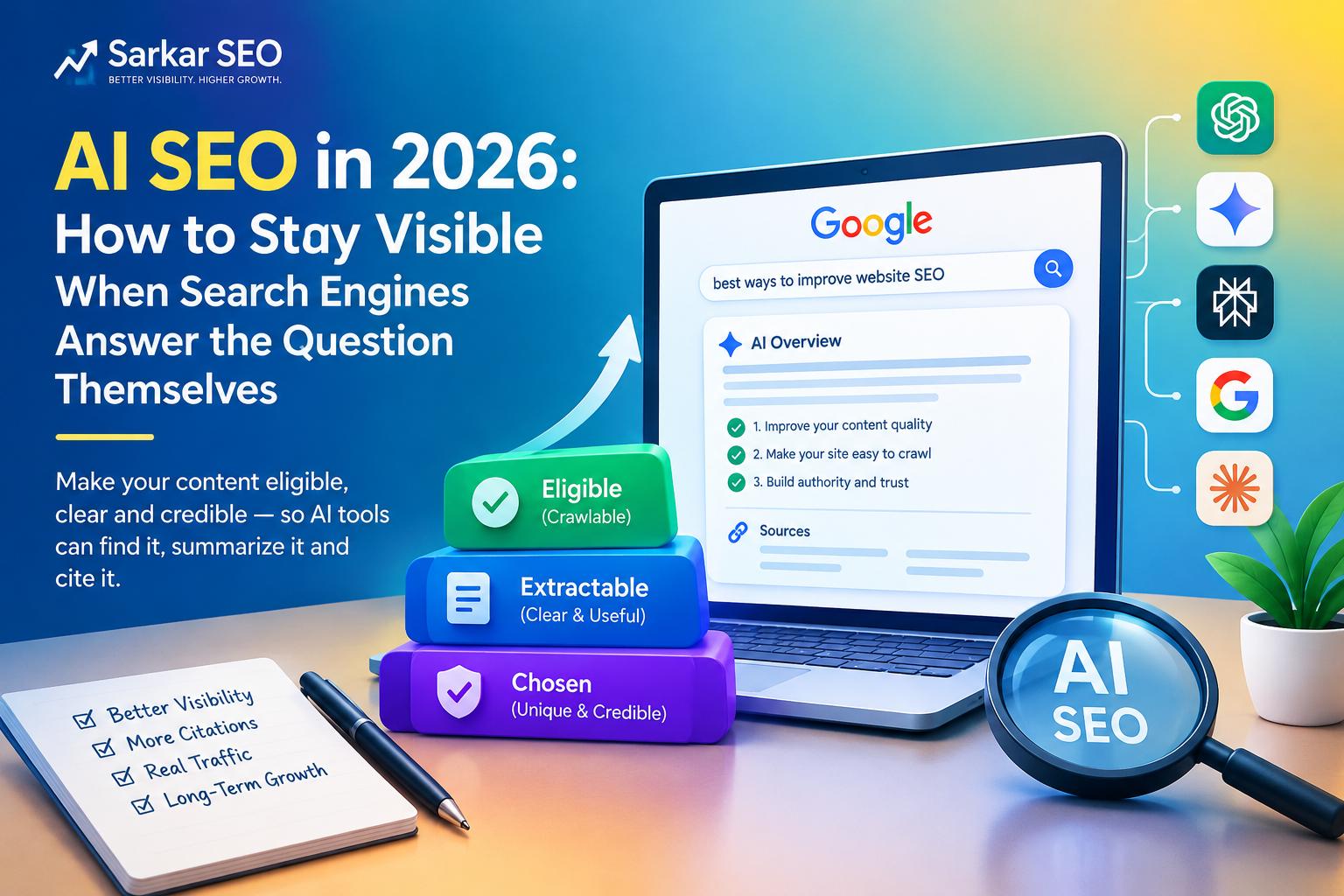
AI SEO is the work of making your content eligible, clear and credible enough that search engines and AI answer tools can find it, summarize it accurately and, when they choose to, cite it. It builds on traditional AI SEO rather than replacing it. The difference is the finish line. A page can rank on page one and still lose the reader to an AI-written answer above it.
What AI SEO Actually Covers
AI SEO spans two overlapping environments. The first is Google’s own AI features, mainly AI Overviews and AI Mode, which draw on pages in Google’s Search index. The second is answer engines such as ChatGPT, Perplexity, Gemini, Grok and Claude, each of which retrieves and cites sources in its own way. No single ranking formula governs all of them, so be cautious of anyone promising guaranteed citations.
At Sarkar SEO, we treat AI SEO as a layer on top of sound search fundamentals. If a page cannot be crawled, or says nothing that other pages do not already say, no formatting trick will rescue it.
What Google Has Officially Said
Google’s May 2026 guide on generative AI features covers unique, non-commodity content, local, shopping, image and video content, myths about AEO and GEO, and early guidance on AI agents. Asked whether SEO still matters for generative AI search, Google’s answer is a short yes. The guidance also says you do not need new machine-readable files, AI text files or special markup to appear in these features, because Google Search does not use them. A new resource for optimizing for generative AI in Google Search +2
The takeaway is that Google describes no separate AI trick. That applies to Google only. Other platforms publish far less about how they select sources, so treat tactics aimed at them as hypotheses to test.
Why the Click Is No Longer the Whole Story
The evidence on lost clicks is substantial but varies by method, so it helps to separate the studies.
- Ahrefs, analyzing 300,000 keywords in February 2026, found AI Overviews correlate with a 58% drop in click-through rate for top-ranking pages. That is a correlation, not proof of cause.
- A preregistered experiment with 1,100 US users found that forcing searches into AI Mode cut click-through to external sites by 18.8 percentage points, while hiding AI Overviews raised it by 8.8 points. It is an arXiv preprint and has not yet been through journal peer review.
- SparkToro believes AI Overviews are likely contributing to rising zero-click searches, but its study does not isolate how much of the increase they explain.
There are counterpoints. Google says clicks from results pages with AI Overviews are higher quality, meaning users tend to spend more time on the site. Seer Interactive found click-through on AI Overview queries rose from 1.3% in December 2025 to 2.4% in February 2026. googlesearchengineland
The sensible reading is that clicks are scarcer and the ones that remain are more deliberate. Being named inside the answer now carries value even when no click follows.
The Eligible, Extractable, Chosen Framework
Sarkar SEO audits pages through three gates in order. Failing an early gate makes the later ones irrelevant.
Gate 1: Eligible
Before anything else, confirm the page can be found. Google’s documentation points to allowing crawling in robots.txt and in any CDN or hosting layer, strong internal links, and a good page experience. A common and avoidable failure is a security or bot-protection setting that quietly blocks crawlers. Check that important content exists as real text, not only inside images or scripts, and that structured data matches what visitors actually see.
Gate 2: Extractable
Answer systems lift passages, not whole pages. Open each section with a direct answer, then add evidence and nuance. Define terms where you first use them. Keep qualifiers attached to the claims they limit, so a quoted sentence still tells the truth. A quick test: copy one paragraph into a blank document. If it no longer makes sense, rewrite it.
Gate 3: Chosen
When many eligible pages answer the same question, selection favors whatever the others lack. Original data, a documented process, a clear point of view and a named author with verifiable expertise all help. Try this check: remove your brand name from the page. Could anyone with a search engine have written it? If so, add something only your business knows, such as real customer questions, internal figures or photos of your own work. Never invent any of it. Invented proof is worse than none.
Measuring AI SEO Without Fooling Yourself
Google counts traffic from AI features within overall Search traffic in Search Console, so you will not find a clean standalone report. Build a simple manual tracker instead.
- Choose 20 to 30 questions your customers actually ask.
- Check monthly whether an AI answer appears, whether you are cited, and which competitors are.
- Record the date, country, language and engine, since results vary by all four.
- Connect the findings to leads or revenue, not impressions alone.
Sarkar SEO recommends reviewing this tracker next to your ranking data, because the two can tell different stories about the same page.
Common Mistakes to Avoid
Creating AI-specific files and expecting Google to read them is one, given Google’s own statement above. Others include rewriting competitors’ pages with slightly different wording, changing “last updated” dates without changing content, and turning every heading into a question in the hope of snippet luck. Each adds effort without adding information.
