



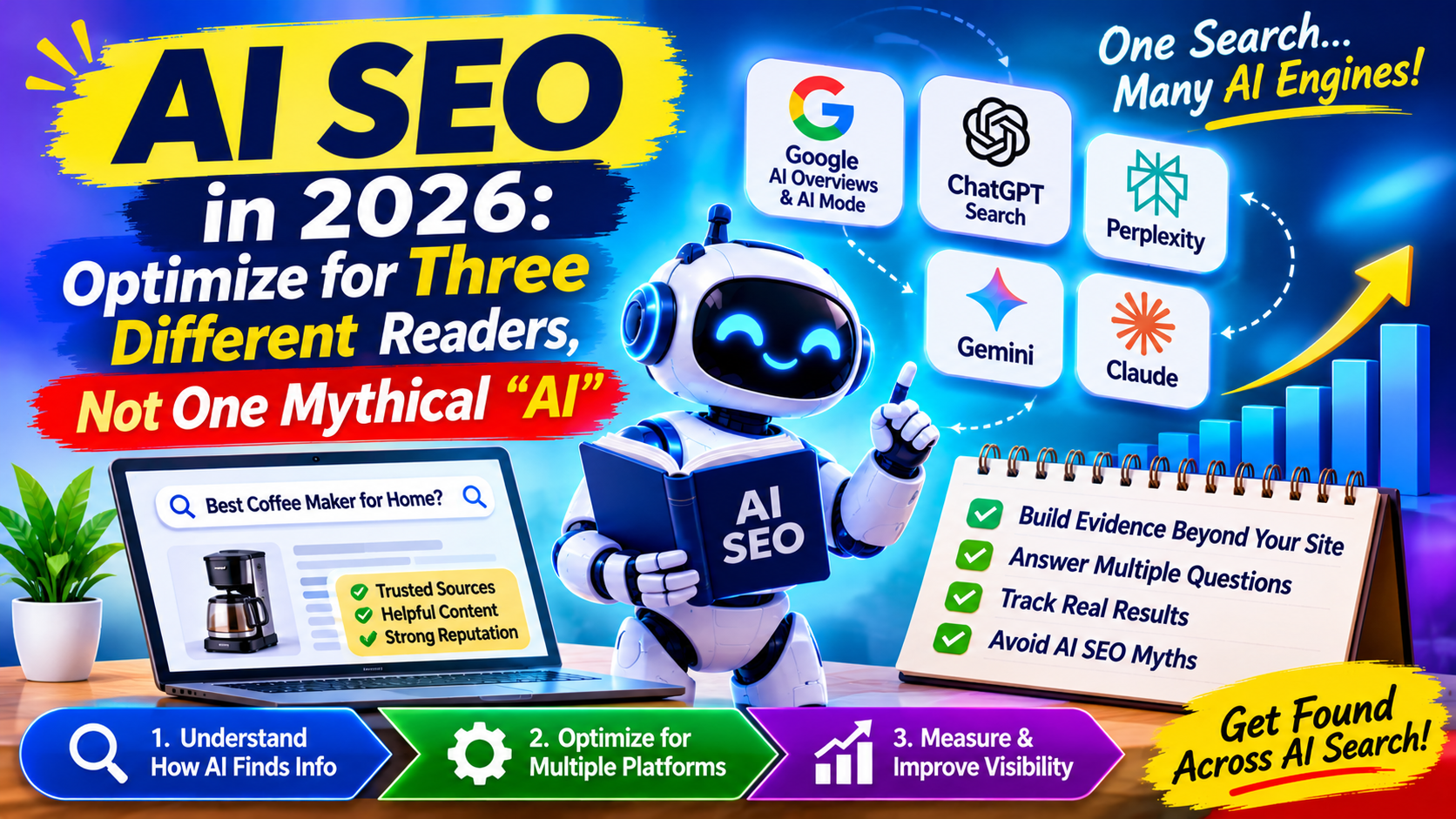
Most advice on AI SEO treats AI search as one thing. It isn’t. A Google AI Overview, a Perplexity answer, and a ChatGPT response each choose sources differently, and the research available so far suggests they rarely agree. Here is how Sarkar SEO thinks about building visibility that survives that fragmentation.
What Google Actually Said
In May 2026, Google published its first official guidance on generative AI features in Search. Its position, as covered by Search Engine Journal and others, is that optimizing for AI Overviews and AI Mode is still SEO. Separate “AEO” or “GEO” workstreams are not required.
The guide is just as clear about what to skip. Reporting on it says site owners don’t need llms.txt files, artificially chunked content, AI-specific rewrites, or special structured data for generative visibility. What it does reward is unique, non-commodity content with a first-hand point of view, a crawlable site, and strong images and video.
This is useful news. If a vendor sells you a “special AI schema,” Google’s own documentation says you can ignore it.
The Gap Google’s Guide Doesn’t Cover
Google’s guide speaks for Google. Your customers also use ChatGPT, Perplexity, Gemini, Claude, and Grok, and those engines don’t follow Google’s rules.
Several third-party studies point the same way, though they are vendor-run and use different methods, so treat the exact figures as directional:
- Analyze’s 54-day dataset (15,530 AI responses across ChatGPT, Claude, and Perplexity) found that about 83% of citations went to third-party sources rather than the brand’s own website.
- The same study found first-party citation rates of 22.2% for Claude, 17% for Perplexity, and 13.5% for ChatGPT.
- Reporting on Profound and Averi’s analysis of 680 million citations says only about 11% of domains were cited by both ChatGPT and Perplexity.
- 5W Research found brand search volume to be the strongest predictor of AI citation it measured (a 0.334 correlation), stronger than backlinks.
The implication is uncomfortable. On non-Google engines, what other sites say about you often counts for more than what you publish yourself. Your own page is evidence, but the surrounding web is the verdict.
Write for the Fan-Out, Not the Keyword
PPC Land’s coverage of Google’s guide highlights two mechanisms: retrieval-augmented generation and query fan-out. When someone asks a complex question, the system splits it into many smaller searches and assembles the results.
So a page targeting “AI SEO” as a single keyword competes against a question that has already been broken into pieces. For a topic like this one, those pieces might be:
- What changed in the Google guidance?
- Do other engines behave differently?
- How do I measure AI visibility?
- Which tactics are a waste of time?
A page that answers each sub-question clearly, with its own evidence, gives a retrieval system more places to attach. This is also not chunking in the sense Google warns against. You aren’t carving text into robot-sized fragments. You are making sure each part of the page can stand on its own for a human who skims.
Build the Evidence Trail Off Your Site
If third-party sources dominate citations, a site-only strategy has a ceiling. Practical ways to raise it:
- Publish something only you can publish. Original data, a named methodology, a documented case. Commodity explainers are exactly what AI systems can synthesize without citing anyone.
- Be consistent about who you are. Use the same company description, service names, and expertise claims across your site, directories, and profiles. Contradictions make a brand harder to summarize.
- Earn mentions where your audience reads. Industry publications, communities, podcasts, and expert roundups. Google warns against inauthentic brand mentions, so the point is genuine presence, not manufactured buzz.
- Grow branded demand. If people search for you by name, that signal appears to travel across engines.
A 60-Minute Citation Audit You Can Run Today
This is the audit Sarkar SEO recommends before anyone spends a rupee or a dollar on “AI optimization.” It costs nothing but an hour.
Step 1: Write ten real prompts. Use the questions customers actually ask, including comparison and “best for” questions, not just your keyword.
Step 2: Run them in each engine. Google AI Mode, ChatGPT with search, Perplexity, Gemini, and Claude with web search. Record in a spreadsheet whether you are mentioned, whether you are linked, and which sources appear instead.
Step 3: Sort the results into three buckets.
- Absent everywhere: a foundation problem. Check crawlability, indexation, and whether your content is distinct.
- Present in Google, absent elsewhere: an off-site reputation problem.
- Mentioned but misdescribed: an entity-consistency problem. Fix your own descriptions first.
Step 4: Look at who wins. The sources that appear most often for your prompts show you where credibility is being built in your category. Those are your outreach targets.
Repeat monthly. AI answers shift quickly, and one run is a snapshot, not a trend. Expect noise, and be wary of anyone who claims precise “AI rankings.”
What to Do Less Of
- Rewriting existing pages “for AI” with no new information
- Adding schema solely because someone said it boosts AI visibility. Use it where it helps search generally.
- Chasing every engine equally. Pick the two or three your buyers actually use.
- Publishing high volumes of thin, automated content. Google’s people-first guidance still warns against this.
Measuring Honestly
Google’s guidance reportedly notes that clicks from AI features can be higher quality even when query volume shifts, but attribution remains imperfect. Track branded search trends, referral traffic from AI platforms, Search Console performance, and your monthly audit results together. No single number tells the story.
