



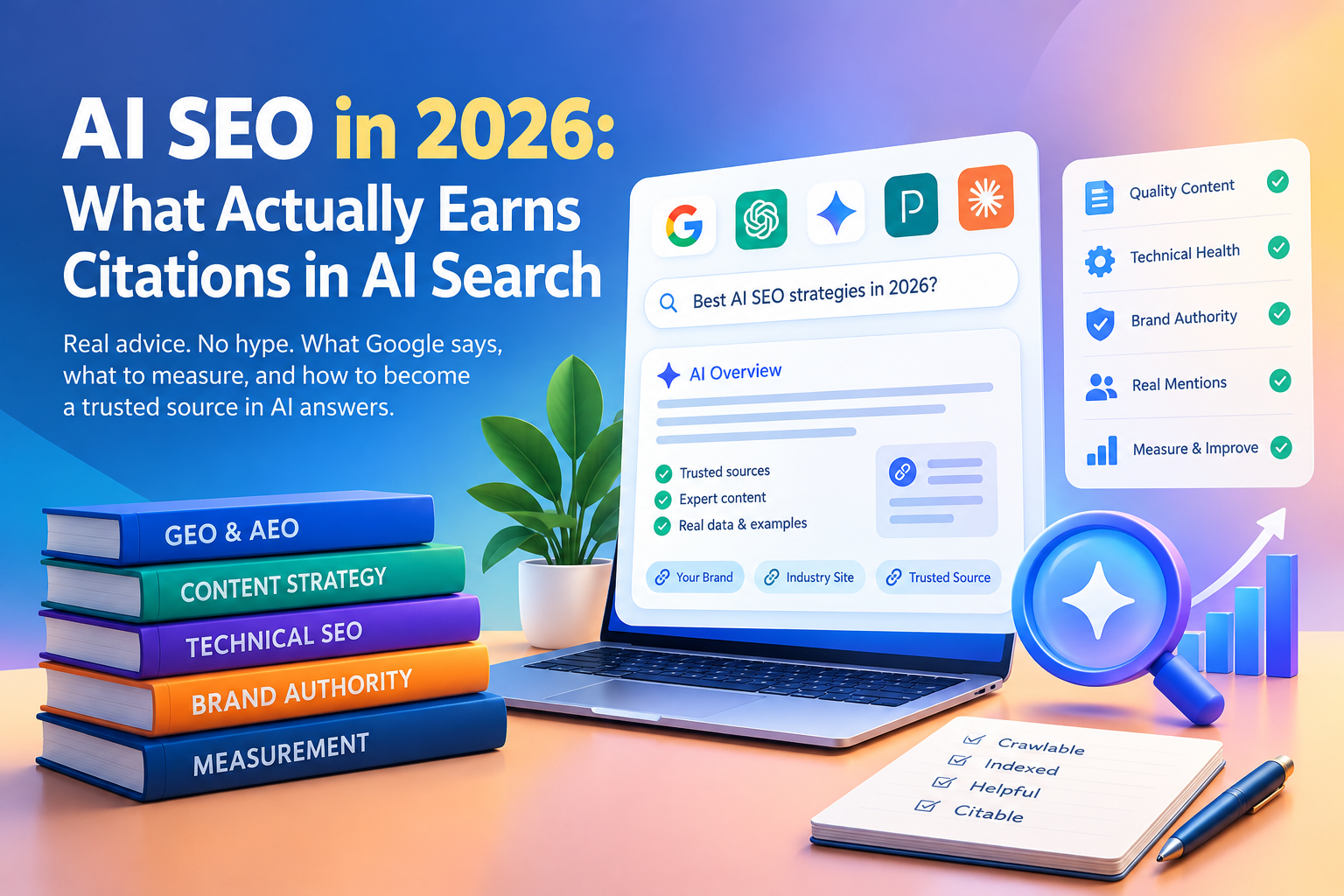
AI SEO is not a new discipline, but it does change how you build content. Learn what Google says, what to measure, and how to become a source AI answers trust.
People now ask a question and get a finished answer before they see a single link. AI SEO shift has produced a wave of new acronyms and confident claims. Most of the noise is unhelpful, so here is what the evidence supports.
What AI SEO Really Means
AI SEO is the work of making your content findable, understandable, and trustworthy for search systems that generate answers. That covers Google’s AI Overviews and AI Mode, and it also covers assistants such as ChatGPT, Perplexity, Gemini, and Claude.
The label is new, but the foundation is not. In May 2026 Google published its first official guide on this topic. It says the guide covers valuable, unique, non-commodity content, local, shopping, image and video content, common AEO/GEO misconceptions, and why SEO best practices remain foundational. In its own framing, optimizing for generative AI search is optimizing for the search experience, and so it is still SEO. You can read the source yourself in Google’s guide to generative AI features.
Why There Is No Shortcut
Google’s AI features are not a separate world. They are rooted in Google’s core ranking and quality systems, and a page must be indexed and eligible to appear in Search with a snippet to show up in them. In practice, a page that cannot rank has little chance of being cited.
Two mechanics explain why. Google’s AI features use retrieval-augmented generation to pull from the existing Search index, and they can use query fan-out, running several related searches across subtopics before composing a response. A single question from a user becomes many smaller questions behind the scenes. A page that answers one of those smaller questions clearly has a real chance of being used, even if it was never aimed at the original query.
Build Pages Around Sub-Questions
Fan-out changes how you should plan content. Instead of one broad page that touches everything lightly, map the questions a buyer or learner would naturally ask on the way to a decision.
Take a business weighing whether to invest in AI SEO. It will want to know:
- What changes for my traffic if answers appear above the results?
- Which of my existing pages are strong enough to be cited?
- How do I know whether any of this is working?
Each of those deserves a direct, self-contained answer in the first lines of a section, followed by evidence and nuance. This helps human readers skimming on a phone, and it gives an answer system a clean passage to lift.
Information Gain Is the Real Differentiator
Google’s guidance stresses unique, non-commodity content. One analysis of the guide puts it bluntly: if your content could have been written by anyone with a search engine, AI models have little reason to prefer your version. previsible
Here is what original value looks like in practice:
- First-party data. Survey results, benchmarks, or patterns from your own client work.
- Specific examples. A named process with real steps, not a generic definition.
- A defensible point of view. A clear position on what works and what does not, with reasoning attached.
- Honest limits. Saying what you tested and what you did not builds more trust than sweeping claims.
Never invent any of these. Fabricated statistics and imaginary case studies damage credibility with readers and with the systems that cross-check sources.
Technical Eligibility Still Comes First
The unglamorous checklist matters more than most people admit:
- Crawlability. Google says its generative models rely on publicly accessible, crawlable content. Check that important pages are not blocked by robots.txt, login walls, or heavy scripts.
- Indexing. Confirm key pages are indexed using Search Console’s URL Inspection tool.
- Page experience. Fast loading and mobile usability remain relevant.
- Clear structure. Use descriptive headings, short paragraphs, and visible authorship.
You may also see advice about special AI markup. Coverage of Google’s guide notes that structured data is not required for generative AI search, and there is no special schema.org markup to add. Structured data can still help search engines understand a page, but it is not a magic switch.
Your Reputation Beyond Your Own Site
Answer engines do not only read your pages. Google acknowledges that its AI features surface what is being said about brands across blogs, videos, and forums. The guide also warns against faking this. According to one summary, seeking inauthentic mentions may flag your site as spam, and AI systems can tell real mentions from fake ones.
The sustainable route is dull but effective: publish things worth referencing, contribute real expertise in communities where your audience gathers, and make your brand easy to describe accurately. At Sarkar SEO, this is the principle behind how we think about authority. Mentions follow usefulness, not the other way around.
Do Not Optimize for One Engine Only
Google’s guidance covers its own products. Analysts point out that it applies to AI Overviews and AI Mode, but not necessarily to Gemini, ChatGPT, or Claude. Each assistant retrieves and cites differently, and those behaviors change often. Treat any claim of a guaranteed formula for ChatGPT or Perplexity with caution. practicalecommerce
What carries across platforms is quality, clarity, and consistency. If your facts are accurate, your pages are easy to parse, and your brand is described the same way everywhere, you are well placed no matter which engine a customer uses.
Measure What You Can, Honestly
Measurement used to be a blind spot. In June 2026 Google launched Search Console reports covering impressions in generative AI features. Third-party commentary adds an important caveat: this reporting does not provide a clean split between AI Mode and AI Overviews.
A sensible measurement routine:
- Track impressions and clicks for pages that answer question-style queries.
- Watch branded search growth, which often rises when you are cited without a click.
- Tie traffic to outcomes such as enquiries, sign-ups, or sales, not visits alone.
- Manually test your priority questions in several assistants each month and record whether you are cited.
Be realistic about clicks. Industry estimates suggest many AI answer sessions end without a visit to any website, though the exact figures vary by source and method. Plan for fewer but better-qualified visits, and judge success on business results.
A Practical Starting Plan
If you have limited time, begin here:
- Audit your ten most important pages for crawlability and indexing.
- Rewrite each introduction so the core answer appears immediately.
- Add one piece of original evidence to each page, such as data, a worked example, or a documented process.
- Fix inconsistent brand details across your site and profiles.
- Set up Search Console reporting and a monthly citation check.
Teams at Sarkar SEO use this kind of sequence because it compounds. Each step improves the page for readers first and for machines second.
