



Search used to be a list of ten blue links. Now a person can ask a question and receive a finished answer, with a few sources cited underneath. AI SEO is the work of making your content one of those sources, without losing the organic traffic that still pays the bills.
The topic is full of noise. Vendors sell new acronyms, and every week brings a “secret” tactic. A cleaner picture emerged in May 2026, when Google said plainly what it wants.
What AI SEO really means
AI SEO covers two jobs. The first is staying visible in Google’s AI Overviews and AI Mode. The second is being cited in standalone assistants such as ChatGPT, Perplexity, Gemini, Grok and Claude. People call these jobs GEO (generative engine optimization) and AEO (answer engine optimization), but the labels matter less than the shared goal: be the source a machine trusts enough to quote.
Google’s own answer
On May 15, 2026, Google published an official guide titled “Optimizing your website for generative AI features on Google Search,” announced by John Mueller on the Search Central Blog. Its central message is that optimizing for generative AI search is optimizing for the search experience, and so it is still SEO.
The guide also named what you do not need. Coverage of it reports that Google says llms.txt files, content chunking, AI-specific rewriting and special schema markup are not required for its AI features. Google also warned that “inauthentic mentions,” meaning manufactured brand references, are risky and may backfire. And it stressed that creating unique, compelling and useful content matters more to generative AI presence than any other suggestion in the guide. Google Clarifies Which AEO and GEO Tactics Actually Matter +2
This only covers Google. Other assistants have their own retrieval habits, and they are less documented. A sensible approach treats Google’s guidance as the floor and tests everything else.
Ranking and citation are drifting apart
Many teams assume that ranking in the top ten guarantees a citation. The data says otherwise. Ahrefs reported in February 2026, across 863,000 keywords, that only 38% of pages cited in AI Overviews also ranked in the top 10 for the same query, down from 76% seven months earlier. One reason is query fan-out. 99.5% of AI Overview sources rank in the top 10 for some query, but it is rarely the query that triggered the overview. It is usually one of the fan-out sub-queries.
In practice, an AI system breaks a question into smaller questions and pulls from whichever pages answer those pieces best. Your page can lose the head term and still win the sub-question. That is an argument for covering a topic in depth rather than chasing a single keyword.
Five practices that hold up
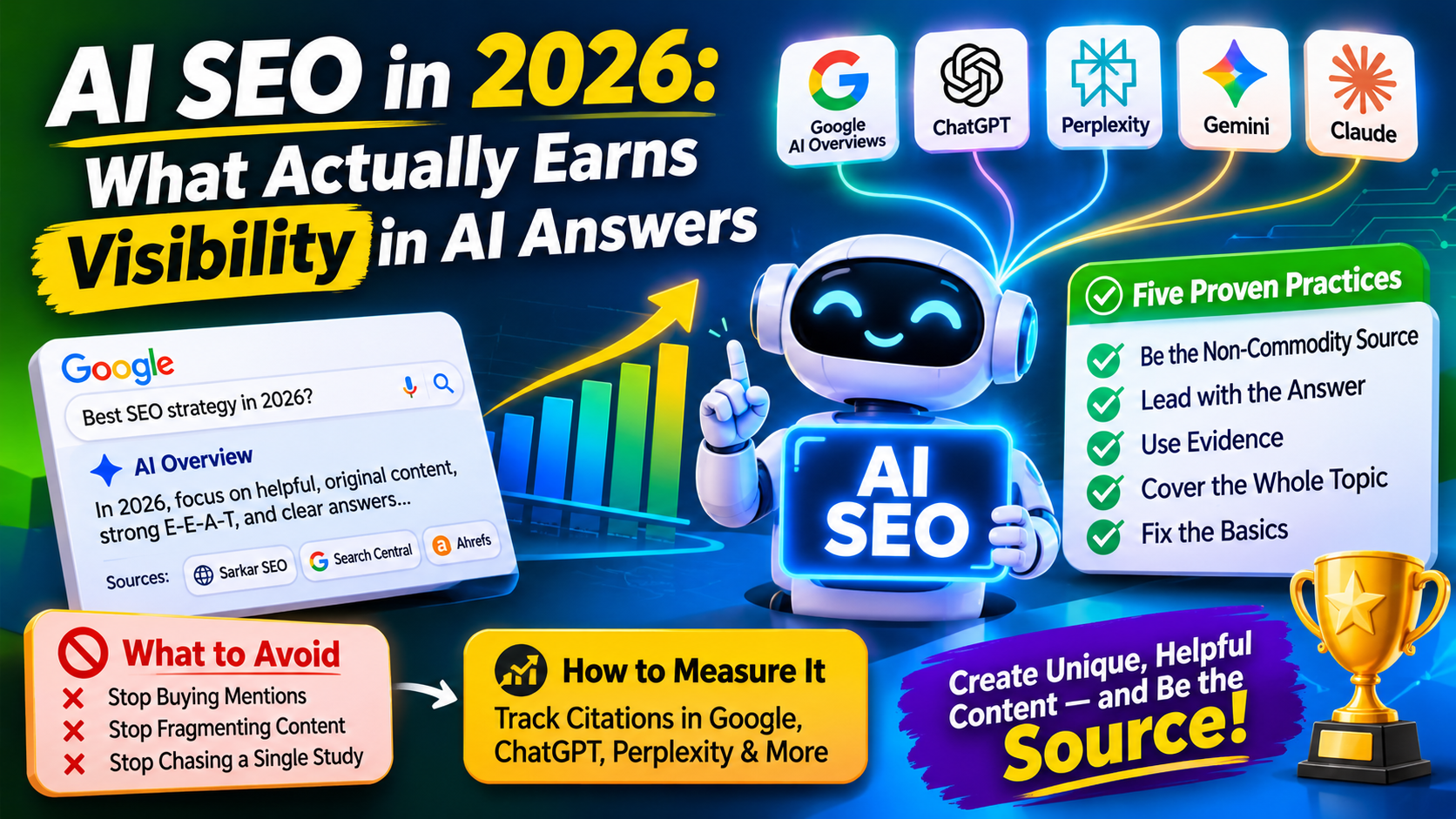
- Be the non-commodity source. If your page says what ten other pages say, a model has no reason to pick yours. Add something only you have: first-party data, a worked example, a tested process, a clear opinion with reasoning. Sarkar SEO treats this as the first question for any draft: what does this page offer that a summary of the top results does not?
- Lead with the answer, then earn the depth. Readers and machines both reward directness. Open each section with a plain statement that answers the heading, then support it. This is good writing, not a trick, and it needs no special formatting to work.
- Use evidence people can verify. The Princeton GEO research tested content changes on generative engines. As summarized by one practitioner guide, adding statistics and credible quotations produced visibility lifts of roughly 40% and 37%. Treat those as directional, not guaranteed. The lesson is still sound: attributed numbers beat vague claims. bigideasdb
- Cover the whole topic, not just the keyword. Because of fan-out, a page that handles a primary question plus its obvious follow-ups has more chances to be pulled in. List the questions a buyer asks before, during and after the main one, and answer each one honestly, including the ones that don’t flatter you.
- Fix the basics first. Google names one hard technical requirement: a page must be indexed and eligible to appear in Search with a snippet. Blocked pages, broken canonicals and thin templates will sink you before any “AI tactic” matters.
What to stop doing
Stop buying mentions. Planted brand references, fake reviews and link-swap schemes disguised as “digital PR” are exactly what Google flagged as risky.
Stop rewriting your entire site into short disconnected fragments. Google’s guidance says chunking for AI is unnecessary, and fragmenting a good article usually makes it worse for people.
Stop treating a file or markup tweak as a strategy. Schema is still useful for accurate, structured information, such as products, organizations and articles. Just don’t expect it to unlock citations on its own.
Finally, stop chasing a single study’s numbers. Citation research varies widely by method, sample and date, and some of the percentages circulating online contradict each other. Use studies to form hypotheses, then check them against your own pages.
How to measure it
Measurement is the weak point of AI SEO. Google points site owners to the Generative AI performance report in Search Console, which covers generative AI features on Google Search and Discover. Start there for Google.
For other assistants, build a simple tracking routine:
- Pick 20 to 30 questions your customers genuinely ask.
- Run them monthly in each assistant you care about.
- Record whether your brand is cited, mentioned without a link, or absent.
- Note which competitor pages appear instead, and study what those pages contain.
Keep the log consistent. Answers vary run to run, so look for trends over months, not single results.
Also watch what happens after the click. AI features may send fewer visits per query, but the visits that do arrive tend to be higher intent. That makes conversion paths, such as clear next steps and fast pages, worth more attention than raw traffic.
A realistic way to start
You do not need a new department. Pick your ten most commercially important pages and audit each against four questions: Is it indexed? Does it answer its core question in the first few lines? Does it contain something original? Is every claim sourced or demonstrable? Fix what fails, then refresh those pages on a regular schedule so the information stays current.
Teams working with Sarkar SEO usually find that the biggest gains come from the pages they already have, not from new content. The reason is simple: most sites have plenty of pages that are fine and few that are genuinely useful.
