



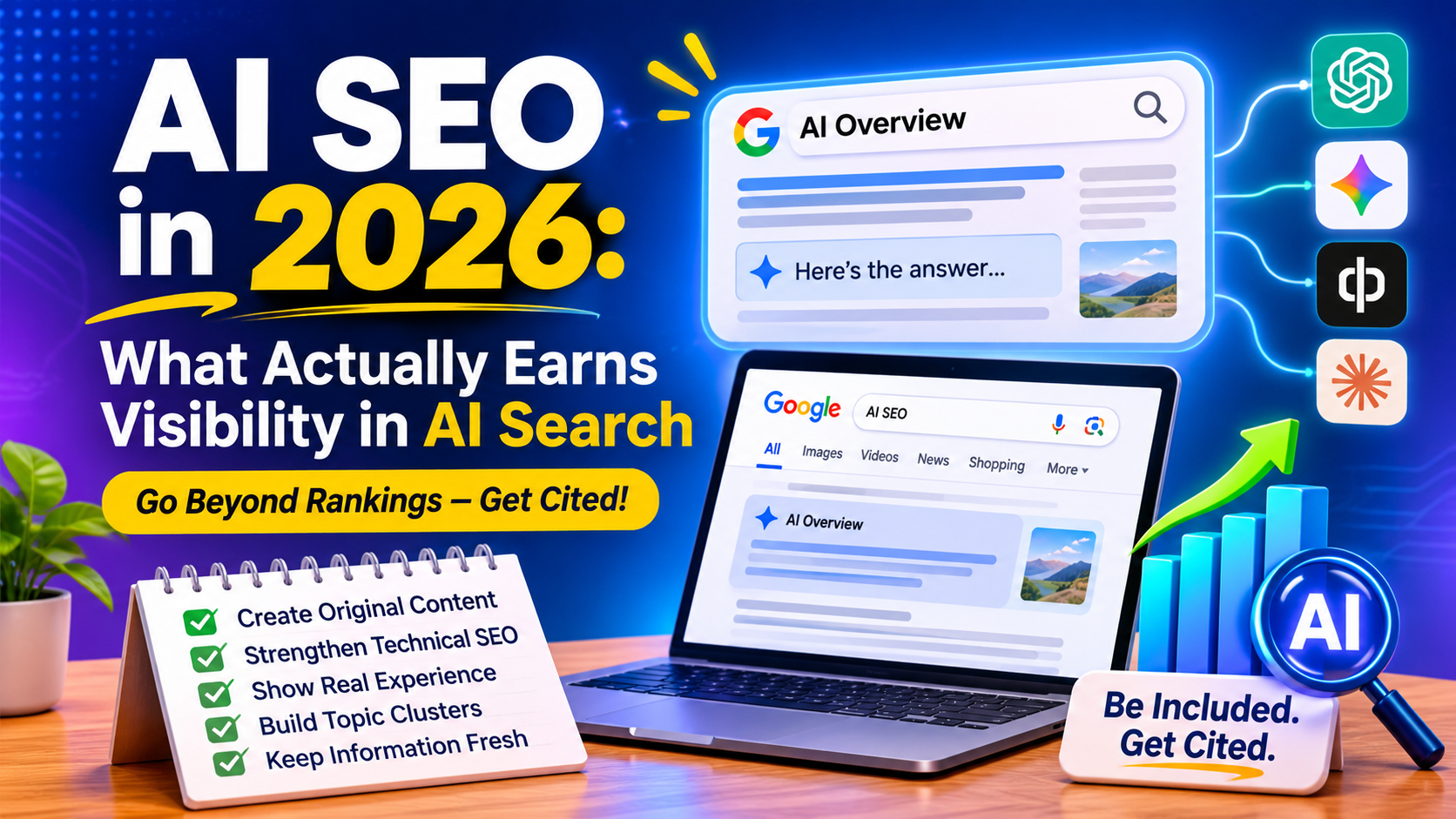
Search no longer ends at ten blue links. Google now answers questions directly with AI Overviews and AI Mode, while ChatGPT, Perplexity, Gemini and Claude answer them without a results page at all. A flood of “AI SEO ” advice followed, and much of it contradicts itself. At Sarkar SEO, we think the most useful thing to do is separate what is confirmed from what is folklore, so your effort goes where it pays off.
What AI SEO Means
AI SEO is the work of making your content easy for search engines and AI answer systems to find, understand, trust and cite. It combines traditional rankings with visibility inside generated answers. You will also see it called AEO (answer engine optimization) or GEO (generative engine optimization). The labels differ; the underlying job mostly does not.
Google’s Position: It Is Still SEO
In May 2026, Google Search Central published its first dedicated guide to optimizing for generative AI features. Its core message is that AI Overviews and AI Mode have no separate index. They build on Google’s existing search systems, so sound SEO remains the foundation.
The guide is just as useful for what it tells you to skip. According to Search Engine Journal and other coverage, site owners do not need llms.txt files, artificial content chunking, special AI schema, or rewriting pages in a stilted style for machines. Google says its systems understand synonyms and meaning, so you need not chase every long-tail variation.
One caution: this applies to Google’s AI features. It does not necessarily describe how ChatGPT, Claude or Perplexity select sources, and nobody outside those companies has a verified checklist. Treat any promise of guaranteed AI citations with suspicion.
Why Topic Depth Now Beats Single Pages
AI Mode uses a technique often called query fan-out: it splits one question into several sub-searches and assembles an answer from multiple sources. For publishers, this changes the target. A page optimized for a single keyword is weaker than a site that covers the surrounding questions well.
Take “AI SEO” itself. Behind it sit questions about how AI systems choose sources, which tactics are myths, how to measure results, and what to do about falling clicks. A site that answers all of them, with clear internal links between the answers, gives retrieval systems more reasons to trust and reuse it. It also gives human readers a reason to stay.
Five Priorities That Hold Up
- Publish non-commodity content. Google distinguishes original contribution from commodity material; a summary of existing advice is commodity. Add what only you have: first-party data, tested processes, original screenshots, expert judgment, real client scenarios. If an AI could write your page from the common pool of the web, it has little reason to cite you.
- Keep technical foundations clean. Pages must be crawlable, indexable and fast, with key content in real HTML text rather than buried in scripts. Google’s early guidance for browser-based AI agents points the same way: semantic markup and content that is accessible in the page itself.
- Make experience visible. Use named authors, credentials and first-hand detail. Support the text with original images, video or diagrams where they genuinely clarify.
- Build connected clusters. Pair a strong pillar page with focused supporting articles, and link them with descriptive anchor text so the relationships are explicit.
- Keep volatile facts current. Prices, availability, opening hours and policies change. Google’s guidance on local and shopping content makes freshness especially relevant for those categories. Show an update date only when you have genuinely revised the page.
What to Stop Doing
Drop the shortcuts that add noise without adding value:
- Creating llms.txt files in the hope of better Google rankings
- Splitting good articles into disconnected “AI-sized” fragments
- Stuffing pages with keyword variations
- Seeding fake or inauthentic mentions across the web, which Google’s guide specifically names
- Treating schema markup as a switch for AI Overviews; it can describe content accurately, but no special markup unlocks them
Time saved here is better spent on research, expertise and original material.
Measure What Is Real
Expect some simple “what is” queries to deliver fewer clicks as answers appear directly in results. Sarkar SEO suggests measuring accordingly:
- Track impressions, clicks and queries in Google Search Console
- Watch branded search growth, a sign people remember you after seeing citations
- Run a fixed set of 20 to 30 buyer questions through major answer engines each month and record whether you are cited, and how accurately
- Judge success on leads and revenue, not sessions alone
Prompt sampling is imperfect because AI answers vary between runs, so look at trends rather than single results.
A Practical Starting Point
Begin with an audit of your ten most important pages. Does each give a clear, citable answer? Does it contain something competitors cannot copy? Is it crawlable and current? Sarkar SEO recommends fixing the weakest of those pages first, then expanding into supporting articles that cover the questions around them.
Is AI SEO different from SEO? For Google’s AI features, Google says no: the same foundations apply. For other answer engines, clear, credible and accessible content still helps, though their citation behavior is less documented.
Do I need llms.txt? Google says not for its Search AI features. Whether other tools use it is unproven, so treat it as optional at best.
Will AI search kill organic traffic? Some informational clicks will shrink, but visibility, brand recall and high-intent queries remain valuable.
