



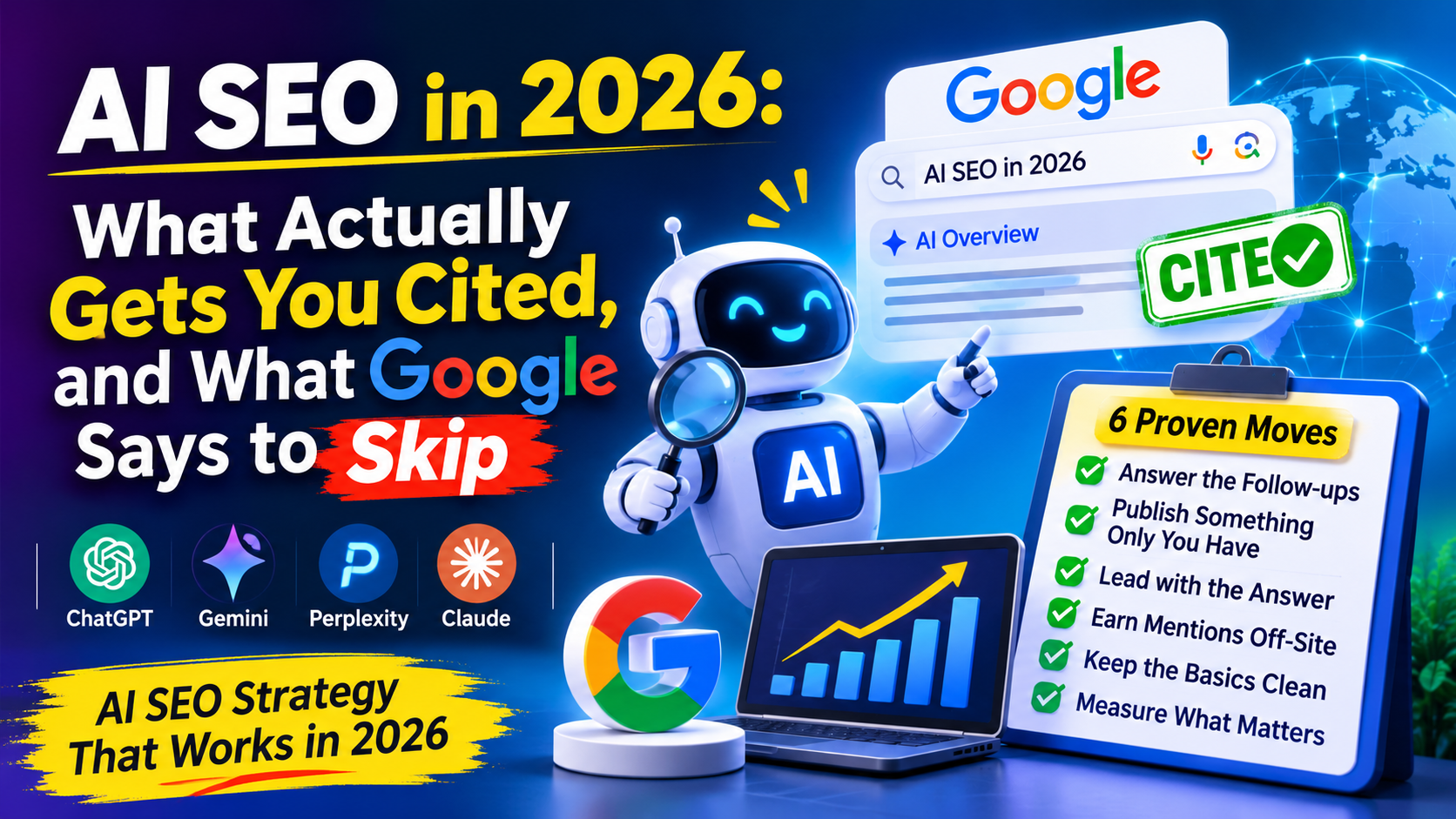
AI SEO has collected more folklore than almost any topic in search: upload this file, add that schema, chop every page into tiny blocks. Then Google published its own guidance, and much of that advice looked shaky. Combined with recent citation research, the guidance gives a clearer picture. AI SEO is mostly good SEO, plus three new problems: query fan-out, volatile results, and visibility beyond your own domain.
What is AI SEO?
AI SEO is the practice of making your content easy for search systems to find, trust, and cite when they generate answers. That includes Google AI Overviews and AI Mode, ChatGPT, Perplexity, Gemini, and Claude. The goal widens from “rank on page one” to “be chosen as a source, then earn the click.”
Google says there is no separate rulebook
On May 15, Google published a documentation page titled “Optimizing your website for generative AI features on Google Search.” According to Search Engine Journal’s coverage, the guide treats AEO and GEO as part of SEO, and says llms.txt, content chunking, AI-specific rewriting, and special schema aren’t needed for its generative AI features. Google’s earlier documentation adds that clicks from results pages with AI Overviews are higher quality, meaning users are more likely to spend more time on the site. Google Just Published Its First Official Guide to AI Search Optimization. Here’s What Actually Matters +2
Two cautions apply. First, this describes Google’s systems only. Other assistants run their own retrieval, so Google’s guide can’t speak for them. Second, “no special tactics” does not mean “no work.” Google still points to the fundamentals: allowing crawling in robots.txt and by any CDN, making content findable through internal links, and providing a great page experience.
Ranking first no longer guarantees a citation
Ahrefs found that only 38% of pages cited in Google AI Overviews also rank in the top 10 for the same query, down from 76% in its July 2025 study. Ahrefs says its citation detection has improved since then, so the two datasets aren’t directly comparable. BrightEdge’s overlap figures are lower still in places, and finance shows just 11% top-10 overlap.
The likely reason is query fan-out. Instead of answering your keyword as typed, the system rewrites the question into many variants and gathers candidate sources for each. Momentic’s 2026 research reports that AI Overviews appear on 9.5% of single-word queries but 46.4% of queries with seven or more words. It also reports that two answers to the same question can reach the same conclusion while only 13.7% of their citations are the same.
The practical meaning: you are competing on sub-questions. A page can lose the headline keyword and still win a citation on a follow-up.
The results won’t sit still
Across 43,000 keywords, AI Overview content changed in roughly 70% of consecutive observations, and 45.5% of sources were new each time. A screenshot of your brand being cited is a snapshot, not a result. Track a fixed set of prompts weekly, record how often you appear, and judge trends over weeks rather than days.
Six moves that hold up
- Answer the follow-ups. For each core topic, list what a buyer asks next: cost, risks, alternatives, edge cases, timelines. Build one deep, well-linked cluster rather than thin pages for every phrasing variant.
- Publish something only you have. Original data, a documented process, a real screenshot, or a position you can defend gives a system a reason to pick you over ten near-identical pages. A useful test, and one Sarkar SEO recommends, is this: if a paragraph could appear unchanged on a competitor’s site, rewrite it or cut it.
- Lead with the answer. Open each section with a direct, standalone answer, then add evidence. Readers appreciate it and extraction systems can lift it cleanly, though Google says chunking itself isn’t required.
- Earn mentions off your site. In Ahrefs’ dataset, YouTube made up nearly 6% of all AI Overview citations. Google also cautions that seeking inauthentic mentions to influence what’s said about your products isn’t likely to help. So contribute real expertise, collect honest reviews, and publish useful video. designrushsemrush
- Keep the basics clean. Pages should be crawlable, indexed, and eligible for snippets, with strong internal links and refreshed dates on time-sensitive content.
- Measure what matters. Google’s documentation says traffic from AI features is counted in Search Console’s Performance report under the Web search type. It is not broken out on its own, so tie landing pages to leads and revenue. Some vendor studies claim AI-referred visitors convert several times better than ordinary organic visitors. Treat that as a hypothesis to test on your own data. At Sarkar SEO, we’d rather see a handful of attributable conversions than a large dashboard of mentions.
