



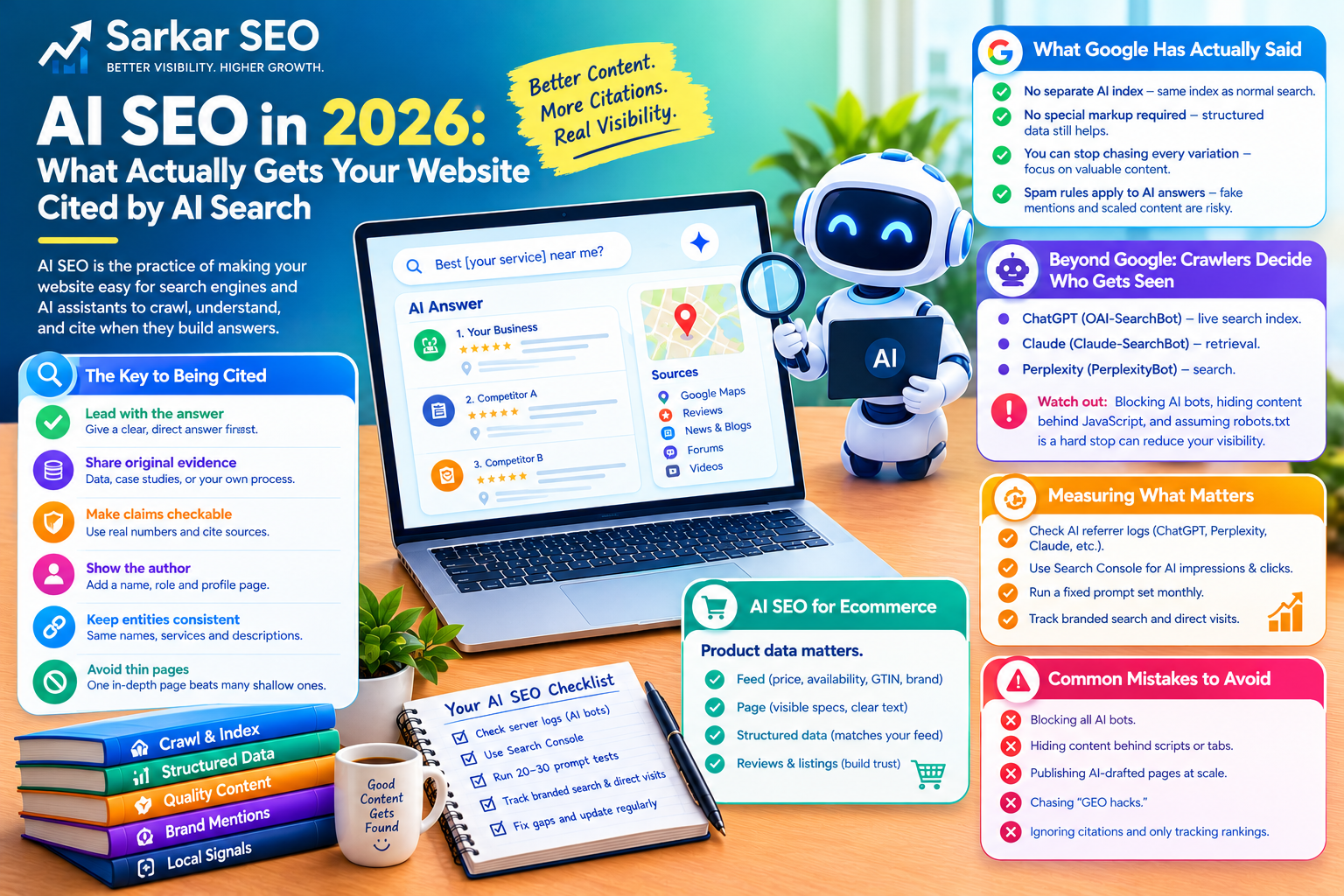
AI SEO is the practice of making your website easy for search engines and AI assistants to crawl, understand, and cite when they build answers. In 2026 it is less a new discipline than a stricter version of the old one. The sites winning citations are mostly technically clean, genuinely useful, and clear about who is behind the content.
What Google has actually said
In May 2026, Google published a dedicated guide to optimizing for AI SEO Overviews and AI Mode. Its central position is that optimizing for generative AI search is optimizing for the search experience, and therefore still SEO. medresponsive
Several practical points follow from the guide and its coverage:
- There is no separate AI index. Generative answers draw on the same index as normal web search, so a page must first be crawlable and indexable.
- No special markup is required. Google says structured data is not required for generative AI search, and no special schema.org markup is needed for AI features. Structured data still helps with rich results.
- You can stop chasing every variation. Site owners don’t need to capture every long-tail keyword variation or write in a particular way for generative AI search.
- Spam rules apply to AI answers. Google updated its spam policies to cover generative AI responses, and tactics such as fake mentions or scaled content aimed at fan-out queries now fall under spam.
If you were sold a secret formula for AI Overviews, this is the reality check. Google’s guidance applies to Google’s own AI features, though. Other answer engines work differently.
Beyond Google: crawlers decide who gets seen
ChatGPT, Claude, and Perplexity each run their own crawlers. Sorting them by job is the clearest way to manage them. Search and retrieval crawlers feed AI answers, while training crawlers such as GPTBot and ClaudeBot are a business decision. therankmasters
The stakes are real. Blocking OAI-SearchBot removes your pages from ChatGPT’s live search index. Claude-SearchBot and PerplexityBot play the same role for their platforms.
The most common failure is invisible. A “block unknown bots” firewall rule written before AI search existed can catch newer crawlers like OAI-SearchBot and quietly reduce visibility without any alert. Sarkar SEO treats this as the first checkpoint in any AI visibility review, because no amount of great content helps if the bot gets a 403 error.
Two more technical cautions:
- Rendering. Most AI crawlers from ChatGPT, Claude, and Perplexity reportedly don’t render JavaScript. If your key content loads only after scripts run, those engines may see an empty page. Serve important text in the initial HTML.
- Robots.txt is a request, not a lock. It states your intent but doesn’t physically stop a crawler. Perplexity-User, the user-triggered bot, is reported not to follow robots.txt. therankmasterssearchenginejournal
You may also see advice to publish an llms.txt file. One technical audit guide concluded it does nothing for visibility. Treat it as optional at best.
Write content worth citing
Google’s guide asks for valuable, non-commodity content that goes beyond common knowledge. That is the part most sites fail. If a paragraph could appear on fifty other pages unchanged, an AI system has no reason to pick yours.
Practical ways to become the citable source:
- Lead with the answer. Put a direct two-sentence answer under each heading, then add nuance. Both readers and retrieval systems can lift it cleanly.
- Publish something only you have. Original survey results, anonymized client benchmarks, test outcomes, or a documented process all give an engine a reason to cite you.
- Make claims checkable. State numbers with the source and date beside them. Unsupported claims are the first thing a careful reader, or a careful model, discards.
- Show the author. Name the writer, state their role, and link to a real profile page. This signals accountability.
- Keep entities consistent. Use the same brand name, service names, and descriptions across your site and profiles so systems can connect them.
- Don’t flood the zone. Google warns against creating a page for every possible sub-question that AI Mode might generate. One thorough page beats ten thin ones.
Prepare lightly for AI agents
Google added early guidance for agentic experiences, where assistants act on a user’s behalf. It centers on semantic HTML, content accessible through the DOM, and a rendering-friendly site. Google frames this as relevant if it suits your business and you have spare time, so it is not an emergency. Clean, accessible markup helps everyone anyway.
Measure what matters
Rankings alone no longer tell the full story. One analysis of Google’s AI Mode reports that most sessions in its fuller conversational experience end without a click. Treat that as directional rather than a universal figure, but it explains why citation presence matters alongside traffic.
A realistic measurement routine looks like this:
- Check server logs for the user agents that matter: OAI-SearchBot, ChatGPT-User, PerplexityBot, Perplexity-User, Claude-SearchBot, and Claude-User.
- Use Search Console for impressions and clicks on pages that appear in Google’s AI features.
- Run a fixed prompt set monthly. Ask the same 20 to 30 buyer questions across several assistants and record whether you are cited, mentioned, or absent.
- Track branded search and direct visits. Being named in an answer often shows up as later brand demand rather than an immediate click.
Common mistakes to avoid
- Blocking every AI bot out of caution, then wondering why you never appear in answers.
- Hiding core content behind scripts or tabs that load late.
- Publishing AI-drafted pages at scale with no original input.
- Chasing “GEO hacks” while crawl errors, duplicate pages, and slow templates go unfixed.
- Reporting only rankings and ignoring citations.
