



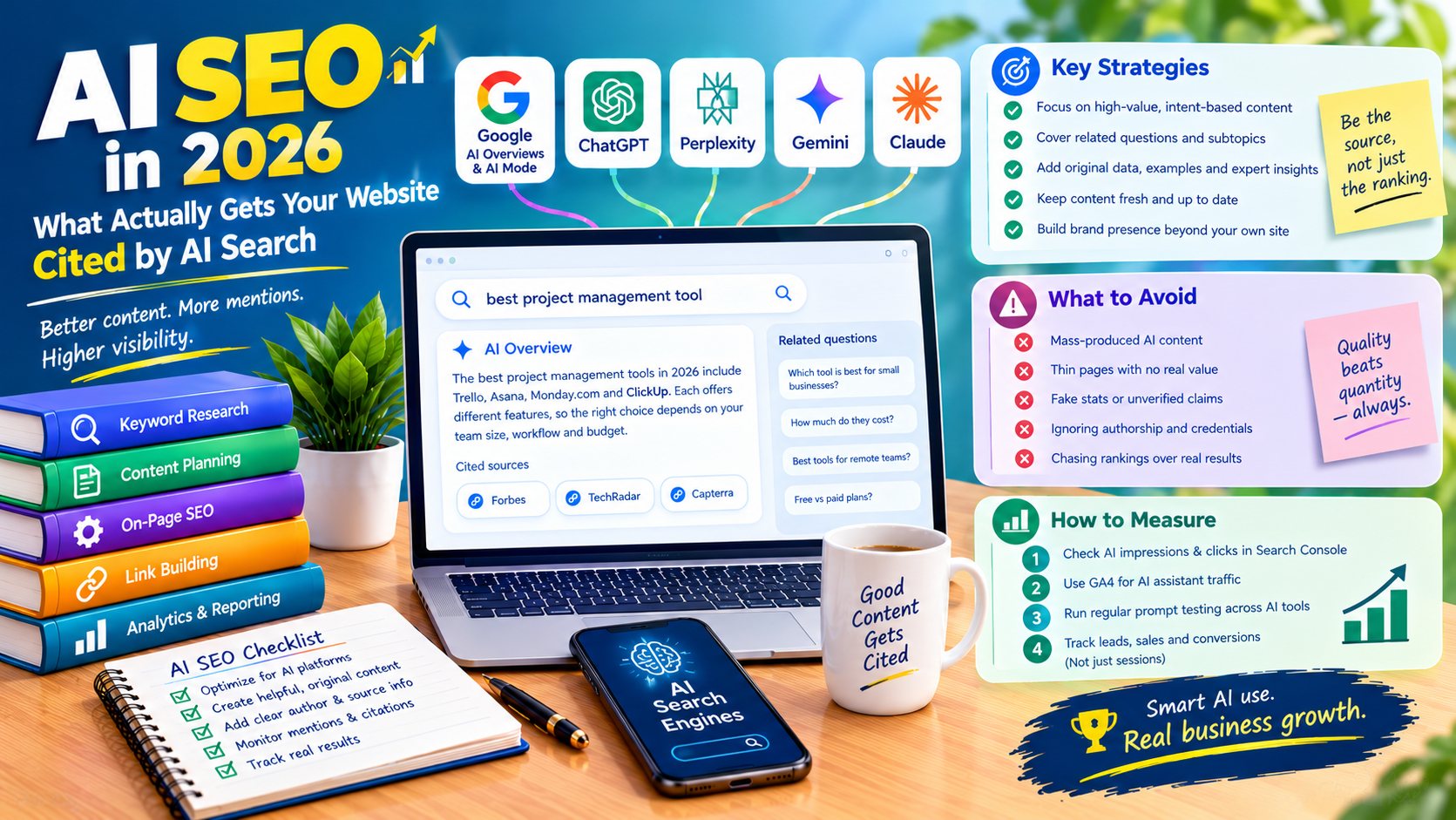
Search no longer ends with ten blue links. A growing share of queries now start with a generated answer, and your content either feeds that answer or gets bypassed. AI SEO is the practice of making your pages easy for search engines and AI assistants to find, understand, trust and cite.
It sounds like a new discipline, but the evidence points the other way. This guide covers what has changed, what hasn’t, and where to put your effort.
What AI SEO Means in Practice
AI SEO covers your visibility in Google AI Overviews and AI Mode, and also in assistants such as ChatGPT, Perplexity, Gemini and Claude. Ranking is only part of the goal. Being selected as a source inside a generated answer matters as much.
The scale is large. One report puts the share of Google searches showing an AI answer at 48 percent in March 2026, up from 34.5 percent in December 2025. That figure comes from SEO.com data as reported by a third party, so treat it as directional rather than exact. Still, the trend is clear. pasqualepillitteri
The Big Shift: Google Says It’s Still SEO
Google’s own documentation is direct about this. It says the same foundational SEO best practices apply to AI features as to Search overall: meeting technical requirements, following Search policies, and creating helpful, reliable, people-first content. An earlier version of the page also states that there are no additional requirements to appear in AI Overviews or AI Mode, nor other special optimizations necessary. googlegoogle
A 2026 follow-up guide reinforced this. Commentary on it notes that the AI features rest on Google’s existing core ranking and quality systems. The practical consequence is that a site with weak fundamentals will not be rescued by AI-specific tricks.
One caveat is worth keeping in mind. Google’s guidance refers exclusively to AI Overviews and AI Mode in Google Search, so it says nothing about how ChatGPT or Perplexity choose sources.
Why Retrieval Works Differently
AI answers are assembled differently from a classic results page. Google says both AI Overviews and AI Mode may use a “query fan-out” technique, issuing multiple related searches across subtopics and data sources to develop a response.
This changes how you plan content. A single page may be pulled in for a sub-question the user never typed. Pages that fully answer one clear question, and cover the surrounding questions well, have more ways to be retrieved. This lines up with the observation that pages focused on answering one clear question tend to perform better in AI Overviews.
Five Priorities That Matter
- Fix crawlability and indexing first
If Google can’t crawl, render and index a page, no AI feature can use it. Check robots rules, canonical tags, internal linking and page speed before anything else. At Sarkar SEO, technical health is the first thing we audit, because every other tactic depends on it.
- Match intent, not just keywords
Google says its AI features try to match the intent behind a query, not just the keywords. Write for the underlying question. A page targeting “AI SEO” should help someone decide what to do, not just define a term.
- Publish information others can’t copy
One analysis claims that proprietary statistics, original research and unique datasets are disproportionately cited by AI features. This comes from a secondary source, so verify it against your own data. It does match common sense, though. If you are the origin of a number, an AI system has a reason to point to you instead of ten sites repeating the same line.
Even small original contributions help: survey results, anonymized client benchmarks, tested workflows, or a documented before-and-after. Keep them honest and clearly sourced.
- Keep important pages fresh
The same source notes that AI features prioritize recently updated content, especially where timeliness matters. Review pages on fast-moving topics regularly. Update the facts, not just the date stamp.
- Build recognition beyond your own site
AI systems form a picture of your brand from many sources. Consistent naming, authorship, mentions on credible third-party sites, and genuine expertise all help. One industry newsletter summed up the 2026 mindset as recognition, not rankings. That is a useful way to think about it, though the claim is opinion, not measured fact.
Myths to Drop
“You need special AI markup.” Commentary on Google’s guide says Schema.org markup is not required to appear in AI Overviews. Structured data can still help search engines understand a page and may support rich results, but it is not a gate to AI visibility.
“Chop everything into micro-paragraphs.” One summary of Google’s guide reports that the idea of breaking content into micro-paragraphs to ease citation is explicitly denied. Write clearly and in natural paragraphs, with headings that describe what follows.
“AI visibility replaces traffic.” It doesn’t. Google says sites appearing in AI features are included in the overall search traffic in Search Console, so you can track them with tools you already have. Keep in mind that third-party claims about click-through, such as one saying that 93 percent of AI Mode sessions end without a visit to a source website, are single-source figures and should be read with caution.
A Simple AI SEO Workflow
- Audit the basics. Crawl, index, speed, mobile usability, duplicate content.
- Map questions, not just keywords. List the main query plus the follow-ups a reader would logically ask.
- Answer early. Put a direct, accurate answer near the top, then add depth, examples and caveats.
- Add something original. Data, process notes, screenshots, or expert commentary with a named author.
- Show who is behind it. Author bios, an About page, clear contact details and consistent business information.
- Monitor and refine. Track impressions and clicks in Search Console. Test your target queries in several AI tools and note which sources are cited.
The last step is where many teams stop short. Manual checks are imperfect, since AI answers vary between sessions, but they show whether your content is being picked up. This kind of testing is part of how Sarkar SEO helps businesses see where they stand in AI results, not just in rankings.
Controlling How Your Content Is Used
Google notes that robots.txt directives for Googlebot are the control for managing how your site is crawled for Search. Other AI companies operate their own crawlers with their own rules, so review each provider’s documentation before deciding what to allow or block. Blocking can reduce your visibility, so decide deliberately.
