



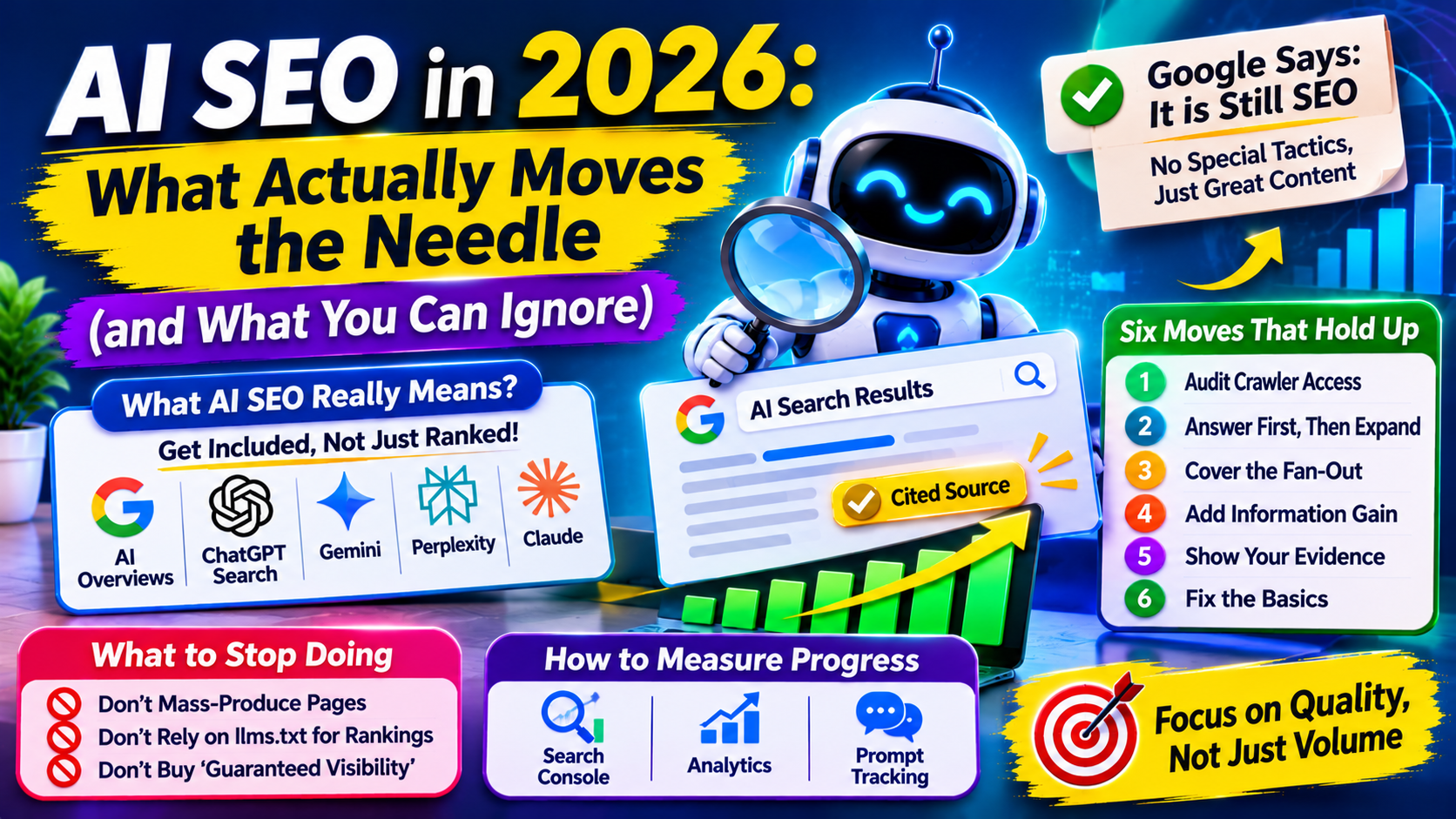
Search used to be a list of links. Today it is also a paragraph written by a machine, with a handful of sources tucked beside it. That shift has produced a crowded vocabulary of AI SEO, GEO, AEO and LLM optimization, plus a lot of confident advice that does not survive contact with the evidence. This guide cuts through it. The working view at Sarkar SEO is simple: AI SEO does not replace search optimization. It is a stricter test of whether your content deserves to be quoted.
What AI SEO Really Means
AI SEO is the practice of making your content easy for AI-driven search systems to find, understand and cite. Those systems include Google’s AI Overviews and AI Mode, ChatGPT search, Perplexity, Claude and Gemini. The goal shifts slightly. Classic SEO chases a ranking position, while AI SEO chases inclusion in the answer itself, ideally with a visible citation and a reason for the reader to click.
Google’s Own Answer: It Is Still SEO
In May 2026, Google Search Central published its first dedicated guidance on generative AI features. Industry coverage reports that these features pull from the same Search index and use the same ranking systems as traditional results. The same coverage says the guide states there are no additional technical requirements for appearing in them. It also reports that llms.txt files, content chunking, special schema and AI-specific rewriting are not needed. google ai search guidelines +2
Three details deserve attention:
- A page must still be indexable and eligible to appear with a snippet before it can serve as a supporting link.
- Google describes “fan-out,” where the system searches across subtopics and data sources, so AI answers can show a wider and more varied set of links than a classic search.
- Google reportedly updated its spam policies so they explicitly cover generative AI responses, which makes manipulation aimed at AI answers a spam risk.
The practical takeaway is that a page that cannot perform in ordinary search should not expect special treatment inside an AI answer.
Other Engines Retrieve Differently
Google’s guide covers Google. It does not necessarily apply to Gemini the app, and certainly not to ChatGPT or Claude. Each platform runs its own crawlers, and confusing them is one of the costliest mistakes in AI SEO.
OpenAI separates GPTBot, which handles training, from OAI-SearchBot, which builds what can appear in ChatGPT search. Sites opted out of OAI-SearchBot will not be shown in ChatGPT search answers, though they can still appear as plain links. Blocking GPTBot alone does not remove you from ChatGPT citations. Anthropic and Perplexity also separate training, retrieval and user-initiated fetching. Perplexity’s own documentation says its user-triggered fetcher generally ignores robots.txt, so a disallow rule governs its index but not every fetch.
The search backends differ as well. One analysis reports that ChatGPT citations match Bing’s top ten results 87% of the time, while Claude’s citations overlap Brave Search’s top results about 86.7% of the time. Treat those figures as directional, since they come from secondary reporting. The implication still holds: ranking well on search engines other than Google can influence which AI tools see you.
Six Moves That Hold Up
This is the checklist Sarkar SEO recommends starting with.
- Audit crawler access. Review robots.txt, your CDN and firewall rules. One reported case traced missing AI citations to a broad block on every AI user agent, including the retrieval crawlers that power citations. Decide training access and retrieval access as two separate questions. growwithsakib
- Answer first, then expand. Open each section with a direct, self-contained answer, then add nuance. This is simply clear writing, not a trick for machines.
- Cover the fan-out. List the questions surrounding your topic, such as costs, comparisons, risks and how-to steps. Then answer them on one page or a tight cluster joined by internal links.
- Add information gain. Original data, firsthand testing, screenshots and named experts give an AI system a reason to cite you rather than a hundred near-identical pages. Coverage of Google’s guide highlights first-hand experience content and multimodal assets.
- Show your evidence. One study reported that pages with many sourced data points earned more ChatGPT citations than sparse ones. That is a correlation, not proof, but citing primary sources makes your claims checkable, which is good practice anyway.
- Fix the basics. Google’s guidance reportedly references crawlability, site structure, mobile usability, page speed and internal linking. A slow, confusing site is a barrier for people and machines alike.
What to Stop Doing
Stop treating llms.txt as a ranking lever, because Google’s guidance reportedly calls it unnecessary. Stop mass-producing pages aimed at every possible fan-out variation, since that pattern is what the updated spam rules target. Stop paying for “guaranteed AI visibility.” Even OpenAI, which documents its crawlers and referral tag in detail, publishes nothing on how pages are chosen for an answer. If the platform will not say how selection works, no vendor can promise it.
How to Measure Progress
Rankings alone no longer tell the full story. A workable measurement routine has three parts:
- Search Console: watch impressions, clicks and the queries that trigger them.
- Analytics: segment referral traffic from AI platforms. OpenAI documents a referral parameter for this purpose.
- Prompt tracking: keep a fixed set of 20 to 30 realistic questions in your niche. Check them monthly across engines and log whether your brand is mentioned, cited and described accurately.
AI answers vary from run to run, so look at trends rather than single results. You may see fewer clicks per impression on simple informational queries, so judge success by qualified visits, enquiries and conversions, not raw sessions.
