



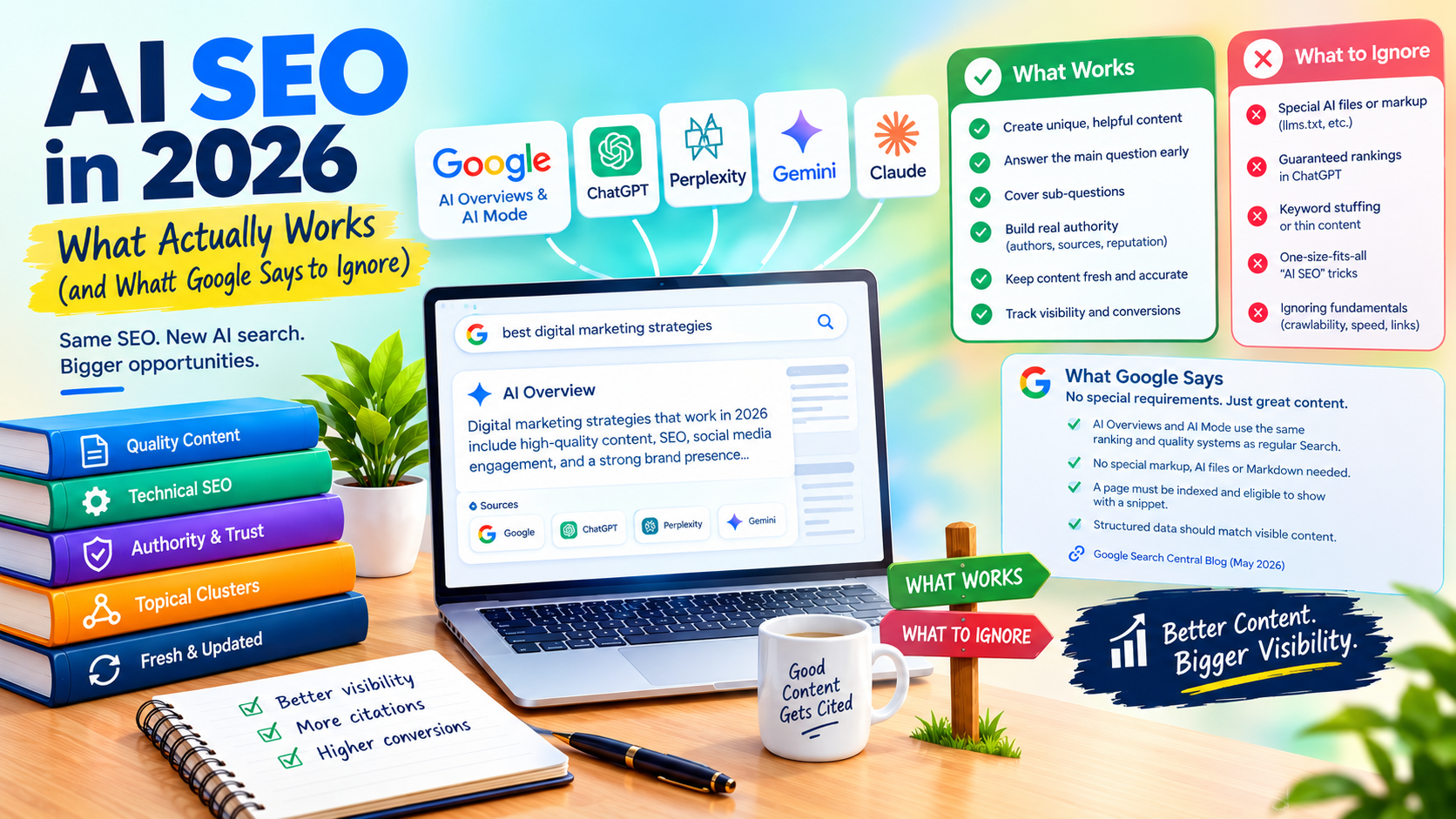
Search no longer ends with ten blue links. People now get answers from Google’s AI Overviews and AI Mode, and from ChatGPT, Perplexity, Gemini and Claude. That shift has brought new acronyms and plenty of bad advice. At Sarkar SEO, our view is simple: AI SEO is not a replacement for good search optimization. It is what good search optimization looks like when machines summarize the web before a human ever clicks.
What Is AI SEO?
AI SEO is the practice of making your content easy for search engines and AI systems to find, understand, trust and cite. It covers visibility in Google’s AI features and in standalone answer engines. You will also hear it called GEO (generative engine optimization) or AEO (answer engine optimization). The labels differ; the goal is the same: be the source an AI chooses when it builds an answer.
What Google Officially Says
In May 2026, Google published its first official guide to optimizing for generative AI features. Its central message is that AI Overviews and AI Mode are built on the same core ranking and quality systems as regular Search, and that unique, valuable, non-commodity content matters more than any tactic. You can read it on the Google Search Central Blog.
Google’s documentation also makes several things clear:
- No special markup, AI-specific text files or Markdown versions of your pages are needed to appear in these features. That includes llms.txt.
- A page must be indexed and eligible to show with a snippet to be used as a supporting link.
- Structured data should match visible page content, but no special schema is required for AI Overviews or AI Mode.
The practical takeaway: if a vendor sells you a “secret AI ranking file,” be skeptical. Google says you do not need one.
How AI Search Chooses Sources
Both AI Overviews and AI Mode can use “query fan-out,” where a single question is split into several related searches across subtopics before an answer is assembled. This changes how you should think about content.
A page that targets one keyword narrowly competes against a system asking five questions at once. A page that answers the main question and the follow-ups a curious reader would ask next gives the system more reasons to pull from you. Depth, structure and clarity beat repetition of a keyword.
A Practical AI SEO Playbook
- Fix the foundation first. Every Sarkar SEO audit starts here: confirm that important pages are crawlable and indexable, that robots.txt and your CDN are not blocking Googlebot, and that key content is real text. Strong internal linking helps users and crawlers find your best pages.
- Lead with the answer. Put a direct answer to the main question near the top, then expand. Short, self-contained explanations are easier to quote accurately. You do not need to chop content into artificial chunks; Google says this is unnecessary.
- Add information gain. If your article repeats what ten other pages already say, an AI has no reason to prefer yours. Include original data, first-hand case notes, screenshots, a tested process or an expert opinion that cannot be found elsewhere. Only claim experience you actually have.
- Build real authority. Named authors, accurate sourcing, up-to-date information and a consistent reputation across the web all support trust. For local and product businesses, keep Google Business Profile and Merchant Center details current.
- Cover the whole topic. Map the follow-up questions around each core topic and answer them in a connected cluster of pages. This is what builds topical authority, and it matches how fan-out retrieval explores a subject.
- Keep content fresh. Update statistics, dates and product details on fast-moving topics. Outdated numbers undermine credibility with readers and machines alike.
Beyond Google: ChatGPT, Perplexity, Gemini and Claude
Google’s guidance governs Google’s own surfaces. Other answer engines retrieve and cite differently, so treat them as separate channels. One analysis of 680 million AI citations in early 2026 reported that only about 11% of domains were cited by both ChatGPT and Perplexity, which suggests that winning in one engine does not guarantee winning in another.
Traffic from these platforms is concentrated but still small compared with organic search. SE Ranking’s 2026 study of more than 100,000 websites found ChatGPT responsible for roughly three-quarters of AI referral traffic, with Gemini, Perplexity, Copilot and Claude sharing the rest. Sarkar SEO recommends tracking each source individually rather than lumping them together as “AI traffic.”
The fundamentals overlap, though: clear writing, original insight and credible sourcing help in every one of these systems. Be wary of tactics that only game a single model.
How to Measure AI Search Visibility
Measurement is improving. In June 2026, Google began rolling out generative AI performance reports in Search Console, starting with a subset of site owners, showing impressions from AI Overviews and AI Mode by page, country, device and date. They do not include click data. Google also announced a control that lets sites opt out of these features, noting that opting out means no traffic or impressions from them.
Beyond Search Console, track referral sessions from chatgpt.com, perplexity.ai, gemini.google.com and claude.ai in your analytics, check brand mentions for priority queries monthly, and judge results by conversions, not clicks alone. Google itself encourages measuring outcomes such as sign-ups and sales.
