



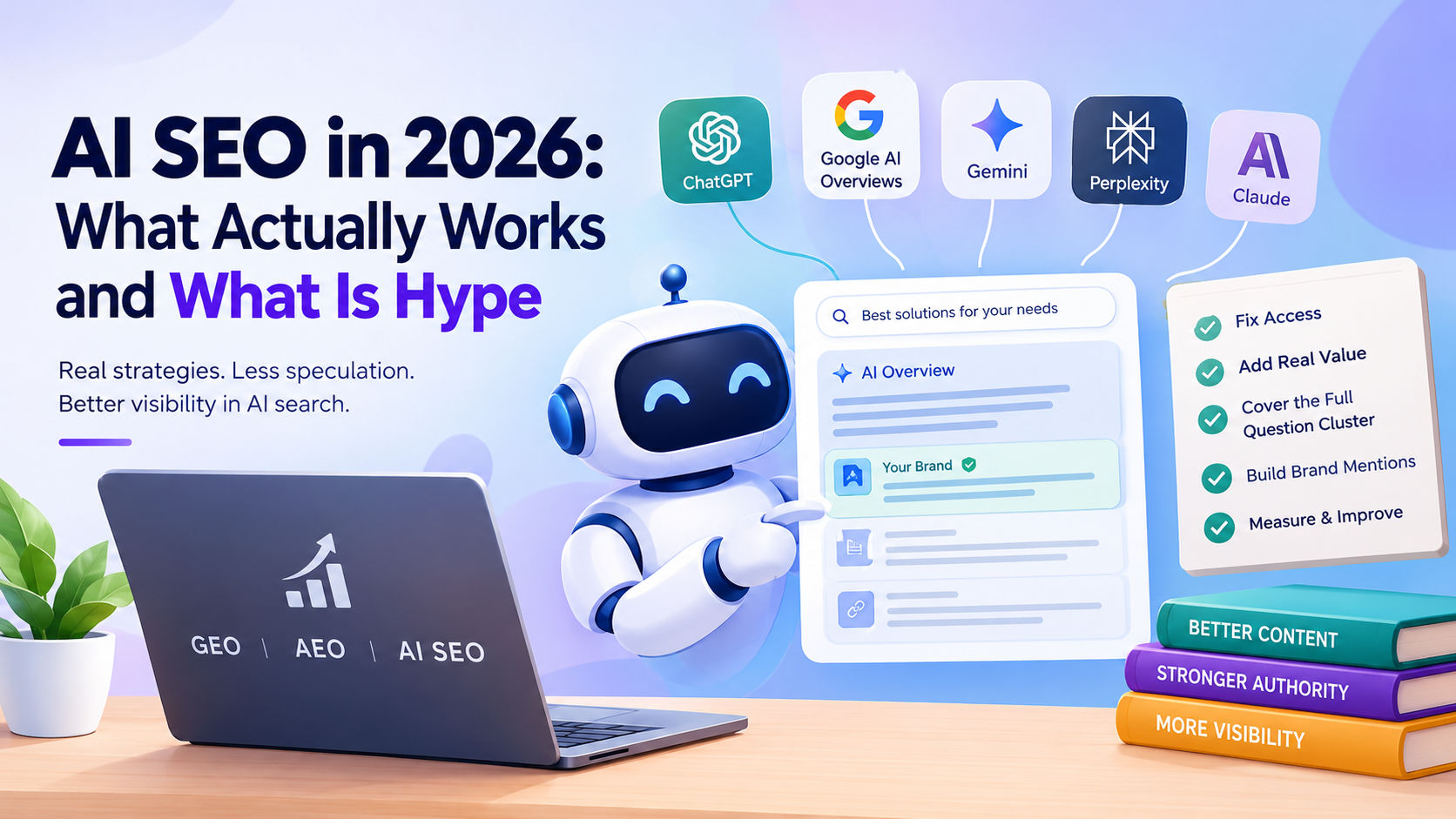
Search no longer ends at ten blue links. Google’s AI Overviews and AI Mode, ChatGPT search, Perplexity and Claude now assemble answers and cite a handful of sources. AI SEO is the work of earning a place among those sources. Much of the advice about it is recycled speculation, so at Sarkar SEO we start from what the platforms have said publicly and what the evidence supports.
What AI SEO Actually Means
AI SEO means making your content easy for AI-driven search systems to find, trust and cite. You will also see it called GEO (generative engine optimization) or AEO (answer engine optimization). The labels differ, but the goal is the same: to be the source an answer engine chooses.
Google addressed this directly on May 15, 2026, when it published its first official guide to optimizing for generative AI features. The guide stresses valuable, unique, non-commodity content, and it debunks common “AEO/GEO” misconceptions. Google says SEO best practices still apply because its generative features are built on its core ranking and quality systems.
That claim covers Google’s own features only. The guidance applies to AI Overviews and AI Mode, but not necessarily to Gemini, ChatGPT or Claude. Treat it as a strong foundation, not a complete map of every answer engine.
Why the Stakes Are Rising
AI answers now take up a large share of search attention.
- Reach: One roundup reports that Google said at I/O 2026 that AI Mode has over one billion monthly users and is expanding to nearly 200 countries. This comes from a secondary news source, so confirm it against Google’s own announcement before quoting it.
- Fewer clicks: Several industry analyses estimate that about 93% of AI Mode sessions end without a visit to any website. These are third-party estimates, not Google figures.
- Measurement: In June 2026, Search Console introduced a generative AI performance report, giving site owners a dedicated view of performance in AI Overviews and AI Mode. It does not give a clean AI Mode versus AI Overviews split.
Fewer clicks make every citation more valuable. Being named as a source builds brand recognition even when the visit never happens.
How AI Search Picks Its Sources
Google’s systems can use query fan-out. AI Overviews and AI Mode can issue several related searches across subtopics and data sources before composing a response. One question can therefore trigger many hidden queries. A page that covers only the headline keyword competes against pages that answer the surrounding questions.
Two requirements follow:
- Eligibility. A page must be indexed and eligible to appear in Google Search with a snippet to be shown in generative AI features.
- Distinctiveness. If anyone with a search engine could have written your content, AI models have little reason to prefer your version.
A Practical AI SEO Playbook
- Fix access first
If a crawler cannot fetch your page, nothing else matters. Training, search and live-fetch bots are separate, so you can treat them differently. A common 2026 publisher approach is to block training crawlers while allowing search and citation crawlers such as OAI-SearchBot and PerplexityBot. OpenAI’s documentation reportedly states that a site disallowing OAI-SearchBot will not appear in ChatGPT search answers.
Check your CDN and firewall too. Cloudflare, Akamai and Fastly can block AI crawlers by default regardless of robots.txt. Also test whether your content renders without JavaScript. Content that requires JavaScript is invisible to most AI crawlers.
- Publish information gain
Answer engines compress consensus. To be cited, add something the consensus lacks: original data, firsthand testing, expert commentary, a clearer framework or a local angle. Rewriting the top ten results adds nothing. Only claim experience you actually have, because unsupported claims erode trust with readers and with systems built to detect it.
- Cover the question cluster
Because of fan-out, map the follow-up questions around your topic: costs, comparisons, risks, steps and edge cases. Give each a direct answer of two or three sentences near the top of its section, followed by the evidence. This helps readers skim, and it makes your passages easy to extract.
- Build real brand mentions
Google’s guide confirms that AI features surface what is said about brands across third-party sources. Genuine reviews, expert quotes, partnerships and community discussion all count. Seeking inauthentic mentions may be treated as spam. Earn mentions through work worth mentioning.
- Measure what you can
Use Search Console’s generative AI reporting for Google. For other engines, track referral traffic and test a fixed set of your target questions each month, noting whether your brand is cited. Tie the results to leads or revenue, not impressions alone. Sarkar SEO builds this kind of reporting into AI SEO engagements so visibility is judged against business outcomes.
Myths to Drop
- “You need special schema for AI.” Structured data isn’t required for generative AI search, and there is no special schema.org markup to add. Schema still helps search engines understand a page, so use it where it fits.
- “llms.txt boosts citations.” One 2026 crawler guide reports that several independent studies found no measurable effect on AI citations. Treat it as optional, not as a strategy.
- “AI SEO replaces SEO.” The evidence points the other way. If you want better visibility in large language models, great SEO done well is still your best bet.
- “Mass-produce AI content.” Mass-produced pages with no recognizable added value, written purely for search engines, are what gets penalized. AI can assist drafting, but the value must come from people.
Where Your Effort Should Go
Rank your priorities in this order. Technical access comes first, because it is cheap and blocks everything when broken. Original, well-structured content comes second and delivers most of the long-term gain. Third is brand reputation across the wider web. Fourth is measurement. Chasing tricks ahead of these gets the order backwards.
