



Search has changed shape. People now type full questions, get a written answer, and ask follow-ups without leaving the results page. For site owners, the question is no longer only “Do I rank?” but “Does an AI system trust me enough to use my page?”
That shift is what people mean by AI SEO: making your content easy to find, understand and cite, both in Google’s AI features and in answer engines such as ChatGPT, Perplexity, Gemini and Claude. At Sarkar SEO, we treat it as an extension of good search work, not a replacement for it. The evidence supports that view, with a few important twists.
What AI SEO Actually Means
AI SEO covers two goals that overlap but are not identical:
- Being eligible and useful inside Google’s AI Overviews and AI Mode.
- Being cited or mentioned by independent AI assistants that run their own retrieval.
Treating these as a single task is the most common strategic error. They behave differently, as the data below shows.
What Google Says: It’s Still SEO
On May 15, 2026, Google published its first dedicated guide for anyone running a website who wants to surface in AI Mode and AI Overviews. Its core message is that these generative features draw on the same Search index and ranking systems as traditional results. Coverage of the guide also notes that if Google can’t crawl, index or understand a page, it can’t surface that page in these features either. google ai optimization guide seo ai mode overviews en +2
The more useful part is what Google says you can skip. Summaries of the guide report that site owners don’t need llms.txt files, content chunking, special schema or AI-specific rewriting. What it emphasizes instead is first-hand experience content, multimodal assets and sound technical basics.
There is also a warning. Reports indicate Google updated its spam policies so that spam rules apply to generative AI responses, and tactics built specifically to manipulate AI answers, such as fake mentions or scaled content aimed at fan-out queries, are treated as spam.
The practical reading is that shortcuts are risky and fundamentals are rewarded.
Why Ranking Well Doesn’t Guarantee AI Visibility
Here is where AI SEO departs from classic SEO. Inside Google, ranking and AI citation are closely linked. An Ahrefs study found that 76% of AI Overview citations came from pages in the top 10.
Outside Google, the picture changes sharply. Ahrefs later analyzed 15,000 prompts and found that only about 12% of links cited by ChatGPT, Gemini and Copilot appear in Google’s top 10 for the same prompt. Perplexity was the outlier, with 28.6% of its cited URLs landing in the top 10.
The engines also disagree with each other. A six-month study of 22.7 million citations reported that Perplexity never touches 89.1% of the websites ChatGPT cites. Another dataset found that 91% of citations appeared in only one engine. wellowssearchenginejournal
Take these numbers as directional. They come from vendor studies with different methods, and engines change quickly. The consistent lesson is that no single ranking position earns visibility everywhere.
One finding offers a way forward. BrightEdge’s April 2026 analysis found that overlap in named brands across engines (36%–55%) was tighter than overlap in cited sources (16%–59%). Separately, Ahrefs reported that branded web mentions correlated roughly 0.66 to 0.71 with brand visibility across ChatGPT, AI Mode and AI Overviews. In plain terms, being widely and consistently known for something matters as much as any one page.
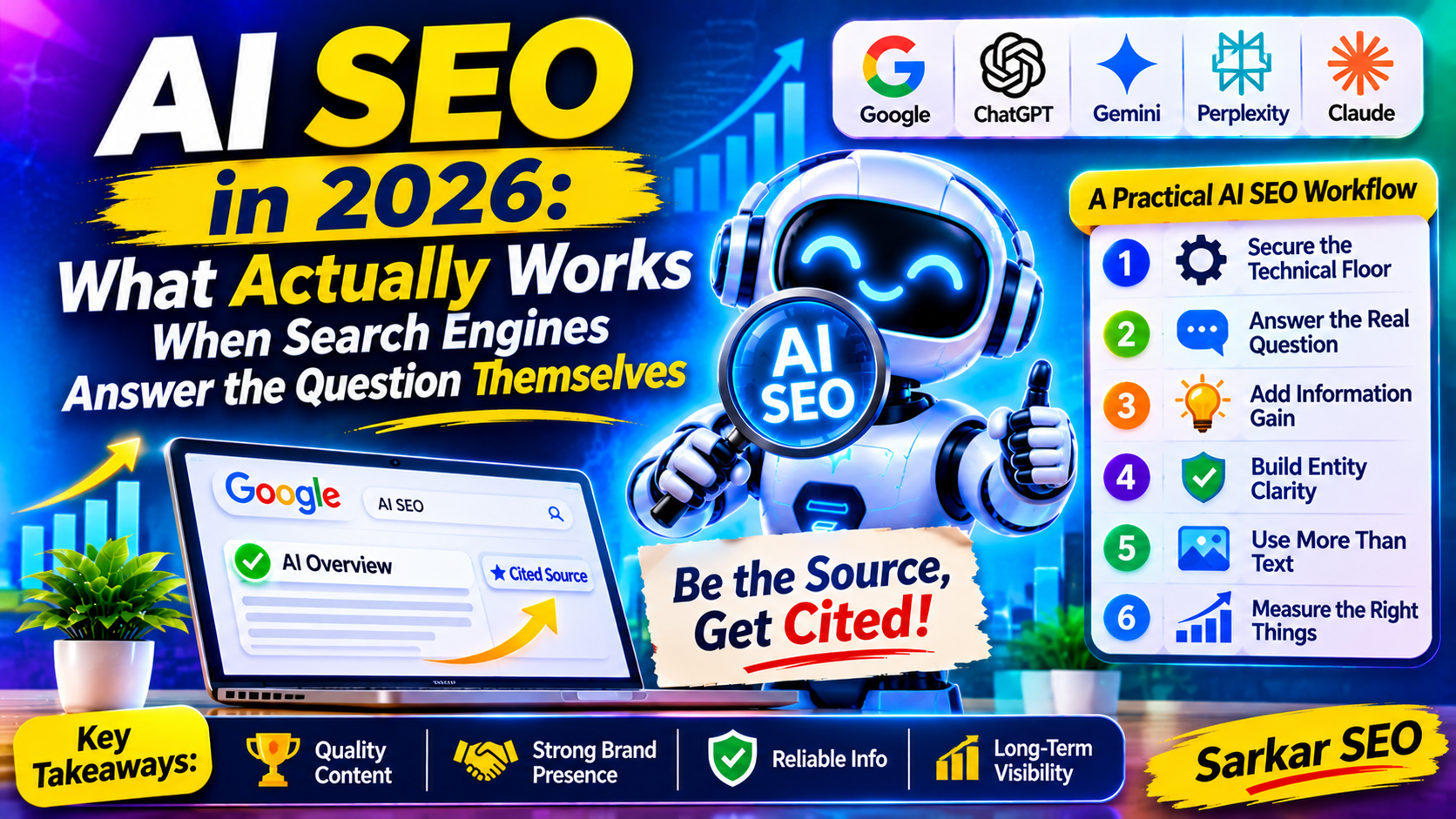
A Practical AI SEO Workflow
- Secure the technical floor. Check that important pages are crawlable, indexable and eligible for snippets. Fix slow mobile pages and weak internal linking. This is unglamorous, and it is the entry ticket.
- Answer the real question, then the next one. Google’s AI features run multiple related searches behind one query, so a page that covers the follow-ups a buyer would ask is more useful than one that answers a single phrasing. Open each section with a direct answer, then add depth.
- Add information gain. If your page repeats what ten others say, an AI system has no reason to prefer it. Bring original data, a tested process, a worked example, a screenshot of your own results or an expert’s judgment. Never invent these. Unverifiable claims hurt trust.
- Build entity clarity. Make it obvious who you are, what you cover and why you’re credible. Use consistent naming, real author bios, an About page that states your expertise, and mentions on respected third-party sites. Because assistants lean on brand recognition, this is where Sarkar SEO focuses early with new clients.
- Use more than text. Original images, diagrams, short videos and clean tables give both users and systems more to work with.
- Measure the right things. Track impressions and clicks in Search Console, referrals from AI platforms in analytics, and a fixed set of 20 to 50 target prompts checked monthly across several engines. Record whether you’re cited, mentioned or absent. Treat results as a trend, because AI answers vary between runs.
Common AI SEO Mistakes
- Chasing formats instead of quality. Splitting every article into tiny “AI-friendly” fragments or adding file types nobody requires wastes effort, based on Google’s own guidance.
- Scaling thin content. Mass-produced pages aimed at every conceivable prompt invite spam treatment.
- Ignoring non-Google engines. If your buyers use ChatGPT or Perplexity, Google rankings alone won’t tell you whether you appear there.
- Optimizing for mentions without substance. Visibility that isn’t earned by genuine expertise is fragile.
- Expecting instant proof. Citation patterns shift, so judge progress over months.
Is AI SEO different from SEO? Mostly it builds on it. Google states that its AI features rely on its standard search systems. Other assistants add extra considerations, especially brand recognition and third-party mentions.
Do I need llms.txt? Google’s guidance says not for its AI features. Other platforms haven’t committed to using it, so treat it as optional at best.
How do I get cited by ChatGPT or Perplexity? There is no guaranteed method. Publish original, verifiable, well-structured content, earn reputable mentions, and keep your site accessible to crawlers.
