



Your page ranks on the first page of Google, yet the AI-written answer above it cites three of your competitors. That gap is the real reason AI SEO has become a serious discipline. It is also why so much advice about it sounds either panicked or vague. This guide separates what is confirmed from what is speculation, so you can decide where effort actually pays off.
What Is AI SEO?
AI SEO is the practice of making your content easy for search engines and AI assistants to crawl, understand and cite. It covers Google’s AI Overviews and AI Mode, plus assistants such as ChatGPT, Perplexity, Gemini and Claude. You will also see it called GEO (generative engine optimization) or AEO (answer engine optimization). The labels differ, but the goal is the same: to be part of the answer, not just a link beneath it.
What Google Has Actually Said
Google has published official guidance on optimizing for its generative AI features. Search Engine Journal’s coverage describes AEO and GEO as being treated as part of SEO, not separate disciplines, for Google Search. Eligibility is plain. A page must be indexed and eligible to appear in Google Search with a snippet, and there are no additional technical requirements. The fundamentals still apply: allowing crawling in robots.txt and by any CDN, making content findable through internal links, and providing a good page experience. 🔥Keystone Cohort: Be the AI-Cited Source — Content Structure & Schema +2
Commentary on the guide adds that an llms.txt file is not necessary for Google Search and won’t improve AI Overviews visibility. There is a caveat. That guidance covers Google’s own features, and ChatGPT or Perplexity may weight signals differently.
Why Ranking Does Not Guarantee Citation
Google says AI Overviews and AI Mode may use “query fan-out,” issuing multiple related searches across subtopics and data sources to build a response. Your page therefore competes on several sub-questions, not on one keyword.
Take a page about AI SEO. It may define the term well and still be skipped, because the fan-out also asks how AI SEO differs from classic SEO, which crawlers matter, how to measure results and what it costs. If your page never touches those, another page will fill the gap.
There is a limit to what we know. One review of Google’s guide notes it does not explain why many pages rank well but never appear in AI Overviews. Treat fan-out coverage as a strong hypothesis to test, not a proven rule.
A Practical Five-Step Workflow
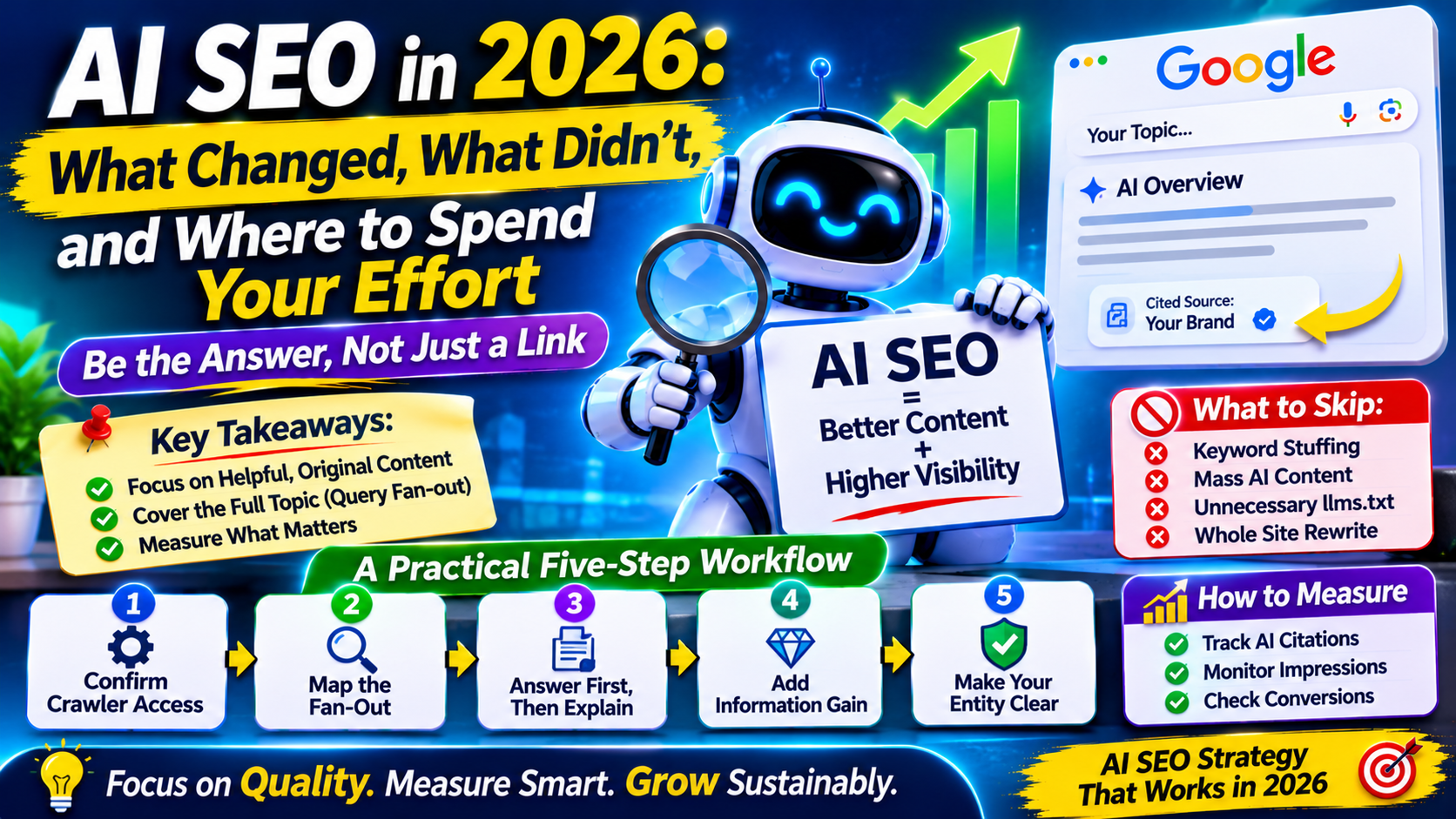
- Confirm access first. Check robots.txt and CDN rules before anything else. Bots have different jobs. OpenAI separates GPTBot, used to train models, from OAI-SearchBot, its search crawler. Blocking one does not block the other. Likewise, Google-Extended controls Gemini training and grounding but has no effect on Google Search, including AI Overviews and AI Mode. Decide on each bot deliberately.
- Map the fan-out. Search your target topic and open the AI answer. List every subtopic it covers. Each one is a section, or a page, you may be missing.
- Answer first, then explain. Open each section with a direct one- or two-sentence answer, then support it. Compare “It depends on many factors” with “Allow search crawlers, answer the question in your opening lines, and back the claim with evidence.” The second is easier for a reader to use and for a system to extract. Google’s advice, as summarized by one agency, is to organize content for human readers with clear paragraphs and descriptive headings rather than contorting it around AI systems.
- Add information gain. If you repeat what ten other pages say, no system has a reason to prefer yours. Add what only you have: your own data, a documented test, real screenshots, a practitioner’s judgment. Never invent any of it.
- Make your entity clear. Use a consistent business name, real author bios, a clear About page and credible third-party mentions, so systems understand who is behind the content. Some vendor sources argue that brand mentions and digital PR now matter alongside traditional link building. Independent evidence on how much is still thin. Sarkar SEO treats this as housekeeping, not a trick.
How to Measure Without Fooling Yourself
Sites appearing in Google’s AI features are counted within overall search traffic in Search Console, so there is no dedicated AI report to lean on. Build your own baseline instead: google
- Write 20 to 30 prompts your customers really ask.
- Run them monthly across Google, ChatGPT, Perplexity and Gemini.
- Record whether you are cited, who else is cited and how you are described.
AI answers vary from run to run, so watch trends, not single results. Pair this with referral data in your analytics tool.
What to Skip
- Keyword stuffing. Clarity beats repetition.
- Mass-produced AI content. Analysis of Google’s guide notes that spam policies such as scaled content abuse are formally in scope for AI Overviews and AI Mode citations.
- Chasing llms.txt for Google visibility. It is not required there.
- Rewriting the whole site at once. Start with the pages most likely to be pulled into an AI answer instead of spreading effort thinly across hundreds of URLs.
The Honest Limits
Most published AI SEO data comes from vendors selling tools. Platform behavior also changes quickly, and nobody outside these companies knows the exact selection rules. Treat every tactic as an experiment: change one thing, wait, record the result. Sarkar SEO favors this slower, evidence-first approach over any promise of guaranteed AI rankings.
