



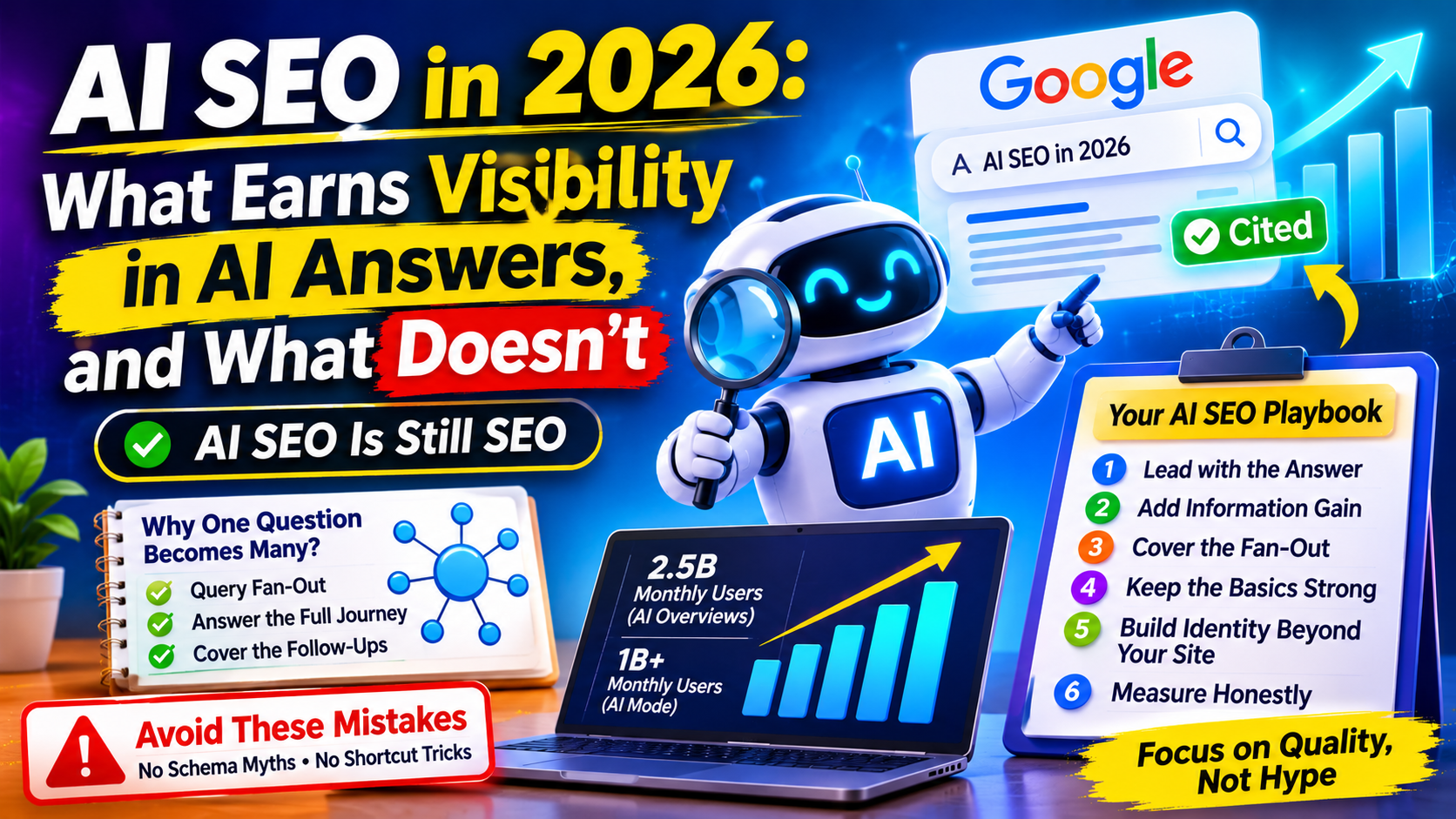
AI SEO is the practice of making your content easy for search engines and AI assistants to find, understand, and cite when they build answers. It covers Google AI SEO Overviews and AI Mode, and also tools like ChatGPT, Perplexity, and Gemini. The goal moves from earning a click to earning inclusion in the answer itself.
The Reset: AI SEO Is Still SEO
Google released its first official guide to optimizing for AI search on May 15, 2026, and it says on-site SEO is still the foundation. Google also states there are no additional technical requirements for appearing in its generative AI experiences. If Google can’t crawl, index, or understand a page, that page won’t appear in an AI answer either. semrushseo-hacker
Google’s own wording is blunt about the hype. The guide addresses AEO and GEO by name and treats optimizing for generative AI search as optimizing for Search. The labels are new, but the work is mostly familiar.
The stakes are real. Google says AI Overviews now reach more than 2.5 billion monthly users, and AI Mode passed 1 billion monthly users as of May 2026. Ignoring these surfaces means ignoring where a large share of searching now happens.
Why One Question Becomes Many
The biggest mechanical change is query fan-out. AI search systems break one query into several related sub-queries to build a fuller answer, and Google explicitly uses this in AI Overviews and AI Mode.
For you, this means a page can earn a citation without ranking first for the headline keyword. It only needs to be the best source for one of the hidden sub-questions. A page about choosing accounting software, for example, might be pulled in because it clearly explains migration costs or data-export limits.
So write for the whole decision, not just the keyword. Cover the follow-ups a careful reader would ask: cost, risks, alternatives, steps, and who the advice does not suit.
Where Google’s Guide Stops
Google’s guidance covers Google. Google AI Mode and AI Overviews retrieve from Google’s index, while ChatGPT, Perplexity, and Gemini draw on training data plus their own retrieval. The guide also doesn’t explain how to track whether your content is cited in AI answers.
That gap is where a brand’s wider footprint matters. Consistent descriptions of your business across your site, profiles, reviews, and credible third-party mentions give every engine the same picture to repeat. This is the layer Sarkar SEO usually asks clients about first: not “how do we rank?” but “how do machines describe us today?”
The Schema Myth
Structured data has been sold as an AI shortcut. The best controlled test so far says otherwise. Ahrefs tracked 1,885 pages that added JSON-LD between August 2025 and March 2026, matched them against 4,000 control pages, and found no meaningful citation uplift across Google AI Overviews, AI Mode, or ChatGPT.
The study has limits, and they matter. Every page in the dataset already had 100+ AI Overview citations before schema was added, so it can’t say whether markup helps pages that have none. The 30-day window may also miss slower effects, and only schema in the page’s HTML was examined. cmswirestanventures
The fair reading is this: keep accurate schema for clarity and entity identity, but don’t expect it to substitute for content worth citing. As Ahrefs’ Louise Linehan put it, if the rest of the SEO work is already strong, JSON-LD isn’t the unlock.
A Practical AI SEO Playbook
- Lead with the answer. Put a direct, self-contained answer in the first lines under each heading, then add nuance. Engines extract passages, so each section should make sense on its own.
- Add information gain. Repeating what the top ten results say gives an AI system no reason to choose you. Publish something others lack: original data, a documented test, a real client scenario, a named expert’s judgment. Claim only experience you actually have. Invented case studies are the fastest way to lose trust, and engines increasingly cross-check.
- Cover the fan-out. Map the follow-up questions around your topic and answer each under its own clear heading. Comparison tables, short definitions, and step lists are easy to lift accurately.
- Protect basic eligibility. Make sure key pages are crawlable, indexable, fast, and eligible to show a snippet. Check that important content appears in the HTML rather than depending entirely on scripts.
- Build identity beyond your site. Keep your name, services, and expertise described consistently everywhere. Earn mentions where your audience reads: industry publications, communities, podcasts, and reviews.
- Measure honestly. Rankings alone no longer tell the story. Google Analytics reportedly added an “AI Assistant” default channel, so AI-referred traffic should start appearing in attribution. Pair that with a monthly routine: run your twenty most important customer questions through each major assistant, record whether you’re cited, and note how you’re described.
Mistakes That Waste Budget
- Treating AI SEO as a separate discipline and neglecting crawlability, quality, and links.
- Chasing markup tricks instead of better content.
- Over-formatting. Bullets and headings help only when the content underneath is substantive.
- Publishing unverified statistics. One fabricated figure can get a page ignored or corrected in AI answers.
- Expecting instant results. Citations shift as models and retrieval systems change, so track trends over months.
Is AI SEO different from traditional SEO?
Mostly it extends it. The foundations of crawlability, helpful content, and authority carry over. What changes is the emphasis on answer-ready passages, sub-question coverage, and brand consistency across the web.
Can I guarantee a citation in AI Overviews?
No. Anyone promising that is overselling. You can improve eligibility and usefulness, but the engines decide what to cite.
Does AI SEO still matter if clicks decline?
Yes. Being named in an answer builds recognition even when no click follows, and it can shape which brands people search for next.
