



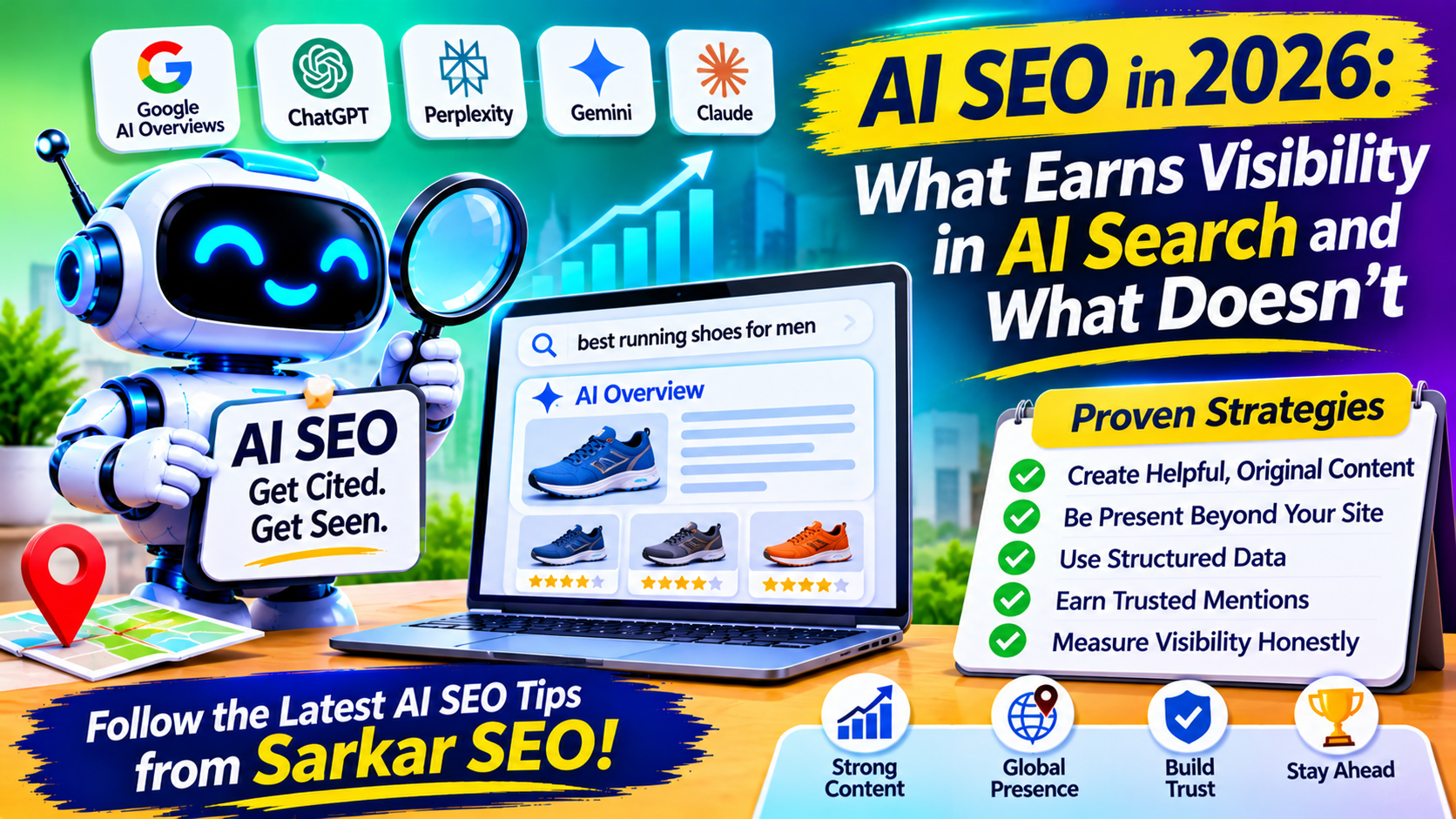
Search no longer ends with ten blue links. People now get synthesized answers from Google’s AI Overviews and AI Mode, and from ChatGPT, Perplexity, Gemini and Claude. AI SEO is the work of making your content easy to retrieve, understand and trust for those systems, so they cite you. The hype around it is loud, so this article sticks to what the evidence supports.
What Google Officially Says
On May 15, John Mueller announced a new Search Central page titled “Optimizing your website for generative AI features on Google Search.” Its central position is that from Google Search’s perspective, optimizing for generative AI search is optimizing for the search experience, and thus still SEO. writtenlyhubwrittenlyhub
The practical consequences are clear:
- Google’s documentation says there are no additional technical requirements to appear in AI Overviews beyond standard Search eligibility.
- One analysis of the guide notes there is no separate AI index, no special schema, and no LLM-specific upload format that unlocks citations.
- The guide stresses valuable, unique, non-commodity content.
There are two caveats. The guidance covers Google Search only, and other platforms use different retrieval systems. Critics also argue it is incomplete. In his response, iPullRank’s Mike King objected to Google’s suggestion that publishers need not write in a specific way, because AI systems can understand synonyms and general meanings. His point is that passage-level retrieval makes structure matter more than Google admits. The sensible reading is that Google’s advice is a floor, not the whole picture.
How Other AI Engines Behave Differently
Ranking well in Google does not guarantee citations elsewhere. The studies below come from vendors and use different methods, so treat them as directional rather than definitive.
- Little overlap between engines. An Averi analysis of 680 million citations found only 11% of domains were cited by both ChatGPT and Perplexity.
- ChatGPT leans on third parties. Yext’s study of 6.8 million citations found 48.7% of ChatGPT citations come from third-party listings such as review and directory sites.
- Perplexity favors communities. A Tinuiti breakdown found 31% of Perplexity citations come from social media, with Reddit dominant.
- Studies disagree on Google overlap. One compilation says 80% of ChatGPT-cited URLs don’t rank in Google’s top 100, while another cohort reports far higher overlap with top-10 results. Don’t assume a high Google ranking will carry over to citations, and don’t assume it won’t.
The lesson is that AI visibility is partly an off-site game. Where the web talks about you matters as much as your own pages.
A Practical AI SEO Playbook
- Protect access first. Make sure the crawlers you want, including Google’s search crawler and AI search bots such as OAI-SearchBot and PerplexityBot, aren’t blocked in robots.txt. Snippet eligibility is the baseline for Google features.
- Publish information that can’t be summarized from elsewhere. Original data, documented processes, named experts and real examples give an answer engine a reason to cite you. Google’s people-first guidance still warns against content made primarily to attract search traffic, extensive automation across many topics, and summaries that add little value. Rewritten consensus content is exactly what AI systems can already generate.
- Lead with the answer, then add depth. Open each section with a direct, self-contained answer. Passage-based retrieval can lift a single paragraph out of context, so every section should make sense on its own. Google reports that the average AI Mode query is triple the length of a traditional Search query, so also cover the follow-up questions a curious reader would ask next.
- Build presence beyond your domain. Keep business profiles accurate. Earn mentions in reputable publications. Take part honestly in the communities where your audience asks questions, such as forums and video. Citation studies suggest these off-site sources often feed AI answers.
- Use multimedia and structured data honestly. Google’s guidance includes meeting technical requirements and creating multimedia content. Markup should match what users can actually see on the page. Structured data isn’t a secret key to citations, but it helps machines understand your page. searchenginejournal
What to Skip
Skip the shortcuts that promise guaranteed AI citations. A separate “AI version” of your pages, mass-produced AI articles and keyword-stuffed question lists add little value. As one commentator put it, commodity content will hurt your AI visibility on Google regardless of any technical optimization. That’s a problem a plugin can’t fix.
Measuring Success Honestly
Expect fewer clicks on some informational queries. A Pew Research study from mid-2025, as summarized by one practitioner, found users clicked through to a source in roughly 8% of sessions with an AI Overview present, versus 15% without. Visibility now includes impressions, mentions and citations, not only visits.
Measurement is improving. Google has announced that Search Console will report impressions, pages, countries, devices and dates for AI Overviews and AI Mode. Until that arrives in your account, run a simple routine. Pick 15 to 20 queries your customers actually ask. Test them monthly across Google AI Mode, ChatGPT, Perplexity, Gemini and Claude. Record whether you were cited, merely mentioned or absent, and which competitors appeared. Pair this with referral traffic and lead quality in your analytics, because AI-referred visitors may behave differently from organic ones. Some vendor benchmarks claim they convert much better, but those figures vary by industry and method.
The Bottom Line
AI SEO is not a replacement for SEO. It is classic SEO fundamentals plus a broader view of where your brand is discussed and how easily a machine can extract your answers. Sites that crawl cleanly, publish original insight and earn trusted mentions are positioned well wherever the answer is generated.
Sarkar SEO builds strategy on that principle: clear structure, original expertise and measurable visibility rather than gimmicks. If you want to know how your brand appears across AI answers today, Sarkar SEO can help you audit your visibility and prioritize the changes that matter. Visit sarkarseo.com to start the conversation.
