



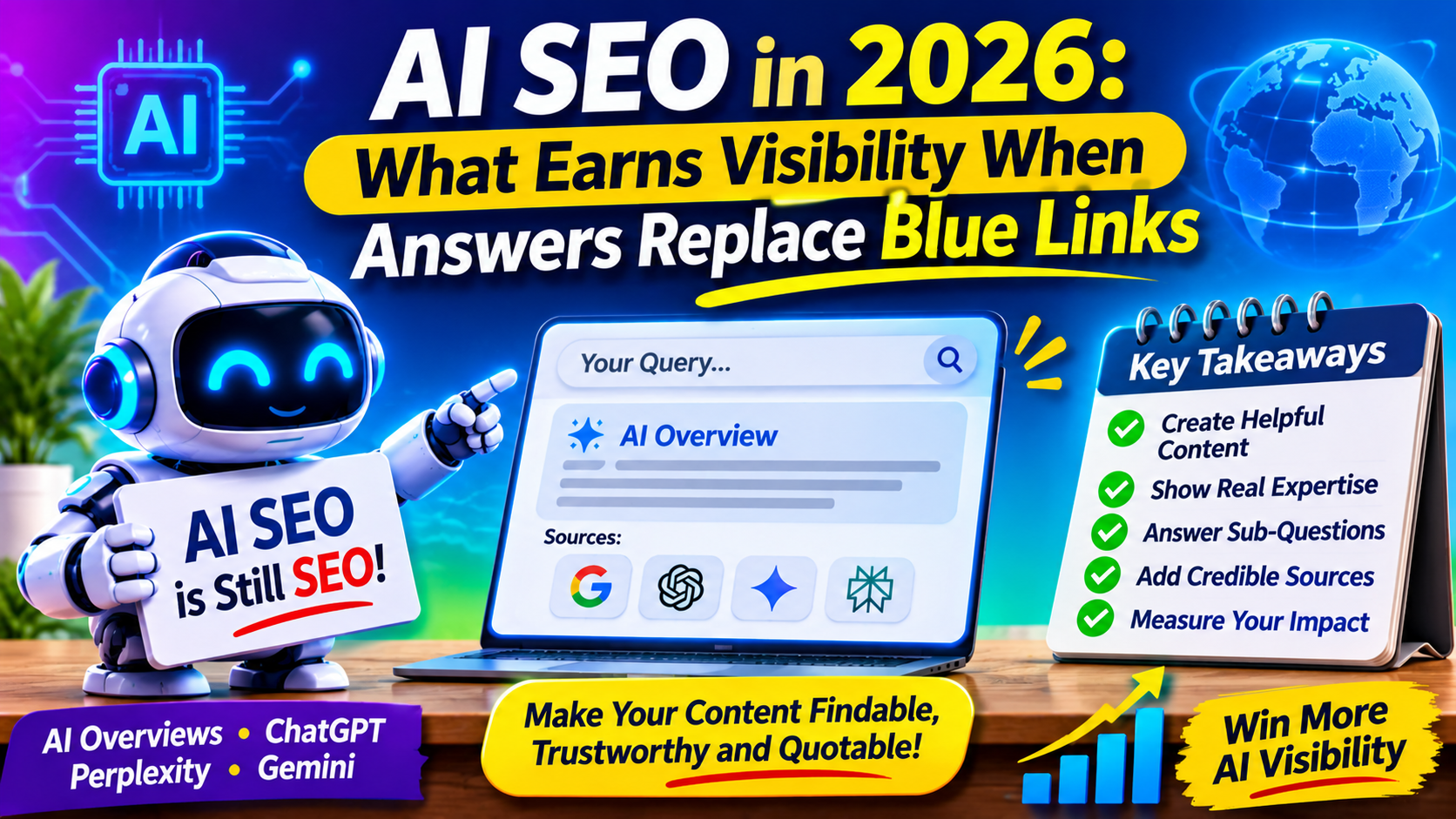
People now get answers from AI Overviews, AI Mode, ChatGPT and Perplexity, often without scrolling a results page. AI SEO is the work of making your content findable, trustworthy and quotable across those systems. Sarkar SEO treats it as an extension of search fundamentals, not a replacement for them.
What AI SEO actually means
AI SEO covers two goals:
- Eligibility: your pages can be crawled, indexed and understood.
- Selection: when an AI system assembles an answer, it picks your page as a source.
Marketers also use the labels AEO (answer engine optimization) and GEO (generative engine optimization). They describe the same two goals, aimed at different platforms.
Google’s position: it is still SEO
Google now has official guidance on this. It says optimizing for generative AI search is still SEO, and the guide does not treat AEO and GEO as separate disciplines. The reasoning is structural: AI Overviews and AI Mode use the existing crawl and index, not a separate AI retrieval layer. Google’s documentation adds that specific optimization isn’t required for AI Overviews and AI Mode, and existing SEO fundamentals remain worthwhile. google ai search optimization guide +2
The guidance also describes how these features find material. They can use retrieval-augmented generation and query fan-out to find and assess relevant information from the Search index. In plain terms, one question can trigger many sub-searches behind the scenes. A page that answers a narrow sub-question well can be pulled in even when it doesn’t rank first for the headline query.
Tactics Google says to skip
Much of the AI SEO market sells shortcuts. Google lists llms.txt files, content “chunking,” AI-specific rewriting, inauthentic brand mentions and over-reliance on structured data for AI purposes as things site owners should not pursue. If a vendor pitches any of these as the secret to Google AI visibility, check the claim against Google’s own documentation.
What Google does reward is content that doesn’t read as if anyone could have written it. A useful test comes from one practitioner: ask whether a generic AI model could write the page without access to your actual experience. If it could, the page needs more substance.
Other engines behave differently
Google’s guidance covers Google Search only. It doesn’t necessarily apply to Gemini the standalone assistant, and certainly not to ChatGPT or Claude. The engines retrieve differently. One industry comparison reports that only 11% of cited domains overlap between platforms, and that ChatGPT leans on Bing’s index while Perplexity runs its own. A separate study of 22.7 million citations found that engines frequently cite sources the others never touch. Treat these figures as directional, since they come from vendor research with different methods. google says ai optimization is just seo +2
A comparison study of ChatGPT and Perplexity found a practical split. Content that earns a Perplexity citation does not necessarily earn a ChatGPT citation, and Reddit and YouTube showed up only via Perplexity. A single “get cited by AI” playbook will therefore underperform. Choose your priority engines based on where your customers actually search.
The traffic reality
Visibility is not the same as visits. One roundup of 2026 studies reports that 65 to 70% of AI answer sessions end without a click to any cited source. Another claim puts the figure for AI Mode at 93%, but it is secondary and unverified, so don’t plan around it. The sensible reading is that AI answers shrink clicks while raising their intent. Google itself says people perform more queries in AI mode, but the clicks are of higher quality. Judge AI SEO by qualified leads and brand demand, not raw sessions alone.
A five-step AI SEO approach
- Confirm eligibility. Check in Search Console that key pages are indexed and snippet-eligible. Google says robots.txt directives for Googlebot are the control for how your site is crawled for Search. Blocking Googlebot to avoid AI features also removes you from classic search.
- Add information gain. Before publishing, ask what this page contains that the top ten results lack. Original data, a named method, a worked example or a documented mistake all qualify. Rewording competitors does not.
- Write for the sub-question. Give each section one clear, self-contained answer under a descriptive heading. This is ordinary good writing, not “chunking” as a trick. Readers and retrieval systems both benefit from sections that can stand alone.
- Back claims with sources. Princeton’s GEO research, as summarized by one industry comparison, found that adding statistics, quotations and source citations each improved AI visibility by 30 to 40%, while keyword stuffing reduced it by roughly 10%. That is a secondary summary of academic work, so treat the exact percentages with care. The direction is consistent with good editorial practice.
- Build corroboration off your site. Other engines draw on the wider web. Reviews, credible mentions, community discussions and video presence matter more on some platforms than on Google. Earn these honestly. Google specifically warns against inauthentic mentions.
Local and product businesses
For local companies, your Google Business Profile, service pages and location details must stay accurate and consistent. For sellers, Merchant Center feeds and product details can help products appear in AI responses. Structured data still helps with rich results, but it won’t compensate for thin content.
How to measure progress
Track what you can verify:
- Search Console: Google reports AI features within the Performance report under “Web” search type, though AI Mode reporting was not yet live at the time of that documentation.
- Prompt panels: run a fixed list of 20 to 30 customer questions monthly across engines and log whether you’re cited. Expect volatility. One study found citation stability ranged from 61% on Perplexity to 71% on AI Overviews.
- Business outcomes: branded search, demo requests and assisted conversions.
Is AI SEO different from SEO?
For Google, no. Its documentation treats them as one discipline. For ChatGPT, Perplexity and Claude, retrieval differs, so source mix and off-site presence matter more.
Should I create an llms.txt file?
Google lists it among tactics site owners should not pursue for its AI features. It is low-cost, but don’t expect Google visibility from it.
Can I guarantee AI citations?
No. No one controls what a model cites, and answers vary from run to run.
