



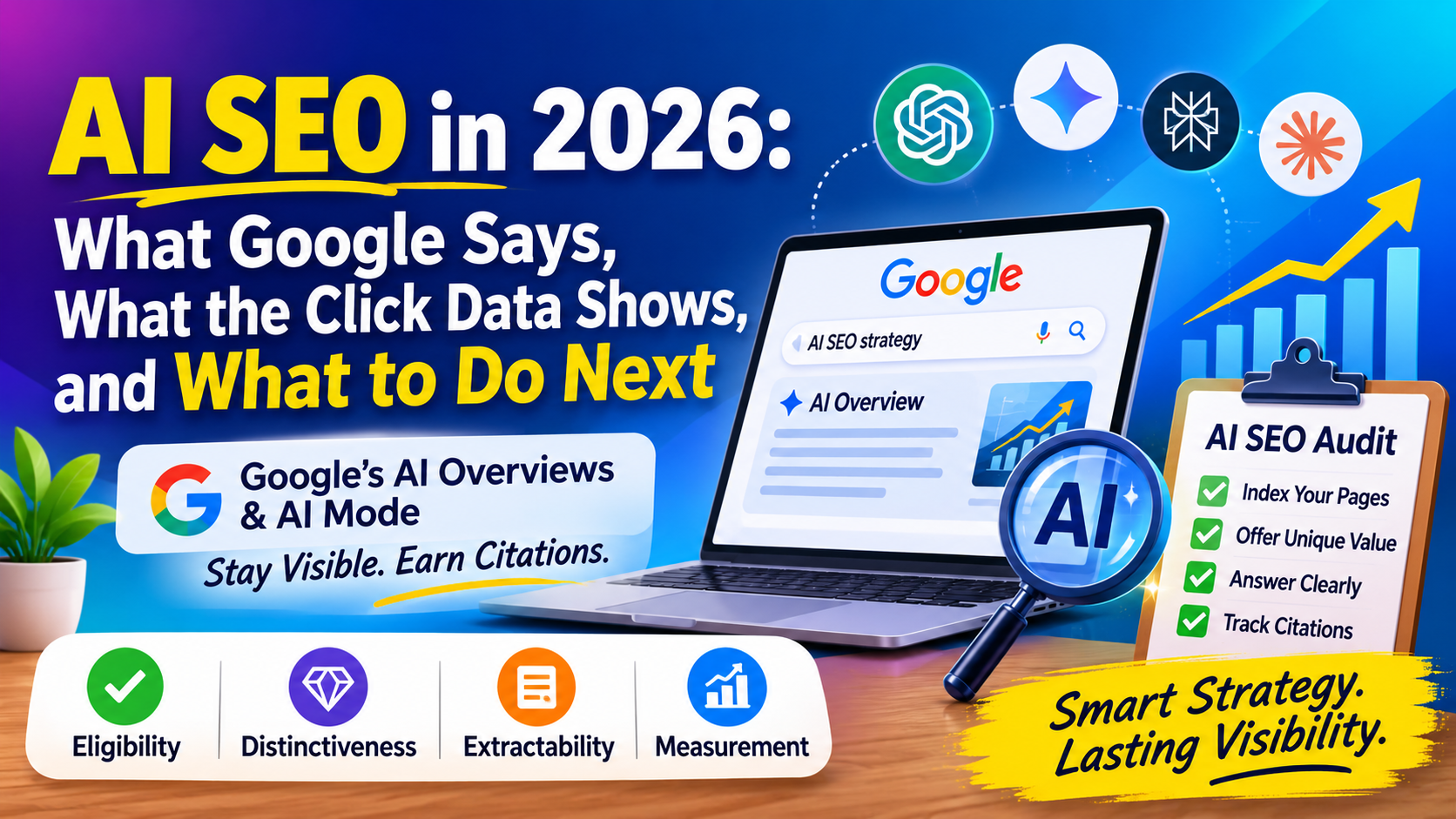
AI SEO is the work of making your content easy for search engines and AI answer systems to find, understand and cite. For Google’s AI Overviews and AI Mode, the company’s own position is that the foundation has not changed: a page must be indexed and eligible to appear in Search with a snippet. The harder question for site owners in late 2026 is not how to game an AI SEO, but how to stay valuable when more answers arrive without a click.
What AI SEO actually covers
Three labels get mixed together. AI SEO for Google’s own AI features is one. Generative engine optimization (GEO) covers chat tools such as ChatGPT, Perplexity, Gemini, Claude and Grok. Answer engine optimization (AEO) means shaping content so a direct answer can be lifted from it. They overlap, but they do not share one index, one ranking system or one citation policy. Treating them as a single hidden algorithm is where most bad advice begins.
What Google has actually said
On May 15, 2026, Google Search Central published a guide titled “Optimizing your website for generative AI features on Google Search,” announced by John Mueller. Its core message is that no special optimizations are needed beyond what Google already documents for AI Overviews and AI Mode. Google’s companion page lists the basics: allowing crawling in robots.txt and at the CDN or hosting layer, making content findable through internal links, and providing a good page experience. It also asks that important content be available as text. googles new guide for ai search what seo really needs now +2
There is no switch that keeps you in Search but out of AI Overviews. Blocking Google’s crawlers removes you from all search results, and existing controls remain blocking, noindex and snippet settings.
Many “AI SEO” audits start with schema or new file formats. Google’s guidance points the other way: check that your pages are indexed first.
What the click data shows
The evidence is real, but it is not settled.
- A randomized field experiment by Saharsh Agarwal and Ananya Sen, published on SSRN in April 2026, found AI Overviews cut outbound clicks by 38% on triggered queries, while zero-click searches rose from 54% to 72%. User satisfaction was unchanged.
- Ahrefs reported in February 2026 that AI Overviews correlated with a 58% lower click-through rate for top-ranking pages. That is a correlation, not proof of cause.
- A separate August preprint with 1,100 U.S. Chrome users found that an AI Mode-only experience reduced publisher click-through by 18.8 percentage points.
Google sees it differently. Its documentation says clicks from results pages with AI Overviews are higher quality, with users more likely to spend more time on the site. A Google search executive has also questioned the methodologies behind studies showing click declines.
The sensible reading: informational queries carry the most risk, and clicks that do arrive may be fewer but more qualified. Plan for visibility that is not always measured in sessions.
A four-part AI SEO audit
This is a working framework for reviewing a site, not a Google requirement.
- Eligibility. Confirm in Search Console that priority pages are indexed and that no robots.txt rule or CDN bot setting blocks Googlebot. If you also want visibility in other AI tools, check that your firewall is not blocking their documented crawlers. Each vendor publishes its own.
- Distinctiveness. Run a swap test. If a competitor could publish your page with only the logo changed, it is commodity content. Google’s guide stresses valuable, unique, non-commodity content. Add what only you hold: first-party data, a documented process, pricing logic, field observations. Where you have nothing original, either gather it or stop investing in that page.
- Extractability. Answer the question in the first sentences of each section. Define terms before using them. Keep qualifiers attached to the claims they limit, so a passage still reads correctly when quoted alone. Google does not mandate this format. It is a practical response to how AI systems summarize pages by passage. Structured data is not required for AI features, though it still supports rich results in normal Search.
- Measurement. Standard analytics will not show whether an AI answer mentioned you. Write 20 to 30 questions your customers would realistically ask. Run them monthly across Google, ChatGPT, Perplexity and Gemini. Record whether you are cited and whether the description is accurate. This prompt-testing method is commonly recommended. Answers vary between runs, so treat the results as a trend, not a ranking. Pair them with Search Console impressions and conversions.
Sarkar SEO treats this audit as a sequence. Eligibility problems get fixed before anyone debates content structure, because a page Google cannot index cannot be cited.
Two tactics to avoid
Do not build a separate page for every sub-question an AI might generate. Google’s process, often called query fan-out, splits a search into related sub-queries, but Google describes a page for every fan-out query as an ineffective long-term strategy. One thorough page usually serves better than many thin ones. digitalappliedlilachbullock
Also, do not assume blocking Google-Extended protects you from AI Overviews. It controls use of your content for Gemini training, not inclusion in Search or AI Overviews.
Where this leaves your strategy
AI SEO is not a replacement for SEO. It raises the price of weak fundamentals and rewards pages that say something specific. Start with indexing, prune or improve commodity pages, write answers that survive being quoted, and measure citations alongside clicks.
If you want an outside review, Sarkar SEO can audit your priority pages against these four parts and tell you which to fix first. For worldwide sites, the same logic applies in every market: eligibility, distinctiveness, clarity and measurement. Sarkar SEO’s aim is a plan you can verify, not a promise of citations nobody can guarantee.
