



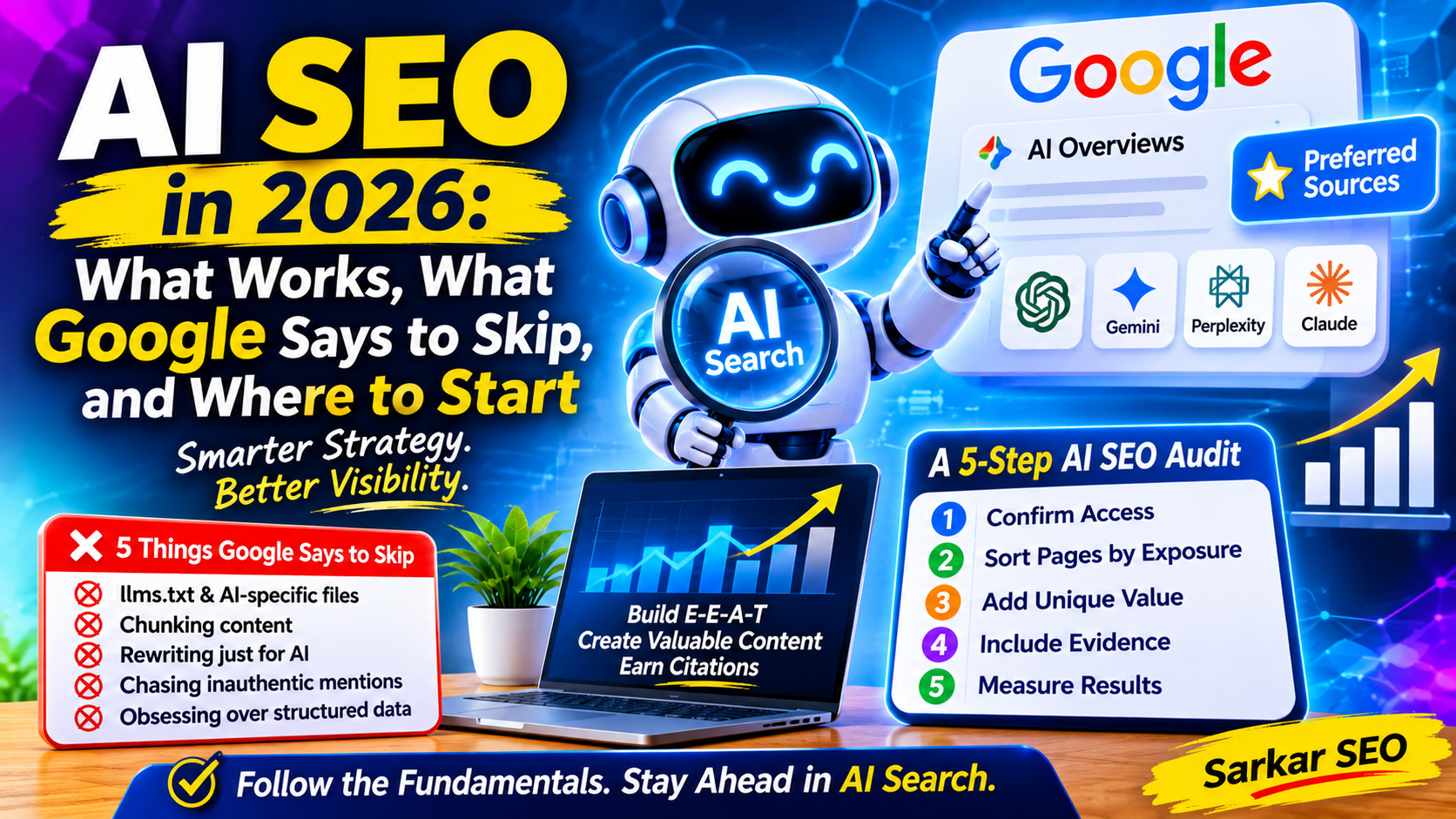
AI SEO is the work of making your pages easy to find, understand and cite in AI-driven search, from Google’s AI Overviews and AI Mode to ChatGPT, Perplexity, Gemini and Claude. For Google, the short answer is reassuring: its own May 2026 guidance says optimizing for generative AI search is still AI SEO. The longer answer is that earning clicks has changed, and the evidence behind popular tactics is easy to misread. At Sarkar SEO, the working view is simple: fundamentals first, experiments second, and no tactic without a source.
How Google’s AI features pick pages
You will see the labels AEO (answer engine optimization) and GEO (generative engine optimization). Google treats both as part of SEO.
Its AI Overviews and AI Mode lean on two techniques. Retrieval-augmented generation pulls relevant pages from the regular Search index to ground an answer. Query fan-out runs several related searches at once. Google’s own example: a question about fixing a weedy lawn can spawn searches on herbicides, chemical-free removal and prevention.
The consequence is that your page can be retrieved for a subtopic you never targeted. To be eligible, a page must be indexed and able to appear with a snippet. Google says there are no other technical requirements, though its guide adds that a site must be included in generative AI features in Search Console.
Five tactics Google says you can ignore
Google’s guide has a mythbusting section. For Google Search, you can skip:
- llms.txt and similar AI-specific files. Google ignores them, so they neither help nor harm.
- Chunking content into tiny pieces. It isn’t required, and there is no ideal page length.
- Rewriting content just for AI. The systems understand synonyms and meaning.
- Chasing inauthentic mentions. Less useful than it looks.
- Obsessing over structured data. It isn’t required, and no special schema is needed for AI features.
One caveat: this describes Google Search only. Other engines retrieve differently, so read the list as a statement about Google, not a universal law.
Why a top ranking no longer guarantees the click
Ahrefs reported that across 300,000 keywords, the top-ranking page earned a 58% lower click-through rate when an AI Overview appeared, comparing December 2023 with December 2025. Its 2025 edition of the study had found 34.5%.
Seer Interactive’s dataset (53 brands, 5.47 million queries, January 2025 to February 2026) adds nuance. Click-through was about 3.3% on searches without an AI Overview, about 2.1% on searches with one where the brand was cited, and about 0.9% where it wasn’t. Citation didn’t restore clicks, but it more than doubled them compared with being left out.
Exposure also depends on intent. Seer’s share of queries showing an AI Overview:
What citation research suggests beyond Google
A 2026 preprint by independent researchers tested 602 prompts across ChatGPT, Google AI Overview/Gemini and Perplexity. Average citations per answer were 6.88 for ChatGPT, 12.06 for Google and 16.35 for Perplexity. Pages that supplied definitions, numbers, comparisons or procedures had more influence on the final answer, while Q&A formatting alone showed slightly lower influence.
The caveats matter. It is a static snapshot, descriptive rather than causal, and its sources lean toward US, English-language sites. Sarkar SEO treats it as directional. Still, it fits Google’s advice: build pages that carry evidence, not pages dressed up as FAQs.
A five-step AI SEO audit for this week
Sarkar SEO recommends starting with a short audit you can finish in days.
- Confirm access. Check that robots.txt and your CDN allow crawling, key pages are indexed, and no stray nosnippet or tight max-snippet rule undermines snippet eligibility.
- Sort pages by exposure. List your top landing pages and mark which target comparison, question or informational queries. Those face the biggest click loss. A “how does it work” explainer is likelier to lose clicks than your pricing or service page, so protect the explainer’s value through citation and brand recall.
- Run the commodity test. Google’s own question: could a generic AI model write this page without your experience? If yes, add what only you have: original data, screenshots, process notes, mistakes and results. Google contrasts a commodity title like “7 Tips for First-Time Homebuyers” with a first-hand account of why one buyer waived the inspection and what it saved.
- Add evidence where it serves the reader. A clear definition, a sourced number, a comparison table, numbered steps. Skip FAQ blocks added for their own sake.
- Measure. Use Search Console’s Generative AI performance report for Google. Then run a monthly prompt panel: ten questions your buyers ask, put to ChatGPT, Perplexity and Gemini, noting whether your page is cited. Google warns that no third-party tool sees its internal ranking systems, so treat such tools as workflow aids, not truth.
One emerging area deserves a watching brief: AI agents that compare products or complete bookings for users. Google’s guide notes that browser agents read pages through screenshots, page structure and the accessibility tree, so clean, semantic HTML helps both agents and screen readers. If you sell online, it is worth a look. Otherwise, it can wait.
No technique guarantees a citation, and any single study, including those above, is one data point. Engines differ, change often, and Google itself says indexing and serving aren’t guaranteed, even for compliant pages. What compounds is accurate, experience-led content on a technically clean site, measured against the queries that matter. This reflects what the sources say as of November 2026; check them again before big decisions. If you’d like a second pair of eyes on your pages, Sarkar SEO is happy to walk through this audit with you.
