



AI SEO has two meanings. One is optimizing for AI search results. The other, covered here, is using AI tools to do AI SEO work faster. The short answer is that AI is genuinely useful for research and structure, and risky as an unsupervised publishing engine. Google judges what you publish, not which tool produced it, so the practical question is where human judgment must stay in the loop.
What Google Says About AI-Assisted Content
Google’s guidance on generative AI content says the technology can be useful for researching a topic and adding structure to original content. The same guidance warns that using AI tools to generate many pages without adding value for users may violate its spam policy on scaled content abuse. It also notes that AI output can contain inaccuracies, so every piece should be manually fact-checked and reviewed before publishing.
The policy is not aimed at AI specifically. Google introduced it in March 2024 and said it can act on scaled content abuse whether content is produced through automation, human effort or a mix of both. A content mill of human writers turning out near-identical pages is just as exposed as an unattended AI pipeline. The test is value added, not tool used.
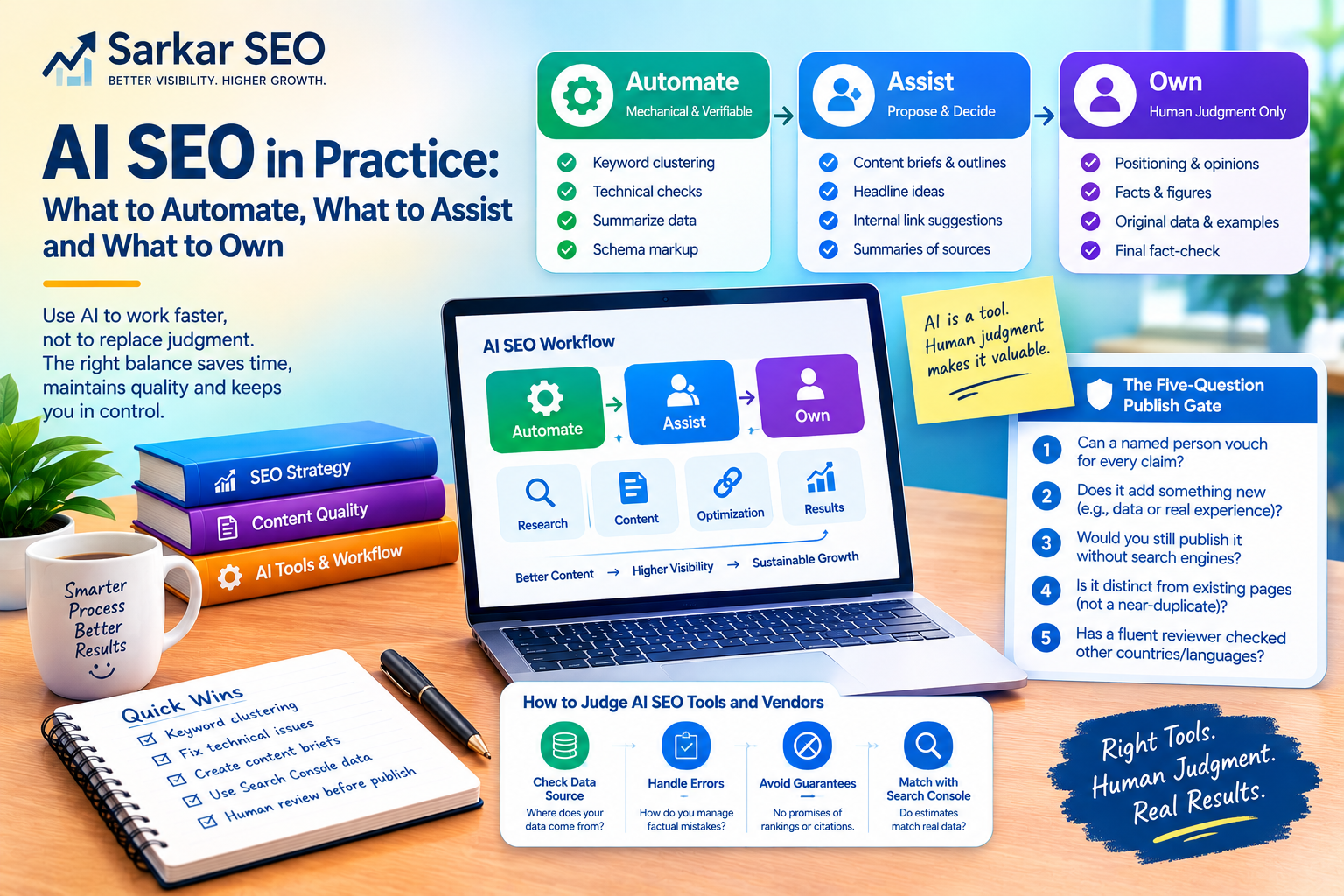
The Automate, Assist, Own Triage
The following framework is our own analysis, not a research finding. It sorts SEO tasks by how costly a mistake would be and how easily the output can be checked. Sarkar SEO uses this kind of triage to decide where AI belongs in a workflow.
Automate tasks that are mechanical and quickly verifiable:
- Clustering keyword exports into topic groups.
- Flagging missing titles, duplicate meta descriptions and broken redirects.
- Summarizing large Search Console or crawl exports.
- Drafting schema markup, which you then validate before deploying.
The rule: you can check the output against real data in minutes.
Assist covers tasks where AI proposes and a person decides:
- Content briefs and outlines.
- Alternative headlines and question mining.
- Internal link suggestions.
- First-pass summaries of long source material.
The rule: a human accepts or rejects each suggestion, rather than approving a finished batch. Drafting full articles belongs here only if a person supplies the experience, examples and verified facts. Drafting an entire article from a lone keyword is the pattern that most often goes wrong.
Own covers everything a human must hold accountable:
- Positioning and opinions.
- Every number, claim and quotation.
- Original data, case results and anything that depends on firsthand experience.
- The final fact-check.
The rule: if an error would mislead a customer or damage your reputation, a person writes or verifies it.
A Five-Question Publish Gate
Before any AI-assisted page goes live, ask:
- Can a named person vouch for every factual claim on it?
- Does it contain something not already in the top results, such as data, an example or lived experience?
- Would you still publish it if search engines did not exist?
- Is it clearly distinct from your other pages, rather than a templated near-duplicate?
- If it targets another country or language, has a fluent reviewer checked it? Tool quality can vary by language, so test rather than assume.
Sarkar SEO applies a gate like this because mistakes accumulate quietly. Hundreds of thin pages rarely hurt on day one, but they dilute a site over time. Periodically merge, improve or remove pages that fail the gate.
How to Judge AI SEO Tools and Vendors
In June 2026, Google added guidance on third-party SEO tools, services and advice. Its main points are worth knowing before you spend money:
- Google does not evaluate third-party services.
- Third-party tools do not have access to Google’s internal ranking data and cannot guarantee performance.
- Some tools present data that users misread as coming from Google.
- Google encourages everyone to use Search Console, its first-party tool, whether or not they use other tools.
The guidance also tells site owners to check whether advice on AI search, often sold as AEO or GEO, matches Google’s own guidance on generative AI features. It is not a blanket dismissal of outside services. Keyword tools, crawlers and rank trackers remain useful when you understand what they estimate.
Ask any vendor these questions:
- Where does your data come from, and how is it calculated?
- How do you handle factual errors in AI output?
- Do you promise rankings or AI citations? Treat a yes as a warning sign.
- Do your traffic or volume estimates broadly match what Search Console shows for pages we already have?
Sarkar SEO treats Search Console as the source of truth for Google performance and third-party scores as directional planning aids.
Where to Start
Choose one workflow, such as keyword clustering or technical audits, and place it in the Automate tier. Run it for 30 days and compare the time saved against any errors you caught. Then extend the approach to briefs. Keep the Own tier human throughout. If you want a second opinion on where AI fits in your processes, Sarkar SEO can review your workflow and publishing standards before you scale anything.
