



Every SEO team now faces the same question. AI can cluster keywords in minutes, draft briefs before lunch and summarise a competitor’s whole site. It can also help you publish a hundred forgettable pages and get your site demoted. The tool is the same in both cases. The difference is the judgment around it.
This guide looks at AI SEO as a working method: which tasks suit automation, where the risks sit, and how to build a process that stays safe as search rules tighten.
How teams actually use AI today
Adoption is high, but full automation is rare. In a 2026 Keyword.com survey of SEO agencies, in-house teams and freelancers, 87% of respondents said they use AI regularly or more extensively, yet only 1% described their work as fully automated. The sample was small, with 97 usable responses, so read it as a snapshot and not a census. keywordkeyword
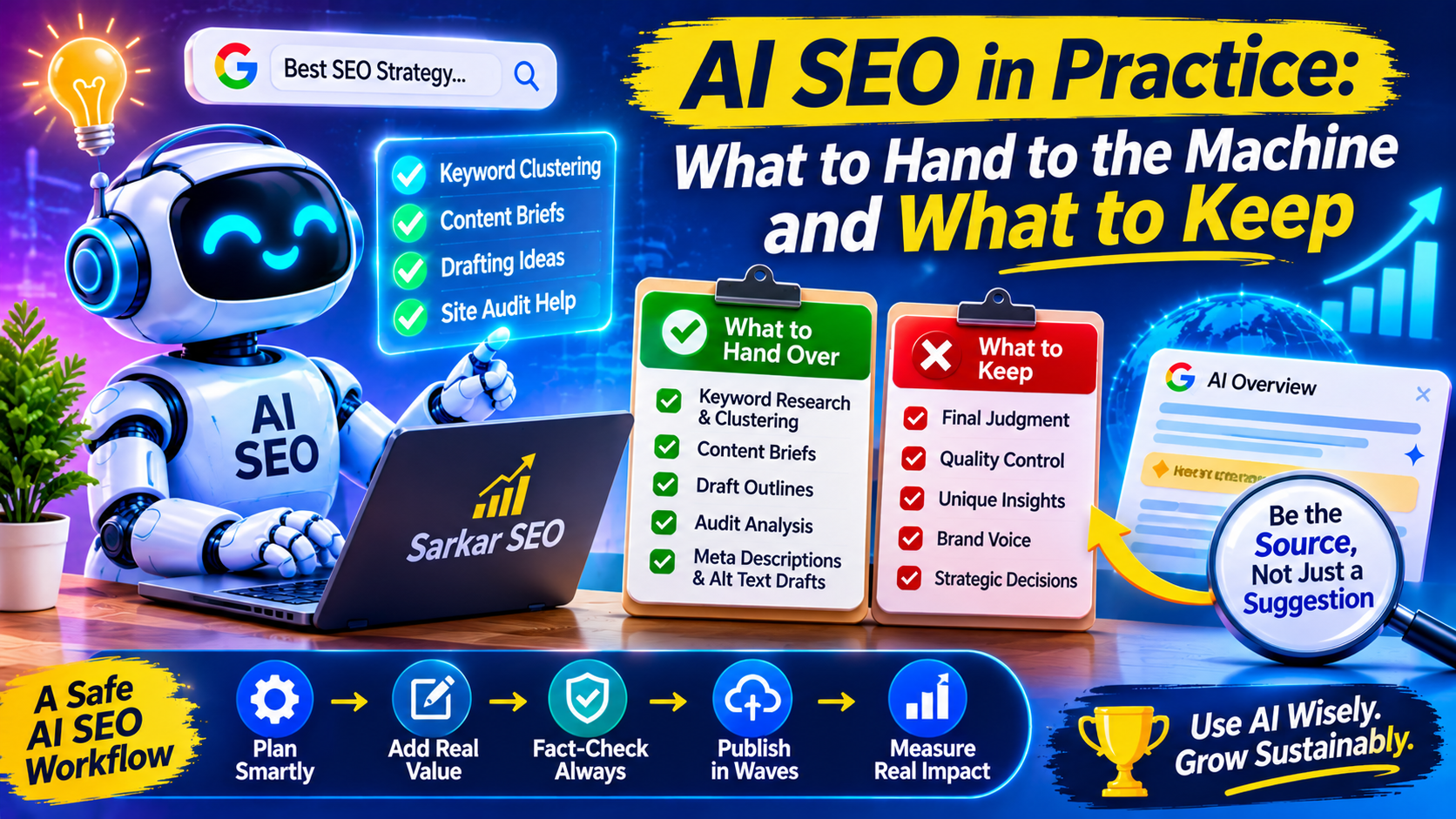
The task breakdown is telling. Respondents most often used AI for content briefs and outlines (77%), keyword research and clustering (68%), and content drafting (66%). Notice the pattern: AI mostly works before the decision point, gathering and organising material for a person to judge.
Teams also hold back deliberately. The most common reason for not automating a task was that quality was not good enough (57%), followed by distrust of accuracy (36%). That caution is healthy.
On time savings, one summary of the same survey reports that 89% of the 92 respondents who answered that question saved at least four hours a week, and it adds that this is survey evidence, not a guarantee for any single team.
Where AI earns its place
Keyword clustering and intent sorting. Grouping hundreds of search terms by meaning is slow by hand. One agency write-up calls AI clustering one of the clearest time savings in SEO workflows, with the advice to treat the output as a first draft. A person still decides which clusters deserve a page, which belong together, and which are not worth chasing. clientvenue
Brief building. A good brief lists the questions to answer, the angle, the sources and the intent. AI can assemble a rough version quickly. You supply what it cannot: knowledge of your customers, your product and the objections you hear on sales calls.
Audit triage. Crawl exports can run to thousands of rows. AI is useful for grouping issues by type and drafting plain-language explanations for stakeholders. Check the fixes yourself before shipping them.
Repetitive drafting. Meta descriptions, alt text drafts and report summaries are low-risk uses where speed matters more than voice.
Where AI SEO goes wrong
The danger is not that Google detects AI. Google’s stated position is that using AI is not itself the problem. According to one compliance guide, Google does not ban AI-generated content but warns that mass-generating pages without adding value may violate its scaled content abuse policy.
That policy matters more each year. Google’s spam policies describe it as generating many pages for the primary purpose of manipulating search rankings and not helping users. Reporting on the policy stresses that it applies no matter how the content is created. A human content farm and an AI content farm face the same standard.
Enforcement is active. A recap of 2026 says the June spam update, which relied on SpamBrain, hit scaled content abuse, site reputation abuse and manipulative links, and did not target AI content as such. A September 2026 spam update also lists scaled content abuse among the policies in scope. Spam policies have also been extended to AI answers: coverage of the update says they now officially cover AI Overviews and AI Mode. Blog / Content & E-E-A-T / AI content & penalties +2
The riskiest patterns are easy to spot:
- Hundreds of near-identical pages for keyword variants or cities. One industry write-up calls templated location pages with thin or duplicate copy a textbook case.
- Pages built for every conceivable follow-up question. One report on Google’s May 2026 guide says building pages for every fan-out variation primarily to manipulate rankings or AI answers violates the policy. Treat that as a secondary reading of the guide and check Google’s own wording.
- Invented authority. Fake author bios or fabricated first-hand stories are a trust problem. One ethics guide rates AI content that mimics first-person experience the author doesn’t have as misleading and a failure of E-E-A-T. This comes from a practitioner blog, not Google, but the logic is sound: people notice when experience is faked.
A workflow that stays safe
One page, one real question. Before drafting, write down who needs this page and what they’ll do after reading it. If you can’t answer, don’t publish it.
Add what AI can’t invent. Original data, screenshots from your own tests, client results you can document and honest opinions are the parts readers remember. A model can polish your insight. It cannot have one for you.
Fact-check every claim. AI tools state invented figures with the same confidence as real ones. Verify numbers and names against the original source, not against another AI summary.
Name a human owner. Every published page should have an editor who can answer for it. That also supports the trust signals that AI answer engines and search quality systems look for.
Publish in waves. Release a small batch, watch indexing and engagement, then expand. Sudden jumps from ten pages to a thousand are what spam systems are built to catch.
Audit what you already have. Old AI-assisted pages can quietly drag a site down. Merge, rewrite or remove thin ones.
Measuring whether it works
Count outcomes, not output. Pages published per week is a vanity metric. Better questions: which pages earn impressions that turn into clicks, which attract links or mentions from other sites, and which lead to enquiries or sales. Track time saved as well, since efficiency is a real benefit, but only after quality holds.
Sarkar SEO treats AI as a research assistant and a first-draft engine, never as the final author. That keeps the speed advantage without handing over responsibility for what goes live.
