



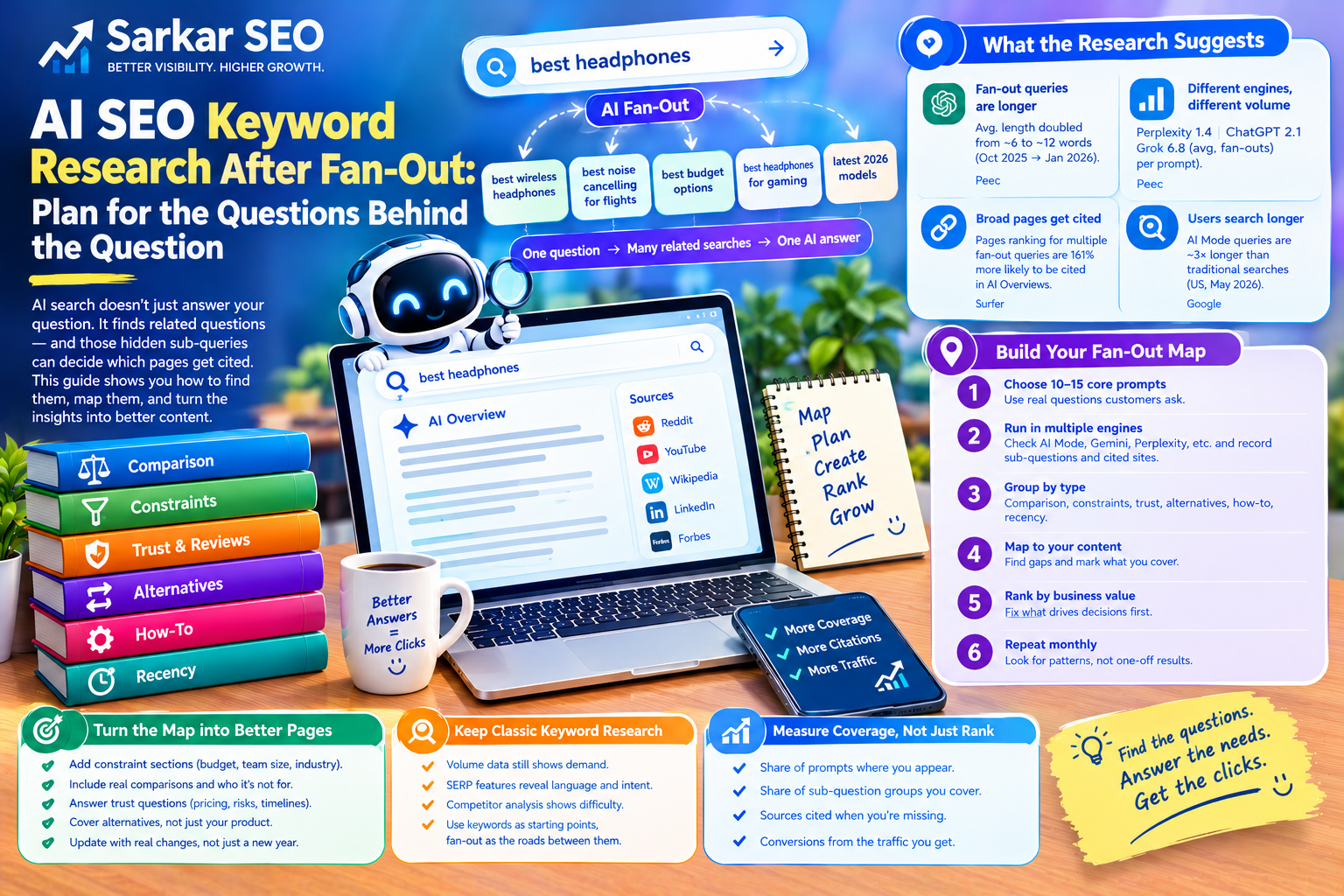
Keyword research was built for a simple model: one search, one list of results. AI search breaks that model. AI SEO single typed prompt can trigger a whole set of hidden searches, and your page may be chosen because it answers one of them, not the one the user typed. Sarkar SEO treats this as a research problem first and a writing problem second. If you cannot see the questions behind the question, you cannot build pages that answer them.
What happens after someone presses enter
The mechanism is called query fan-out. Google describes AI Mode as issuing multiple related searches concurrently across subtopics and data sources, then combining the results into one response. Other engines do a version of the same. A prompt like “best headphones” can fan out into hidden sub-queries such as best wireless headphones, best noise-cancelling for flights, best budget options and current-year variants.
The consequence for visibility is significant. In ChatGPT’s case, results are merged with an algorithm in which content that matches several fan-outs ranks higher. Winning one keyword matters less than being present across a cluster of related questions.
What the research suggests
Fan-out data is young and varies by method, so read the numbers as indications:
- Peec analyzed 5 million ChatGPT fan-outs and found that the engine inserts words such as “best”, “top” and “reviews,” and that fan-out queries doubled in length from about 6 to about 12 words between October 2025 and January 2026.
- Engines differ in volume. In the same dataset, Perplexity averaged 1.4 fan-outs per prompt, ChatGPT 2.1 and Grok 6.8.
- Other research reports much higher counts, with Seer Interactive and Nectiv finding an average of 9 to 11 fan-out queries per prompt. The gap likely reflects different engines, prompts and measurement. Complex prompts trigger more fan-out, and simple factual queries may not trigger it at all. ahrefsnogood
- A Surfer study found that pages ranking across several fan-out queries are 161% more likely to be cited in AI Overviews than pages ranking only for the main query. That is a correlation. Broadly strong pages tend to do well everywhere.
The searches themselves are also getting longer. One report cites Google’s own May 2026 usage data showing that the average AI Mode query in the US now runs triple the length of a traditional search query. searchenginejournal
Do not chase individual fan-outs
There is a trap here. Fan-out queries are unstable. Surfer found that only 27% of fan-out queries remain consistent across multiple runs of the same prompt. Treating one captured list as a fixed target means optimizing for noise.
Google’s guidance adds another warning. It says you do not need to chase every long-tail variation, since the systems understand synonyms and intent, and summaries of the guide report that scaled content built around fan-out queries is treated as spam. The goal is to understand patterns, not to publish a page per variant.
Build a fan-out map
This method gives you a repeatable view of how your topic gets researched:
- Choose 10 to 15 core prompts. Use real questions customers ask before buying, comparing or choosing, written the way people speak.
- Run them in several engines. Google AI Mode and Gemini show the sources they used, and a free simulator such as iPullRank’s Qforia can simulate fan-out for AI Overviews and AI Mode. Record the sub-questions and the sites cited.
- Group the sub-questions by type. Useful buckets include comparison, constraints (budget, size, location, skill level), trust (reviews, pricing, risks), alternatives, how-to steps and recency.
- Map each group to your content. Does a page answer it, and is the answer easy to find? Mark every gap.
- Rank gaps by business value. Fix the ones tied to decisions first. Ignore trivia no customer would pay to resolve.
- Repeat monthly. Since fan-out shifts between runs, look for patterns that appear again and again.
Run the same prompt several times. A sub-question that shows up in every run is a stable need. One that appears once is noise.
Turn the map into better pages
Most gaps close inside existing pages, not in new ones. A well-built guide can answer the follow-ups its reader will have:
- Add constraint sections: “if you have a small budget”, “if you manage a team of five”, “if you are in a regulated industry”.
- Add honest comparisons with real criteria, including who a product or approach is not suited for.
- Address trust questions directly: pricing ranges, risks, limits, timelines, what can go wrong.
- Describe alternatives instead of hoping readers never consider them.
- Update dated material with real changes, not just a new year in the title.
Build a separate page only when a sub-question is a distinct need that deserves a full, original answer.
Keep classic keyword research
Fan-out does not make keyword research obsolete. A Similarweb practitioner writing on this topic argues that declaring traditional keyword research dead is lazy. Volume data, SERP features and competitor analysis still show demand, language and difficulty. Think of keywords as the map’s starting points and fan-out as the roads between them.
Measure coverage, not just rank
Rank for one phrase says little about this behavior. Track instead:
- The share of your core prompts in which your brand or pages appear.
- The share of mapped sub-question groups your content answers well.
- The sources cited when you are missing, so you know who is filling the gap.
- Conversions from the visits you do receive.
Sarkar SEO suggests keeping this in a simple sheet: prompts down the side, engines across the top, and a note on whether you appeared and who did instead.
