



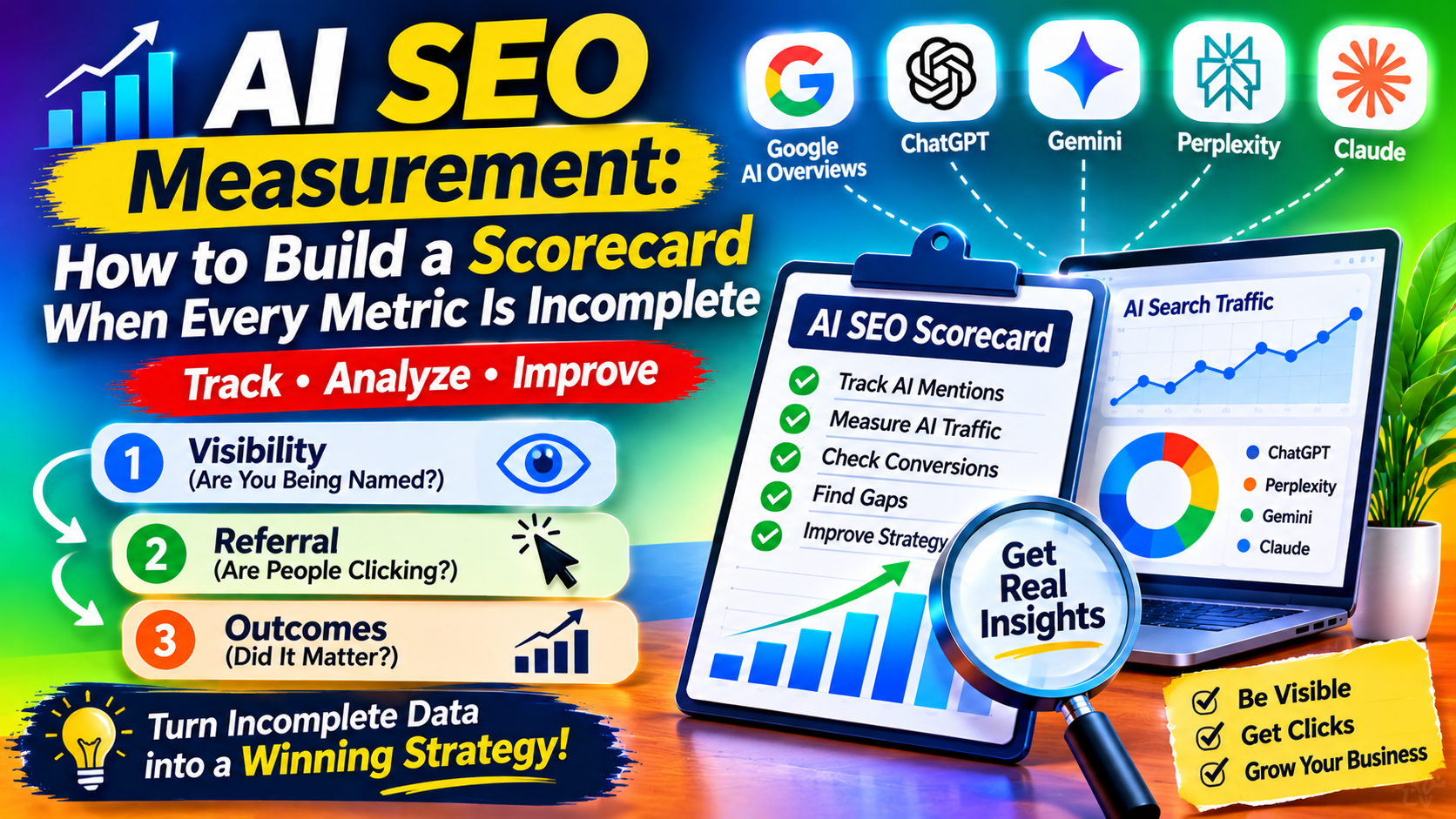
Ask ten marketers how their AI SEO is performing and you will get ten confident answers built on shaky numbers. The tools that report on AI search are new, partial and sometimes misleading. That does not mean you cannot measure. It means you need a method that treats every figure as evidence rather than a verdict. At Sarkar SEO, we build reporting this way: three layers, each honest about what it cannot see.
Why the Familiar Dashboard Misleads
Traditional SEO reporting assumes a page ranks, gets seen, and earns a click. AI answers break each link in that chain. Someone can read a complete answer, absorb your brand name, and never visit.
Google’s own reporting shows the strain. Its generative AI report in Search Console reached all sites globally at the end of August 2026, and per Search Engine Journal, it focuses mainly on impressions, and its figures are a filtered subset of the regular search report. That second point matters: adding the two together double-counts. An early rollout also showed AI Overviews and AI Mode combined, without click or query data. searchenginejournalsearchenginejournal
The limits go further. A commentator quoted in the same coverage noted that an impression can be counted even when a user never saw the link, and that position reflects the AI block rather than your link within it. Google’s John Mueller agreed that position is hard to report usefully for these features. Use the data, but never mistake it for a ranking report.
Layer One: Visibility (Are You Being Named?)
Start with Search Console, then add what it cannot tell you: what the assistants actually say.
Build a prompt panel. This is a fixed list of 20 to 30 questions your ideal customers would genuinely ask, spanning broad, comparison and “which should I choose” intents. Each month, run the identical wording through the assistants you care about and log:
- Whether your brand appears at all
- Which of your URLs, if any, was cited
- How you were described, accurately or not
- Which competitors appeared alongside you
Run each prompt a few times, because answers vary between sessions. Record the date and your location, and keep the list stable so month-to-month changes mean something. The panel is manual and small, but it answers the question no dashboard can: what does a buyer actually see?
Layer Two: Referral (Are People Clicking Through?)
Clicks are the part you can count, though never completely. Practitioner guides report that GA4 added a native AI Assistant channel in May 2026, but it covers only a narrow slice, since many AI tools omit referrer data, so the result should be treated as a floor on real volume.
A custom channel group helps. Match referrer sources such as chatgpt.com, perplexity.ai, claude.ai, gemini.google.com and copilot.microsoft.com, and place that channel above generic Referral so visits match it first. Also understand the blind spots:
- ChatGPT’s mobile app traffic often lands in Direct, and Google AI Overviews visits are filed under Organic Search with no separation.
- Clicks from AI answers tend to land on specific guides and FAQs. If you see a rise in Direct visits to deep, hard-to-type URLs, that is a clue worth investigating, not proof.
Layer Three: Outcomes (Did It Matter?)
Visibility and visits only count if they connect to revenue. Because attribution is leaky, add human signals:
- Include a “How did you hear about us?” field with options such as “ChatGPT or another AI assistant” and “Google AI answer.”
- Ask sales teams to note when a prospect arrives already knowing your pricing model or name.
- Watch branded search and direct inquiries in the weeks after you appear in your prompt panel.
- Compare conversion rate and engagement for identified AI visitors against your other channels. Do not assume they are higher.
These are imperfect, but three imperfect signals pointing the same way are far more persuasive than one precise-looking chart.
Rules for Honest Reporting
- Label floors as floors. Write “at least” next to AI referral counts.
- Report trends, not totals. Direction over months is more reliable than any single number.
- Never add overlapping reports. Search Console’s AI view sits inside the Web data.
- Be wary of borrowed authority. Google’s guidance warns that no third-party tool has access to its internal ranking or AI systems. Use such tools for workflow, not as ground truth.
- Pair numbers with the prompt panel. Where figures and observed answers disagree, investigate both.
