



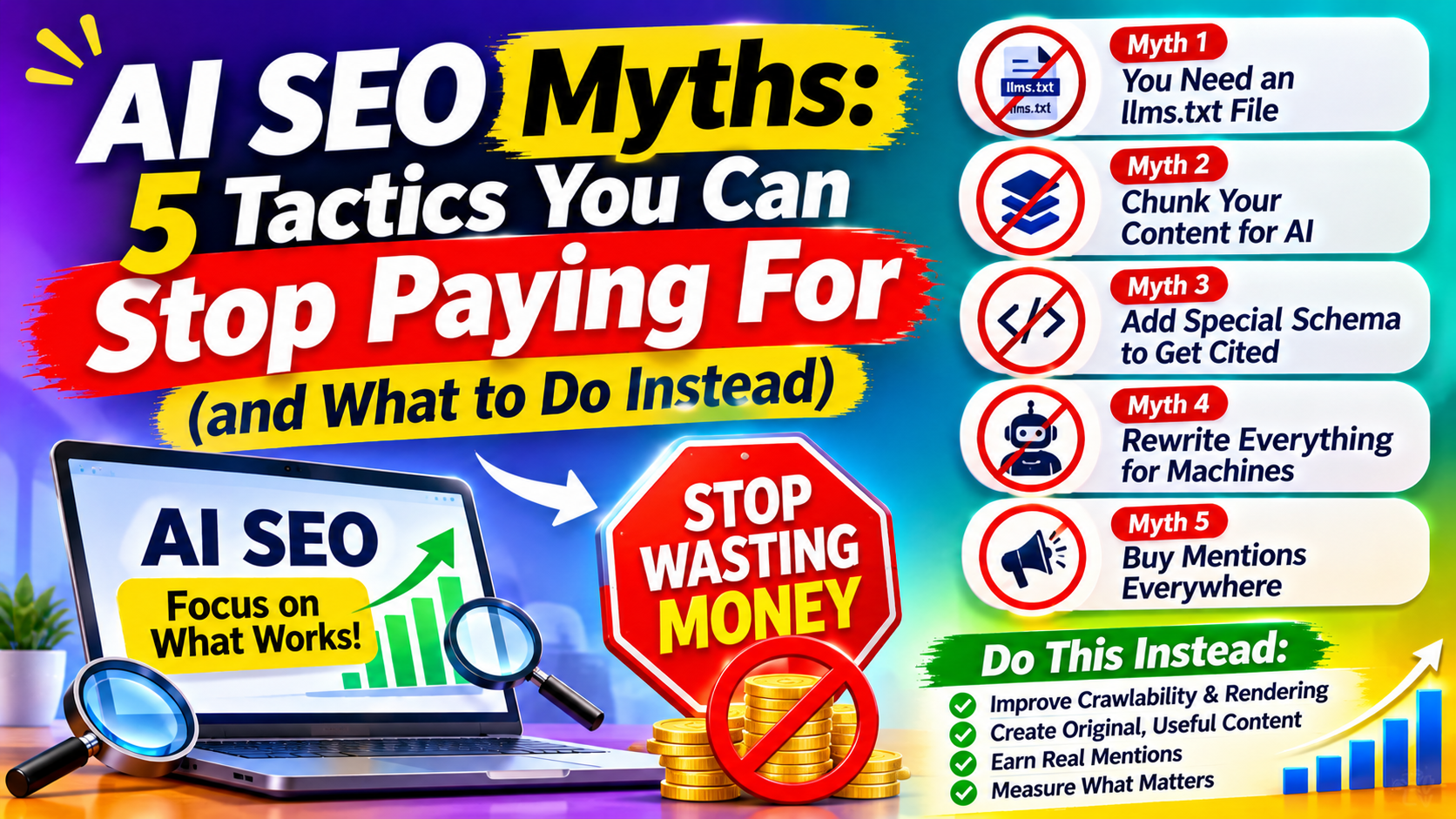
AI SEO has produced a fast-growing industry of “must-have” fixes. Some are sold as software, some as monthly retainers, and many are sold with confidence that outruns the evidence. Before you spend time or budget, it helps to know which popular tactics hold up and which don’t.
This article takes the skeptic’s view. It examines five common AI SEO claims, what the evidence says, and what deserves your effort instead.
Where the Myths Come From
Whenever a new search interface appears, a shortcut market follows. The common pitch is that AI systems read the web differently from people, so you need special files, special formatting and special rewrites. It sounds reasonable. Much of it is untested.
Google addressed this directly. Its official guide includes a section on myths, and it names five tactics you can ignore for Google Search: machine-readable files such as llms.txt, content chunking, AI-specific rewriting, inauthentic mentions, and an over-focus on structured data. One caveat applies throughout. That guide covers AI Overviews and AI Mode, not standalone Gemini, ChatGPT, Perplexity or Claude, and the signals across those systems are not identical. searchenginejournalcxl
Myth 1: “You Need an llms.txt File”
The idea is that a text file telling AI crawlers what to read works like robots.txt for language models. Google’s position is blunt. It says you don’t need new machine-readable files, AI text files, markup or Markdown to appear in generative AI search. Search doesn’t use these files to determine visibility, so adding one neither helps nor harms.
Creating one is harmless and cheap, so there is no reason to fear it. The mistake is paying for it as a growth lever or treating it as a deliverable worth a retainer. For Google, it isn’t.
Myth 2: “Chunk Your Content for AI”
Chunking means splitting articles into tiny, self-contained pieces on the theory that models retrieve small passages. Google’s guide says there is no requirement to break content into small pieces for AI systems.
That doesn’t mean structure is irrelevant. Clear headings and direct answers help human readers and still make passages easier to understand. The difference is intent. Write for clarity first. Don’t fragment a good page into disconnected snippets that no person would enjoy reading.
Myth 3: “Add Special Schema to Get Cited”
Structured data is useful, but the claim that it works as an AI citation magnet is weak. Google says structured data isn’t required for generative AI search and that no special schema.org markup needs adding, though it recommends continuing to use it for rich-result eligibility. One developer guide adds that structured data remains worth using and may help non-Google engines. searchenginejournalsanity
So keep your markup accurate and matched to visible content, and skip the idea that more markup means more citations. Technical health still matters more. A related warning from one analysis: if Googlebot can’t render the page, no amount of structured data saves you.
Myth 4: “Rewrite Everything for Machines”
AI-specific rewriting assumes models prefer a different style than people. The evidence doesn’t support abandoning human-first writing. Google’s guide lists AI-specific rewrites among tactics you can ignore, and what it positively recommends is original value: non-commodity content is the key to appearing in AI Overviews and AI Mode.
A rewrite for “machines” usually produces blander text, and bland text is what AI systems can already generate themselves. At Sarkar SEO, we push clients in the opposite direction: more first-hand detail, clearer opinions and proof that a real person knows the subject.
Myth 5: “Buy Mentions Everywhere”
This is the most nuanced one. Google warns against gaming mentions, and its guide lists inauthentic mentions among things to skip. Yet the same commentary notes that authentic off-site visibility keeps surfacing as a primary driver of AI visibility across four independent studies.
The reconciliation is simple. Real mentions earned through useful work help. Manufactured ones are a risk. Contribute expertise, publish research others want to cite, and be accurate about who you are.
A Quick Way to Audit an AI SEO Vendor
Google’s guidance gives you a practical filter. If a consultant’s core deliverable is llms.txt files and content chunking, it is fair to ask why. Use these questions:
- What evidence shows this tactic works on the engines my customers use?
- Is the result measured by citations or traffic, or only by tasks completed?
- Which part of the work improves the site for human visitors?
- How will we test whether it worked, and over what period?
- What happens if the tactic is ignored by search engines entirely?
A good provider answers plainly. A weak one retreats into jargon.
What Deserves Your Budget Instead
Spend where the evidence is steadiest.
Crawlability and rendering. Confirm pages are indexed and render fully. This is basic, and it blocks everything else when it fails.
Original content with a point of view. Publish what others can’t copy: your data, your process, your mistakes and what you learned from them.
Clear answers to real questions. Lead sections with the answer, then add depth. This helps people and machines without turning the page into fragments.
Authentic reputation. Earn genuine coverage, reviews and expert mentions over time.
Measurement. Track whether engines actually cite you for questions that matter. Without that, every tactic is guesswork.
This is the order of work Sarkar SEO follows: fix the foundation, create something worth citing, then verify results.
The Limits of This Advice
Be careful with absolutes in either direction. Google’s statements describe Google’s systems. Other engines may behave differently, and cheap experiments like an llms.txt file can be reasonable if you treat them as low-cost tests rather than strategy. Systems also change, so revisit any conclusion periodically.
The core point is proportion. Don’t spend your best resources on unproven tricks while your pages remain thin, slow or generic.
