



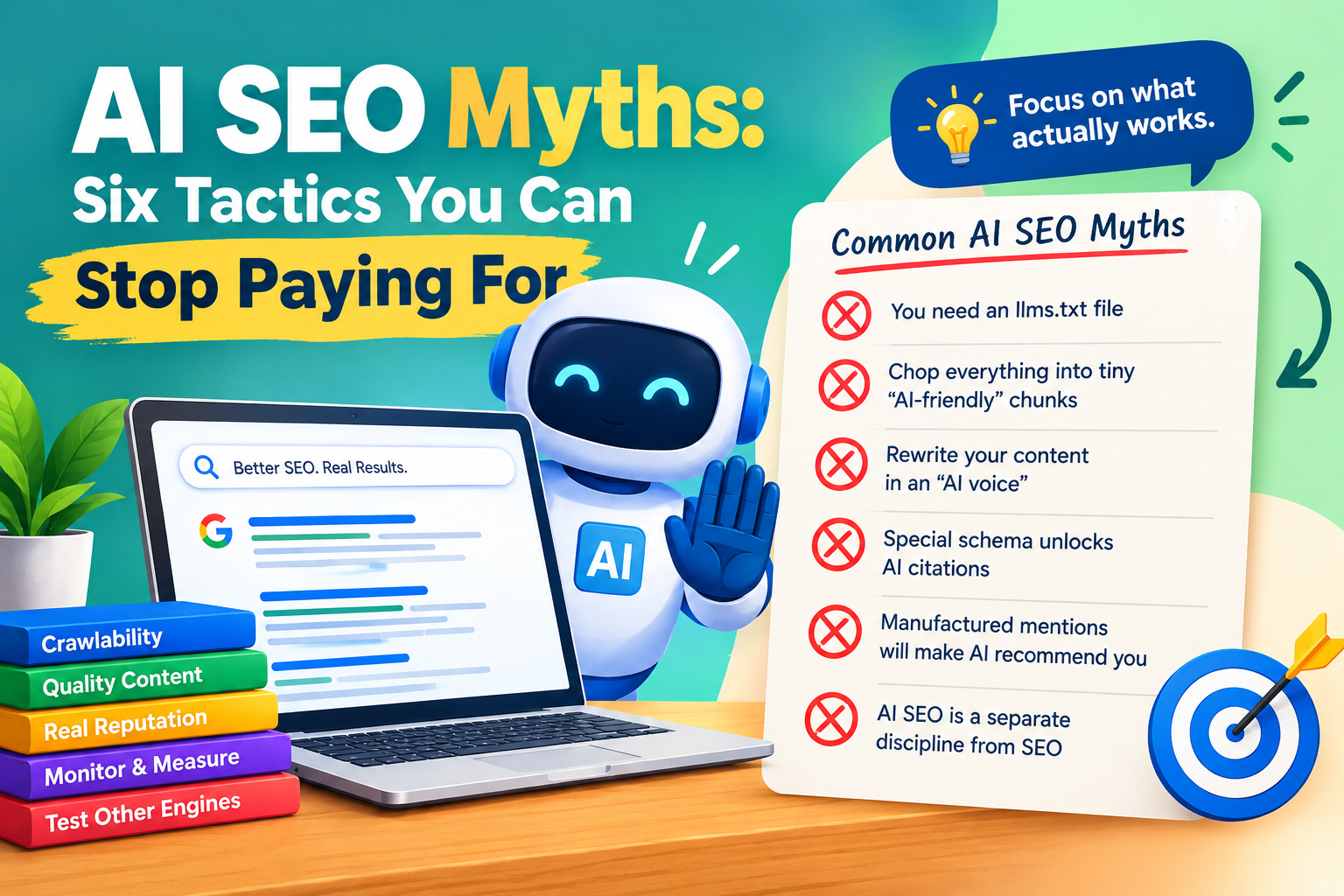
Every few months, a new “must-do” appears in AI SEO. A special file, a rewritten page format, a trick for getting mentioned by chatbots. Agencies add it to service menus before anyone checks whether it works. Sarkar SEO takes a different approach: test every popular claim against what search engines and platforms have actually said. This guide does that for six common AI SEO tactics.
Why Google’s May 2026 guide changed the conversation
For two years, advice about AI search came mostly from vendors and bloggers. That changed when Google added an official Search Central page on optimizing for AI Overviews and AI Mode on May 15, 2026. It treats the new labels as a rebrand of an old job, stating that optimizing for generative AI search is optimizing for the search experience, and thus still SEO. linkedinsearchenginejournal
The page also contains a section titled “Mythbusting generative AI search: what you don’t need to do.” Several items from it are covered below. Keep one limit in mind: the guidance describes Google Search, not every answer engine.
Myth 1: You need an llms.txt file
The llms.txt idea is a proposed file meant to give AI systems a curated map of your site. Plugins added one-click generators and agencies sold the setup. Google’s guide is blunt: you don’t need new machine-readable files, AI text files, markup or Markdown to appear in generative AI search.
Google’s position was already visible in 2025. In June of that year, John Mueller said no AI system currently uses llms.txt. Independent log data points the same way. Ahrefs reportedly analyzed 137,000 domains and found 97% of llms.txt files received zero requests in May 2026. That figure comes from secondary reporting, so treat it as supporting evidence rather than a final verdict. seroundtableletsdatascience
There is one narrow use. Mueller suggested it might help an agent already on a site to navigate or finish a task. That is about agents completing jobs, not about ranking or citation.
Myth 2: Chop everything into tiny “AI-friendly” chunks
Some guides tell writers to break every page into short, isolated blocks. Google disagrees: there is no requirement to break content into tiny pieces, and no ideal page length. The sensible conclusion is that length and structure should follow the reader’s need. Clear headings still help people. Fragmenting a page for a machine does not give it a special advantage.
Myth 3: Rewrite your content in an “AI voice”
Another claim says pages need a particular phrasing or keyword variants to be understood. Google’s guide counters that you don’t need to write in a specific way just for generative AI search. A summary of the guide adds that AI features can understand synonyms and general meanings. If your page answers the question clearly in natural language, rewriting it for a model adds cost without adding value.
Myth 4: Special schema unlocks AI citations
Structured data is still useful for rich results. But Google says it isn’t required for generative AI search, and no special schema.org markup is needed. An independent review of the guide goes a step further, noting that research has not established that extra schema or llms.txt increases AI citations. Use markup where it describes your content accurately. Don’t expect it to work as a shortcut.
Myth 5: Manufactured mentions will make AI recommend you
This one is the most tempting and the riskiest. Some sellers promise to plant brand mentions across forums and directories so that AI systems pick them up. Google warns that inauthentic mentions are unlikely to help, because generative features rely on the same systems and spam safeguards as core ranking. A mention that exists only to be scraped is the kind of signal those systems are built to discount.
Myth 6: AI SEO is a separate discipline from SEO
The labels vary by company. Google acknowledges that “AEO” and “GEO” exist as terms. Microsoft’s Bing documentation uses “generative engine optimization,” yet says SEO fundamentals support eligibility for AI-generated experiences. Across both, the foundation is the same: pages must be crawlable, indexable and genuinely useful. The new vocabulary describes where results appear, not a different craft.
What to do instead
If the tricks are mostly noise, where should the budget go? Based on the sources above, five things hold up.
- Check crawlability first. Google’s guide says its generative models use publicly accessible, crawlable content to ground responses. If a page can’t be fetched and indexed, nothing else matters.
- Publish things worth citing. Original data, firsthand testing, clear definitions and honest comparisons give a summary something that a generic rewrite can’t replace.
- Build real reputation. Earn mentions the old-fashioned way: useful work, genuine coverage, happy customers who talk about you.
- Monitor with the right tool. Google points site owners to a Generative AI performance report in Search Console. Check it before buying a third-party dashboard that estimates the same thing.
- Test other engines separately. Run your target questions in ChatGPT, Perplexity, Gemini and Claude on a schedule, and log the date and prompt each time.
That last step matters because Google’s guidance doesn’t automatically extend to other platforms. Sarkar SEO’s recommendation is to treat any claim about those engines as unproven until the platform itself documents it. Several vendors have published their own crawler and retrieval rules, and those documents are the place to look.
How to evaluate the next AI SEO claim
Before paying for a new tactic, ask four questions:
- Has the search engine or AI platform documented it, or is it only a vendor’s theory?
- Is there independent data, such as server logs or controlled tests, rather than screenshots of one lucky result?
- Does it also improve the page for human readers?
- Would you be comfortable if a competitor saw exactly what you did?
A tactic that fails the first two questions is probably a bet, not a strategy.
