



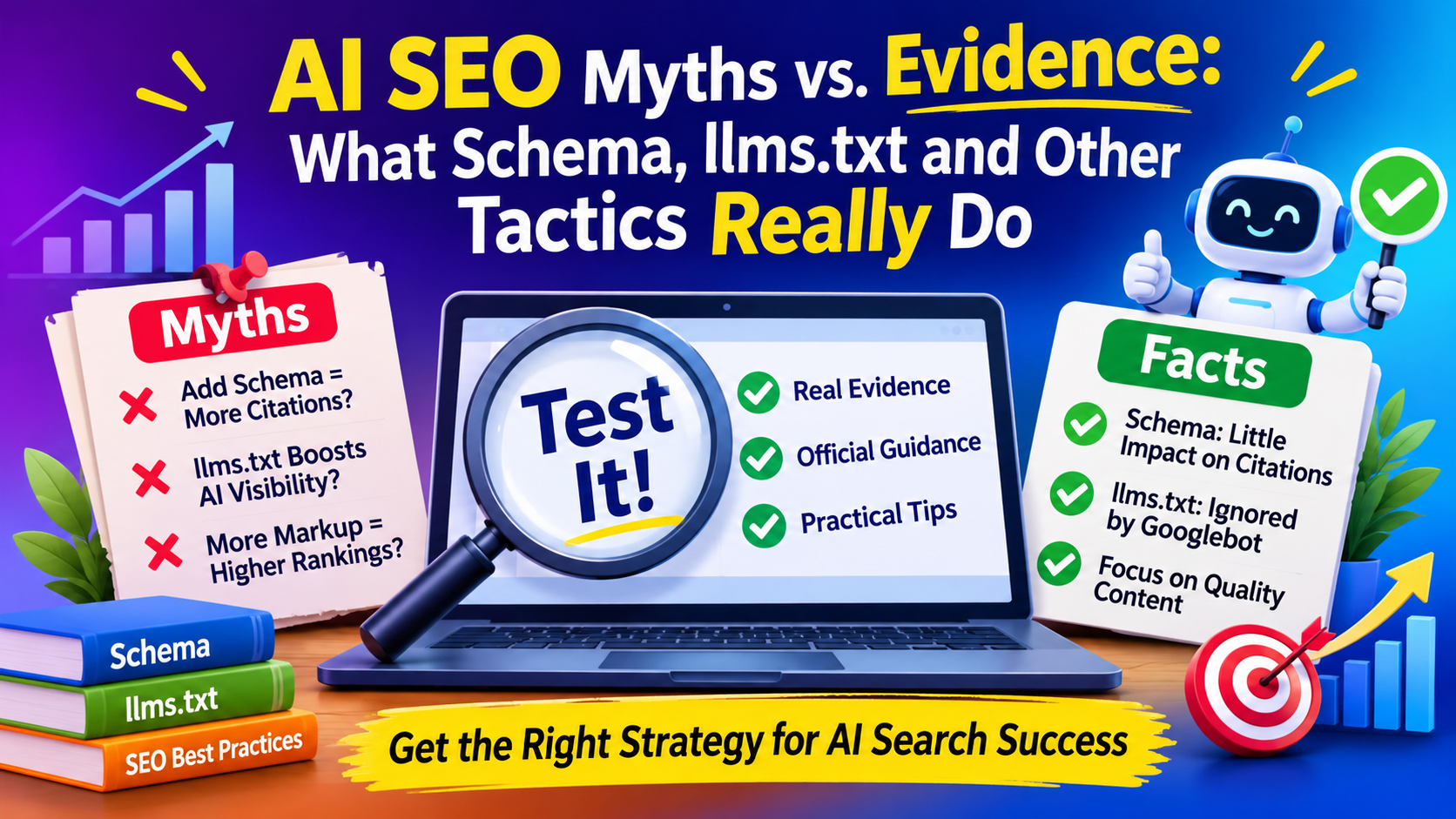
Every few weeks, a new “secret” for getting cited by ChatGPT or Google AI SEO Overviews starts circulating. Add this file. Add that markup. Rewrite your pages this way. Most are sold with confidence and very little proof.
This guide takes a different approach. Instead of listing tactics, it shows how to test the claims behind them, using two of the most popular recommendations, schema markup and llms.txt, as worked examples.
Why Bad Advice Spreads So Easily
AI search is new, the platforms are opaque, and nobody outside them can see exactly why one page is cited and another is not. That gap gets filled with theories, and the theories often come from people who sell the fix.
The most common error is mistaking correlation for cause. Take the schema story. Ahrefs analysed 6 million URLs and found AI-cited pages were almost three times more likely to contain JSON-LD. It looks like proof. But strong pages tend to be well-built pages, and well-built pages tend to have markup. The markup could be a symptom of quality rather than the reason for the citation. strategicrevenue
Test Case One: Schema Markup
Ahrefs did something rare: it ran a follow-up experiment. The study tracked 1,885 pages that added JSON-LD between August 2025 and March 2026 and compared them with about 4,000 control pages, finding no meaningful citation uplift across Google AI Overviews, AI Mode or ChatGPT. A chart summarising it reports changes of +2.2% on ChatGPT, +2.4% on AI Mode and -4.6% on AI Overviews, all close to zero.
Other work points the same way. A Search Atlas analysis of citations across OpenAI, Gemini and Perplexity found that domains with extensive markup were cited no more often than those with little or none.
Now read the limits, because they matter. Every page in the Ahrefs dataset already had 100 or more AI Overview citations before schema was added, so those pages were already inside the consideration set. The study also does not cover pages that AI systems cannot see at all. For such pages, schema might still help them get crawled, parsed or indexed.
So the fair conclusion is narrow. Adding schema to a page that already performs is not an unlock. That is not the same as “schema is useless.” Google continues to recommend structured data because it can help pages qualify for traditional rich results. Keep your product, article and organisation markup accurate. Just do not pay a premium for it as an AI citation tactic.
Test Case Two: llms.txt
This one has a stronger answer, because the platform spoke. According to Search Engine Journal’s analysis of Google’s guide, Googlebot reads your HTML and ignores llms.txt entirely, so the file does not change what gets cited in AI Overviews or AI Mode. A separate agency reports it tested the file itself and found no measurable effect on AI citations. searchenginejournalsomethinginc
The scope is again important. That statement concerns Google Search. It says nothing certain about every other assistant or about future agents that might read such files. If you want to experiment because the file costs little, that is a defensible choice, as long as you describe it honestly as an experiment.
A Warning About Planted Evidence
One finding shows why even clever tests need care. According to a write-up, Mark Williams-Cook planted a fake company’s address only inside deliberately invalid JSON-LD, and both ChatGPT and Perplexity repeated it. That suggests some systems may read markup text as plain text. It does not show that markup earns more citations, and it also reminds us that wrong data placed in markup can be repeated as fact. Keep markup truthful.
Five Questions to Ask Before Believing an AI SEO Claim
Use this checklist on any tactic, from any author, including us.
- Was there a control group? A before-and-after on a few pages proves little, since rankings, news and seasons all move at once. Look for matched pages that did not change.
- Is the sample large enough? A dozen pages cannot support a sweeping rule.
- Does the source sell the remedy? Vendors can still be right, but they deserve a second source. Be especially wary of figures that circulate without a traceable original. One review found that numbers such as “schema triples your citations” circulate through vendor decks and secondhand chains, and none traces to a controlled study.
- Does the result cover your situation? A test on pages that already rank says little about a new site.
- Has the platform said anything on the record? Official guidance outranks a theory. Even then, check its scope. One platform’s statement does not cover another.
What Has Better Support
Rather than chase unproven files, focus on the points where evidence and official guidance agree. Google’s own message, as summarised by Search Engine Journal, is that AI features still rest on ordinary SEO foundations. One practitioner study of large citation datasets suggests that original editorial content accounted for 81% of news citations, while syndicated press releases accounted for 0.04%. I only saw this through a secondary summary, so verify it, but the principle fits common sense: original reporting and first-hand information get used; reprints do not.
Practically, that means:
- Make pages crawlable and indexable before anything else.
- Publish information that does not exist elsewhere: your own data, tests, pricing and case notes.
- Keep facts consistent and current across your site.
- Measure whether you appear, instead of assuming a tactic worked.
How to Run Your Own Small Test
You do not need a research budget. Pick ten similar pages. Change an element on five, such as adding a clear summary paragraph or updating outdated facts, and leave five alone. Record, before and after, whether each appears when you ask the same questions in several assistants. Repeat across several weeks because answers vary. It will not be scientific, but it is far better than guessing.
Where Sarkar SEO Stands
We would rather tell a client “this will not move the needle” than sell a tactic on hope. At Sarkar SEO, we sort recommendations into three groups: backed by official guidance, supported by controlled evidence, and still unproven. The unproven group gets small experiments, never a big budget.
