



Every few months, search produces a new “must-have” tactic. Right now it’s AI SEO. Vendors sell special files, rewritten pages and bolt-on markup, all promising a shortcut into AI-generated answers. Some of it is useful. Much of it is noise.
This guide tests the most common claims against what Google has said publicly and what independent data shows, so you can spend time and money where it counts.
First, a Working Definition
AI SEO means improving a website so that search engines and AI assistants can find, understand and cite it. Google’s own position is that this isn’t a new craft. One summary of its 2026 guidance says optimizing for AI Overviews and AI Mode remains part of SEO rather than a separate discipline. Keep that in mind as we go through the myths. letsdatascience
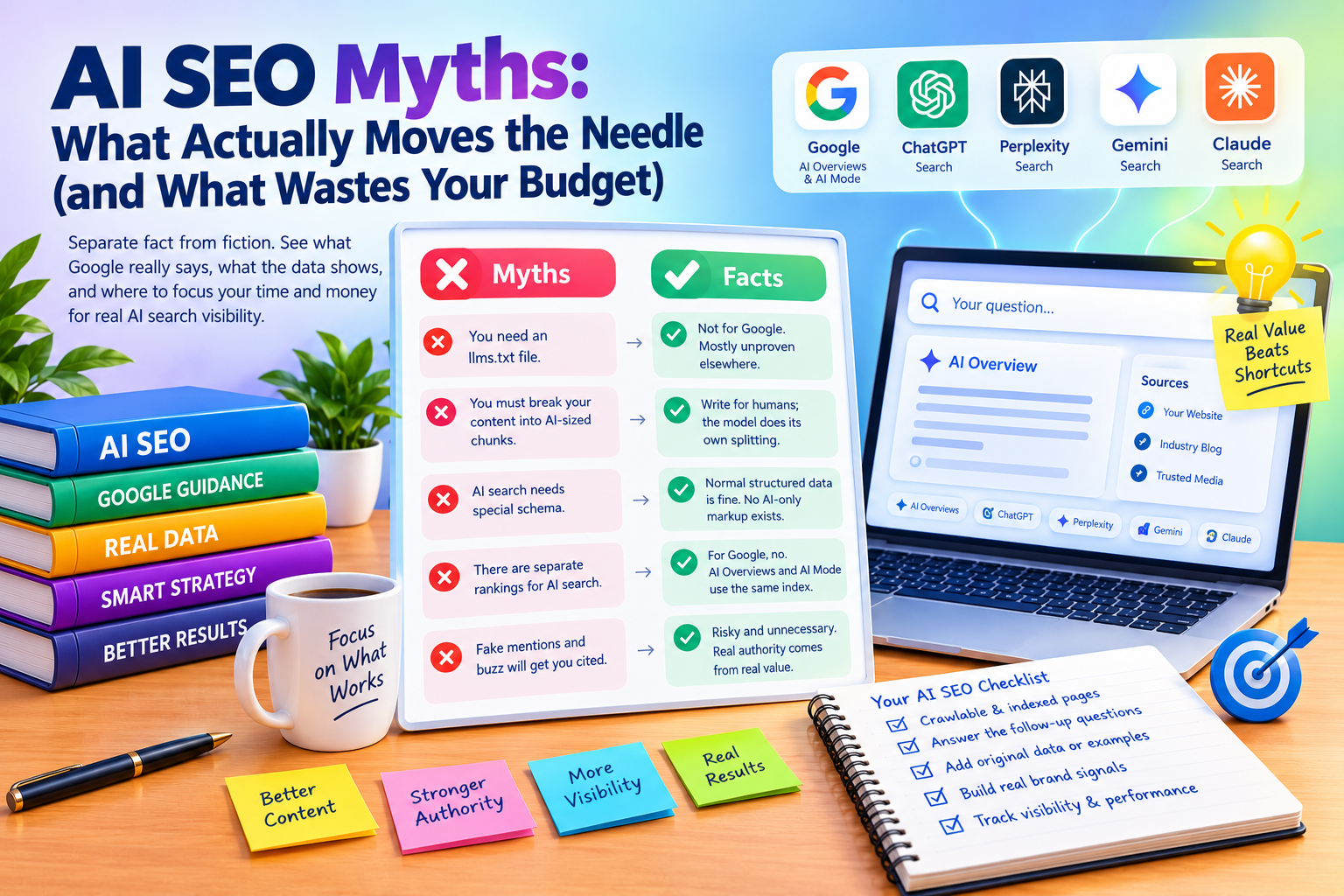
Myth 1: “You need an llms.txt file”
Verdict: Not for Google. Mostly unproven elsewhere.
llms.txt is a proposed plain-text file meant to summarize your site for language models. It has attracted enormous attention, but the evidence is thin.
Google’s May 2026 optimization guide lists it among things you don’t need. One analysis of the guide notes that Google Search ignores such files, so adding one neither helps nor harms rankings. That follows an earlier statement: in July 2025, Google’s Gary Illyes said at Search Central Live that Google doesn’t support llms.txt and has no plans to. indiehackersoptimizely
What about other AI crawlers? Roughly 10 percent of sites have created the file, but AI bots request it in just 0.1 percent of cases. One monitoring study counted 84 requests for llms.txt among more than 62,100 AI bot visits.
There is a counterpoint worth knowing. Some practitioners argue these files can surface in retrieval and are cheap for agents to read. Google’s Chrome team even audits for it in Lighthouse, a message that sits awkwardly beside the Search guidance. So the fair conclusion is: harmless to add, but don’t expect traffic from it, and don’t pay for it as a growth strategy.
Myth 2: “Break your content into AI-sized chunks”
Verdict: Write for humans; the model does its own splitting.
Chunking advice often arrives with oddly precise word counts. But retrieval systems divide pages on their side. As one explainer puts it, when an AI search engine processes your page, the chunking happens on its side of the fence. Google’s guide tells site owners they can ignore the tactic, according to the same source.
What this does not mean is that structure is irrelevant. Clear headings, short paragraphs and logical order help readers, and readers are who you are writing for. Just don’t engineer paragraphs to hit a number.
Myth 3: “AI search needs special schema”
Verdict: Accurate markup is fine; AI-only markup doesn’t exist.
Google says no special schema is required for AI features beyond the normal structured data that already helps search engines understand your content. The practical rule: mark up what is genuinely on the page, keep it consistent with visible text, and stop there. Structured data that describes content users can’t see invites problems.
Myth 4: “AI search is a separate game with separate rankings”
Verdict: For Google, no.
There’s no separate index. Analyses of Google’s guidance state that there is no separate “AI ranking”: AI Overviews and AI Mode pull from the same Google index as regular Search. If a page can’t rank or be indexed, it won’t be cited.
Other assistants are different. Each has its own crawler, partners and retrieval method, and they change often. Don’t assume tactics for one transfer to another.
Myth 5: “Fake mentions and manufactured buzz will get you cited”
Verdict: Risky and unnecessary.
Google’s guide specifically calls out pursuing inauthentic mentions as something to skip. Real mentions, such as being quoted by journalists, listed by industry bodies or recommended by customers, come from being worth mentioning. That’s slower, but it compounds.
What Actually Works: Three Things Rarely Discussed
If special files and formatting tricks are mostly noise, where should effort go? Beyond the usual advice on crawlability and helpful content, three less obvious areas deliver.
- Own the “second question.” AI answers are built from several related searches, not just the headline query. Review your top pages and ask what a buyer would ask right after reading. If that follow-up isn’t answered on your site, someone else’s page will be cited instead. Sarkar SEO’s approach to content audits starts here, because the gaps between questions are where competitors are weakest.
- Publish something that can’t be summarized from elsewhere. A pricing benchmark, an internal test, a survey of your customers, a documented before-and-after. Original material is the only content that models and people both need to cite you for. If you have no original data yet, say so honestly in your content and start collecting it.
- Make your brand easy to verify. Consistent business details, named authors with real credentials, and an “about” page that proves who you are all help any system, human or machine, decide whether to trust you. It’s unglamorous work, but it is the foundation of credible AI visibility.
A Quick Test for Any AI SEO Claim
Before buying a tool or following a tip, ask four questions:
- Is there a primary source? Look for a platform’s own documentation, not a screenshot or a thread.
- Is there independent data? One vendor’s study of its own customers is a hint, not proof.
- Does it help a human reader? If not, it’s likely a workaround that will expire.
- What does it cost to be wrong? Cheap experiments are fine. Expensive overhauls need stronger evidence.
What to Do Next
Skip the new-file gold rush and run a simple three-step check:
- Confirm your key pages are crawlable and indexed.
- Rewrite one page per week to answer its most obvious follow-up questions.
- Test your target questions in two or three assistants each month and record whether you appear.
Sarkar SEO advises clients to treat AI visibility as a measurement problem before a tactics problem. If you don’t know where you stand today, no new technique can prove it worked.
