



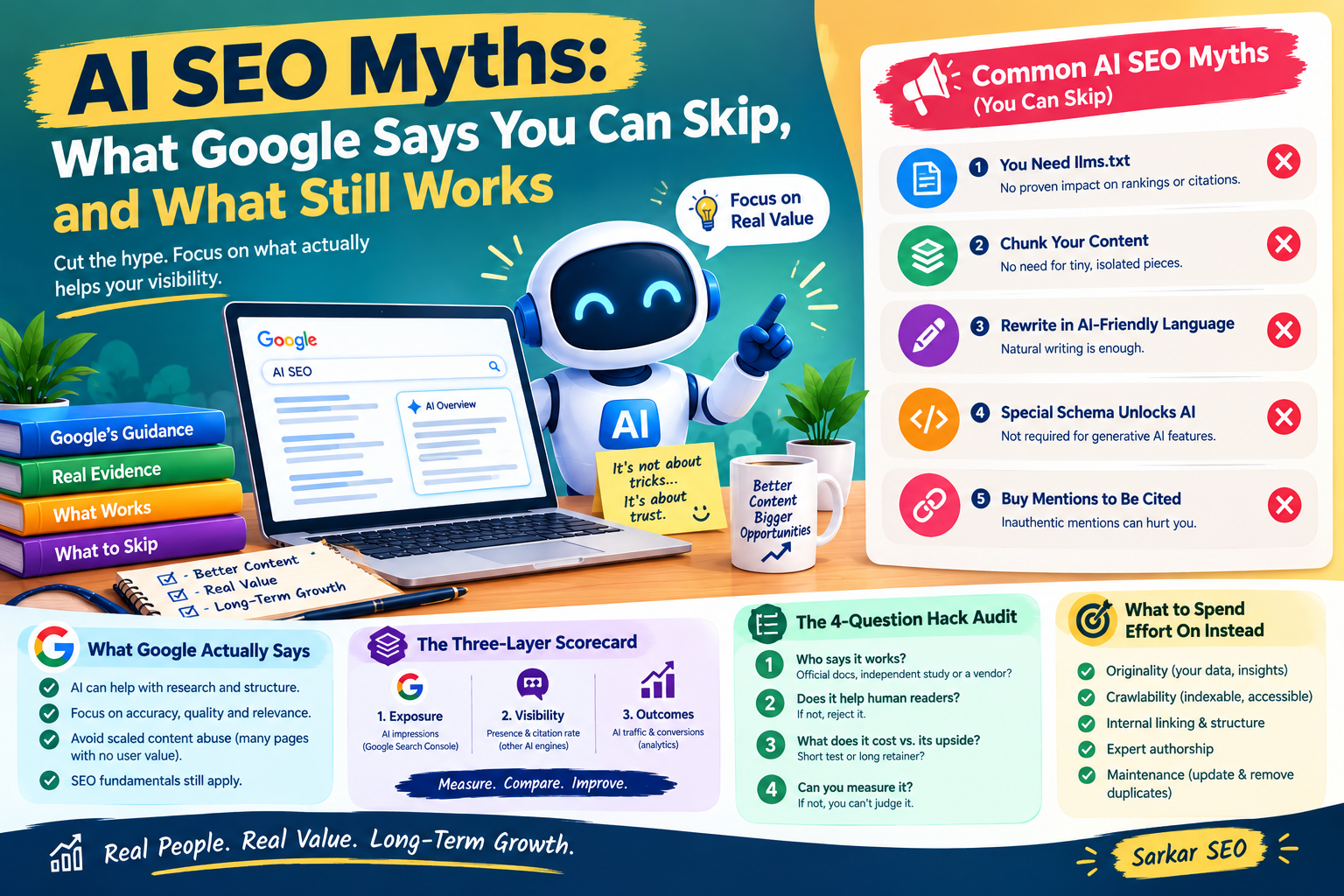
The AI SEO market has produced a long list of “must-do” tactics: llms.txt files, content chunking, special schema, AI-friendly rewrites. In May 2026, Google published its first official guide to optimizing for AI Overviews and AI Mode, and a large part of it tells site owners what they do not need to do.
This article sorts the popular claims into what the evidence supports, what it doesn’t, and what remains uncertain.
What Google Said
On May 15, 2026, Google published a guide to optimizing for generative AI features in Search. I could not retrieve the original page directly, so I worked from several independent write-ups that quote and summarize it consistently, including Search Engine Roundtable. Their accounts agree that the guide includes a “mythbusting” section listing things you don’t need to do: create llms.txt files or special AI markup, break content into chunks, rewrite pages for AI systems, seek inauthentic brand mentions, or overfocus on structured data.
The positive advice is plain. SEO fundamentals still apply, content should be helpful and people-first, and Google separates “commodity” content, which anyone could assemble from existing pages, from non-commodity content built on original research, direct experience, or proprietary data. That is worth reading as a standard for your own pages.
Myth 1: “You Need llms.txt”
llms.txt is a proposed file that summarizes a site for language models. The evidence for it as a visibility tactic is thin:
- SE Ranking analyzed about 300,000 domains and found the file on roughly one in ten, with no clear effect on AI citation frequency.
- Ahrefs reportedly checked server logs on 137,210 domains and found 97% of valid llms.txt files received no requests in the study month.
- Otterly’s test, as summarized by Optimizely, recorded 84 llms.txt requests among more than 62,100 AI bot visits.
- Google says it does not use the file for Search, and in June 2026 logged a clarification to that effect in its documentation changelog, according to one analyst.
No major AI platform has publicly confirmed reading it when building answers. The file may still help coding agents that fetch documentation, so developer-facing sites can reasonably keep one. For everyone else, it takes minutes to add and should never be sold as a growth strategy. Sarkar SEO treats it as optional housekeeping, not a ranking lever.
Myth 2: “Chunk Your Content for AI”
Chunking means splitting text into tiny, self-contained pieces so models can lift them cleanly. Google’s guide says there is no requirement to do this, because its systems can already understand a page covering several topics and surface the relevant part.
Be careful about what this does and doesn’t rule out. It does not tell you to write messy pages. Clear headings, direct answers, and logical order help human readers, and that has always been good practice. What it rules out is restructuring everything into artificial fragments purely for machines. The test is simple: if a change makes the page worse for a person, skip it.
Myth 3: “Rewrite Everything in AI-Friendly Language”
Some vendors recommend repeating every question phrasing and keyword variation so models can match them. Google says this is unnecessary, noting that its systems understand synonyms and meaning, and one commentary on the guide warns that overdoing it could drift into scaled content abuse. Write naturally, answer the real question, and move on.
Myth 4: “Special Schema Unlocks AI Answers”
According to the guide’s summaries, structured data is not required for generative AI features, and there is no special markup to add. Schema remains useful for rich results and for clarifying entities, so don’t delete it. Just don’t expect it to be an AI switch, and don’t pay premium rates for it as one.
Myth 5: “Buy Mentions to Be Cited”
Google lists inauthentic mentions among the things to avoid. This is consistent with a cautious reading of the research on citations: independent coverage correlates with AI visibility, but manufactured coverage is a different thing, and engineered signals carry risk with little proven upside.
Where the Guide Stops
Two limits matter. First, the guide covers Google’s AI Overviews and AI Mode only. ChatGPT, Perplexity, Claude, and others run their own systems, and Google’s statements are not evidence about how they behave. Treat any claim of a universal rule with suspicion, whether it says a tactic works everywhere or nowhere.
Second, absence of proof isn’t proof of absence. A tactic with no measured effect today could matter later. The sensible stance is to separate cheap, harmless tests from costly commitments.
A Four-Question Hack Audit
Before paying for or implementing any AI SEO tactic, ask these questions. This is my own checklist, not an industry standard.
- Who says it works? Is it the platform’s documentation, an independent study with a stated sample, or a seller of the service?
- Does it help human readers? If a person would find the page worse, reject it.
- What does it cost versus its upside? A ten-minute file is a different decision from a quarterly retainer line item.
- Can you measure it? If you can’t define a result, you can’t judge the spend.
Run your current plan through these four questions. Anything that fails two or more is a candidate for cutting.
What to Spend Effort On Instead
The reliable work is unglamorous:
- Originality. Publish what only you can: first-party data, real outcomes, and a clear point of view. Google’s commodity versus non-commodity framing is the best test I’ve seen for this.
- Crawlability. Make sure important content is accessible and indexed. Google’s guide notes that AI can process JavaScript-rendered content only when it isn’t blocked and calls that route more complex, so serve key text in plain HTML where you can.
- Internal linking and site structure. These help both people and crawlers find related material.
- Expert authorship. Show who wrote the page and why they know the subject.
- Maintenance. Update pages when facts change and remove duplicates.
None of these requires a new acronym.
