



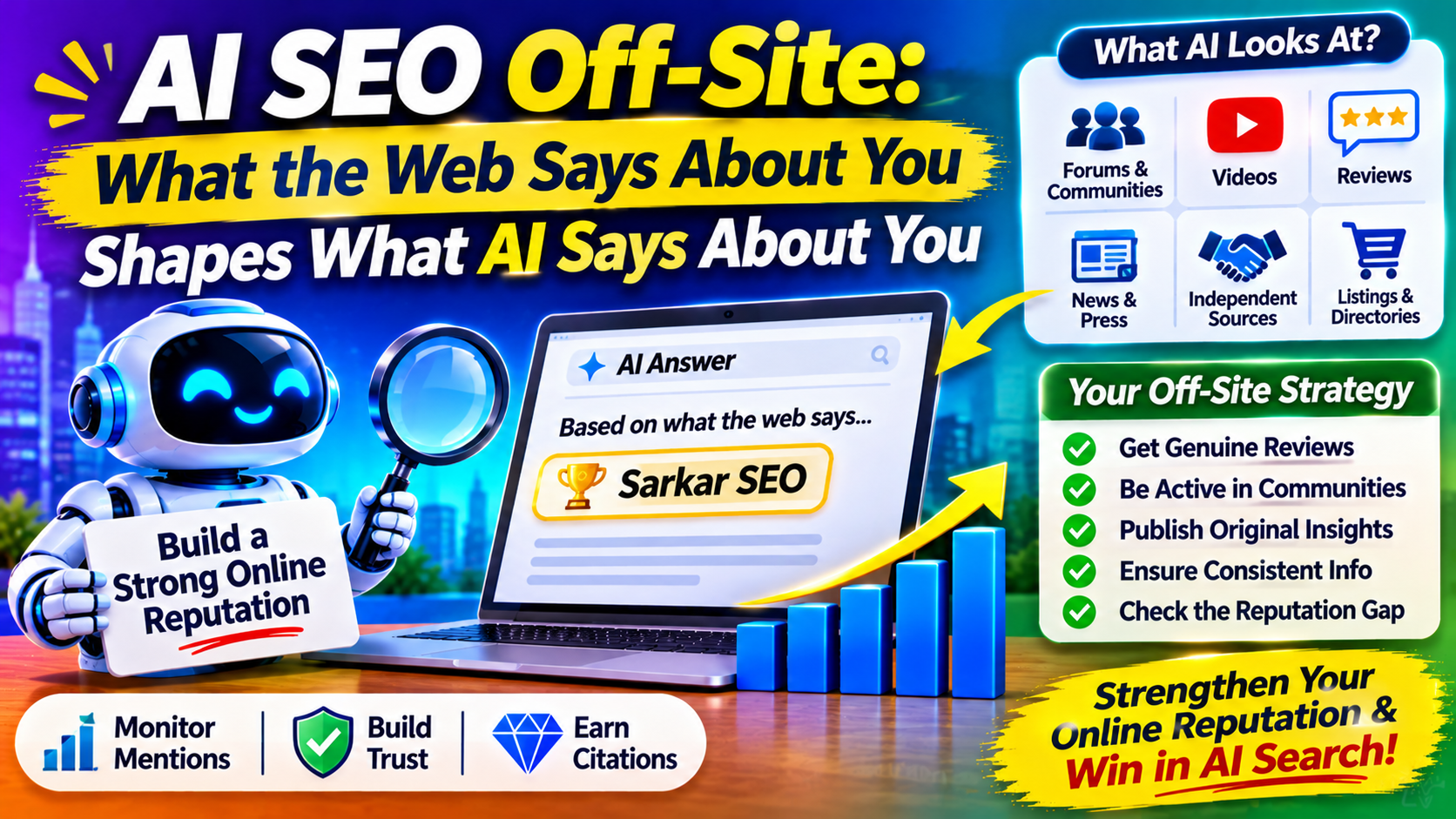
When someone asks an AI assistant to recommend a provider, it rarely repeats your homepage. It assembles an answer from what the wider web says about you: review sites, forums, videos, press and reference pages. That makes AI SEO partly a reputation discipline, and most brands are only working on half of it. At Sarkar SEO, we start these projects by asking a blunt question: if your website vanished tomorrow, what evidence of your quality would still exist?
Your Website Is Only Part of the Evidence
Studies of AI citations keep reaching the same uncomfortable conclusion. A Search Engine Journal roundup of AI visibility research reported that about 85% of brand mentions originate from third-party pages rather than owned domains, and roughly 48% of citations come from community platforms like Reddit and YouTube.
Treat figures like these as directional. Most come from software vendors with their own methods and commercial interests, and the numbers differ from study to study. Google’s guidance supports the underlying idea, though: its AI features can show what is being said about products and services across the web, including in blogs, videos and forum discussions.
The Mix Depends on What You Sell
One sponsored analysis from the vendor Trendos reviewed 107 million AI answers across ChatGPT, Perplexity, Gemini and Google AI Overviews. It sorted sources into three groups and found a revealing pattern:
- Community content made up close to half of the leading citations in all three industries studied.
- B2B IT services relied heavily on independent sources, with owned sources at just 2% and independent editorial and reference sources, such as review directories, at 47%.
- Consumer goods flipped the picture: brand, retail and owned sources took 46%, while independent editorial nearly vanished at 4%.
The report also found the engines behave differently, with Google AI Overviews leaning social, ChatGPT leaning editorial, and Gemini depending on the industry. Because the study was sponsored by a company selling citation tracking, weigh it as one input, not a law. Its practical lesson still holds: there is no universal off-site playbook.
The Source Ledger
Instead of guessing, build a source ledger for your market. It is a different exercise from tracking your own mentions, because it studies the ecosystem around you.
- Write 15 questions a buyer asks just before choosing.
- Run them through the assistants your customers use.
- Record every domain cited, one row each, including competitors’ sources.
- Sort each domain into one of three buckets: community, commercial or owned, and independent editorial or reference.
- Highlight where you are absent and where a competitor is present.
The dominant bucket tells you where your effort belongs. A software firm may find review directories matter most. A product seller may find marketplace listings and reviews carry the answer. Either way, you stop spreading effort evenly across channels that do not influence your buyers.
Earn It, Don’t Engineer It
The temptation is obvious: manufacture mentions. Google’s guidance warns against it, saying that seeking inauthentic mentions across the web is not as helpful as it might seem, because its ranking systems focus on high-quality content while other systems block spam. google
Legitimate work looks slower but compounds:
- Claim and fully complete the profiles on the directories your buyers actually use.
- Ask real, satisfied customers for reviews, and reply to critical ones helpfully.
- Take part in communities by answering questions openly, with your affiliation disclosed.
- Publish original data or analysis that journalists and creators genuinely want to cite.
- If your brand merits a reference entry, support corrections with independent sources instead of editing your own page, since conflict-of-interest rules discourage that.
What to avoid: fake reviews, undisclosed paid endorsements and sockpuppet accounts. They carry legal and reputational risk, and they work against the very trust AI answers draw on.
The Reputation Gap Check
Here is an exercise most teams skip. Compare three things side by side: what your website claims, what customers say in reviews and forums, and what AI answers currently say about you. Gaps are diagnostic. If your site promises fast support and reviews describe slow replies, no amount of content will fix the answer. The product or service must change first, and the evidence will follow.
This also catches the reverse problem: strengths that customers praise but your own site barely mentions. Those are quick wins, because you can document them with real quotes and results.
