



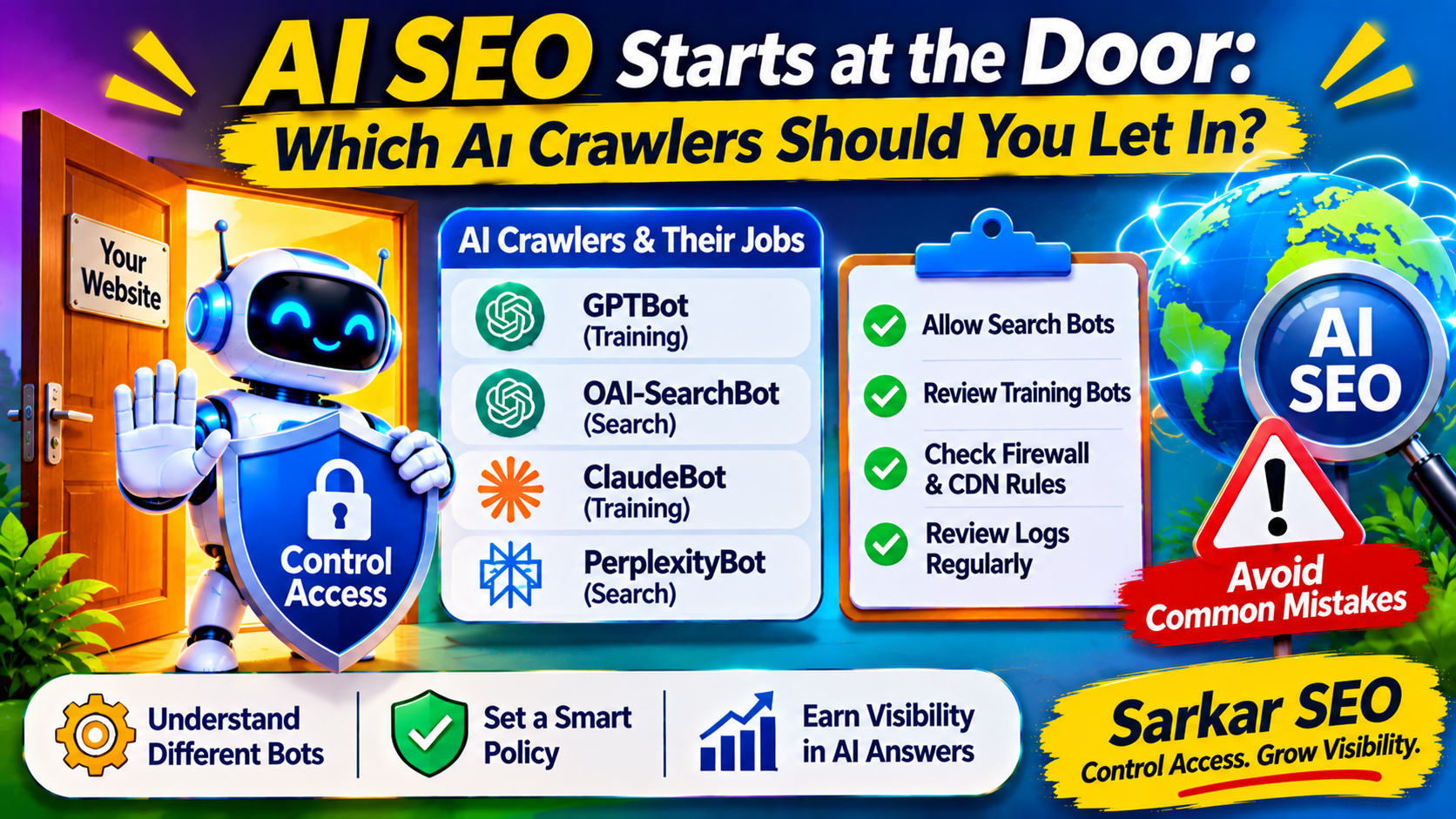
Before an AI tool can cite your site, its crawler has to be allowed to reach it, and not every AI crawler does the same job. Some collect training data, some build a search index, and some fetch a page only when a user asks. Blocking the wrong one can remove you from answers you wanted to appear in.
Sarkar SEO sees this as the most overlooked layer of AI SEO: access control. Great content cannot earn a citation from a system that was never allowed to read it.
The three jobs AI crawlers do
Major AI companies now separate their bots by purpose, and the labels matter more than the brand names.
Training bots gather content that may help build future models. Search bots index pages so an AI product can surface them in answers. User-triggered agents visit a page in real time because someone asked a question.
OpenAI’s documentation shows the split clearly. GPTBot is tied to model training. OAI-SearchBot surfaces sites in ChatGPT’s search features. ChatGPT-User acts on a person’s request. OpenAI states that each setting is independent, so a site can allow search while blocking training.
Anthropic describes a similar structure. ClaudeBot collects content for model development, Claude-User may retrieve pages when someone asks Claude a question, and Claude-SearchBot supports search quality.
Google works differently
Google-Extended is a robots.txt token that lets you opt out of Gemini model training and Gemini grounding. According to Marie Haynes, summarizing Google’s own statements in 2025, it does not affect inclusion in Google Search and is not a ranking signal. It also does not remove you from AI Overviews or AI Mode, because they are part of Search.
That leaves a hard trade-off. The only control mentioned for limiting AI features in Search is a snippet restriction such as nosnippet, which also removes your normal search snippets. For most businesses that cost is too high.
Three mistakes that quietly cost visibility
Blanket blocking. A rule written in 2024 to stop “AI scraping” may block search bots too. Review it against the table above.
Blocking at the wrong layer. Anthropic warns that blocking its IP addresses may not work reliably, because the bot then cannot read your robots.txt file. Firewalls and bot-protection tools at the CDN level can also override a friendly robots.txt, so check that layer separately.
Treating all bots as one policy. Training and retrieval are different decisions, and combining them forces a bad trade.
What about llms.txt?
Many guides suggest adding an llms.txt file. The evidence is weak. One secondary summary reports a correlation study of about 300,000 domains that found no link between publishing the file and AI citation frequency. It also reports a server-log study of roughly 900 domains where GPTBot, ClaudeBot, PerplexityBot and Google-Extended made zero requests for it. Google has said its Search ignores the file.
I could not verify those underlying studies directly, and logs cannot rule out unannounced agents. So treat llms.txt as optional housekeeping, perhaps useful for developer documentation, never as a citation strategy.
Choose a policy by business model
There is no universal setting. Sarkar SEO’s rule of thumb is to match access to what you sell and where your customers look for answers.
- Lead-generation and service businesses: Allow search and user-triggered bots. Visibility in answers is the point, and your content exists to be found. Training access is a separate choice.
- Publishers and paywalled sites: Weigh licensing and revenue before allowing training bots, but remember that blocking search bots reduces discovery.
- Ecommerce: Keep product pages crawlable and prices in text, since search and user-triggered retrieval may be how shoppers see your products.
A fifteen-minute access audit
Here is the checklist Sarkar SEO suggests running first. Two details from Anthropic’s documentation are worth knowing: rules must be repeated for each subdomain, and its crawlers support the non-standard Crawl-delay setting if a bot loads your server too heavily. That is a gentler fix than blocking outright.
- Open your robots.txt and list every AI user agent mentioned.
- Label each as training, search or user-triggered using the vendor’s documentation.
- Remove any rule that blocks a search bot you meant to allow.
- Check your CDN and firewall settings for bot rules that override robots.txt.
- Review server logs after a few days to see which AI agents actually visit, noting that some may not identify themselves.
- Re-check every quarter, because vendors add and rename bots.
Control access, then earn the citation
Crawler access is only the entry ticket. It guarantees nothing, and no company outside the AI platforms can promise citations. After access comes the harder work: pages that answer real questions with specifics competitors lack. But a clean, deliberate policy removes a silent failure that no amount of writing can fix.
If you are unsure what your robots.txt is telling AI systems today, Sarkar SEO can review your access rules and help you build a policy that fits your goals.
