



Every AI SEO conversation eventually reaches one question: does this traffic actually make money? The honest answer is “sometimes, and it’s hard to tell.” Studies disagree, analytics tools hide the visits, and many AI answers influence buyers without sending a click at all. This guide focuses on the part most articles skip: what happens after the citation.
Small Volume, Mixed Quality
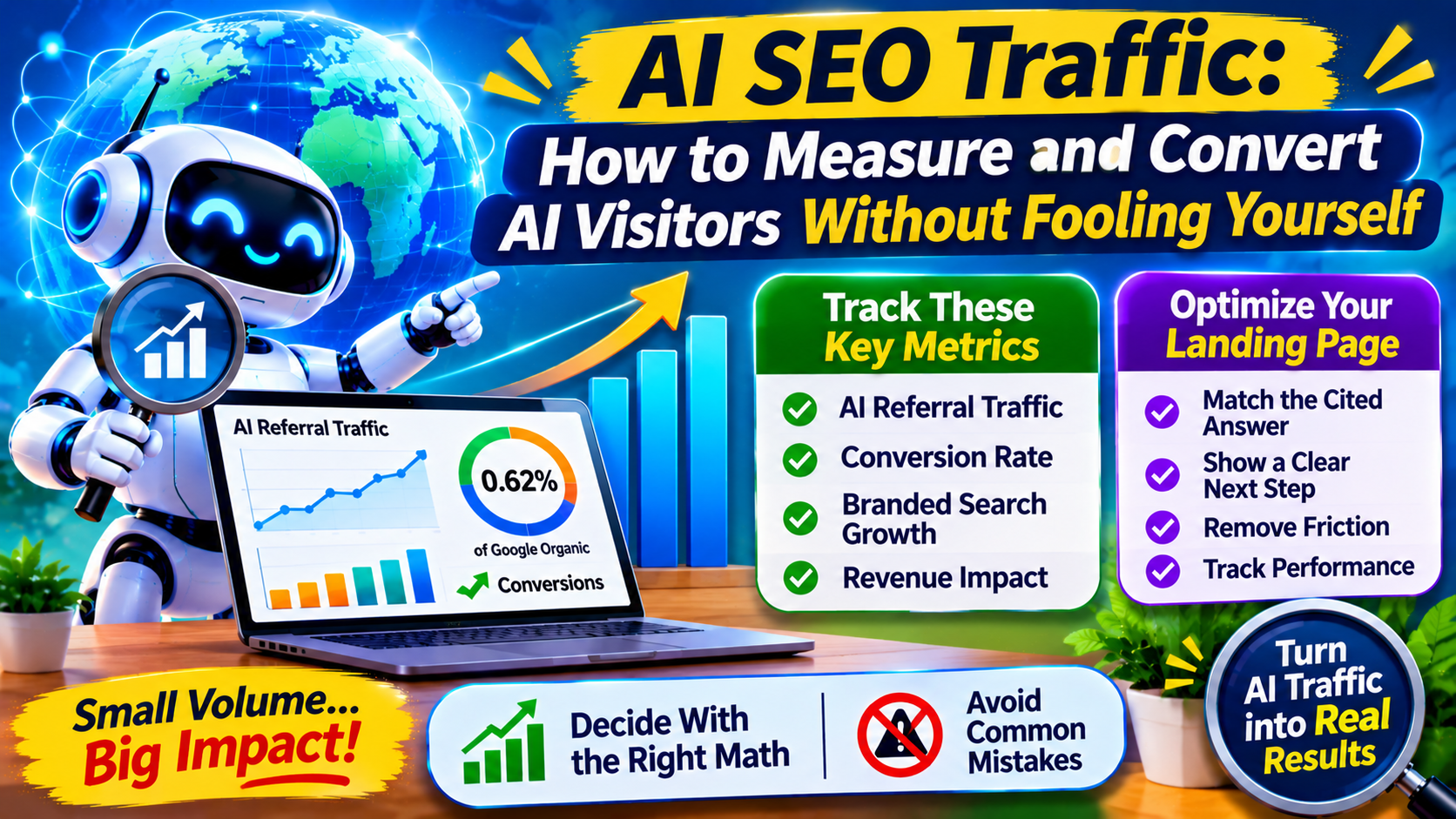
Start with scale. A roundup of October 2026 studies reported that ChatGPT sent just 0.62% as many sessions as Google organic across 100 sites, and a separate study of 95 UK client sites found organic search sent 39 times more traffic than AI assistants.
Quality looks better, but the evidence splits. In the same roundup, one researcher found ChatGPT visitors converting at 13.8% versus 3.02% for Google organic across 55 sites that tracked conversions. Another study of UK agency clients found a far smaller gap: 7.18% for AI referrals versus 6.08% for organic, about a fifth better. On 23 of the 63 sites with conversion data, AI traffic actually converted worse than organic, and five sites recorded no AI conversions at all.
Other widely shared numbers sit even higher. Seer Interactive reported ChatGPT referrals converting at 15.9% against 1.76% for Google organic, but that came from a single client, with just under 11,000 AI sessions compared with almost 14 million organic ones. Ahrefs reported that AI search drove 12.1% of its own signups from 0.5% of visits. These are real observations, but each is one dataset with its own definition of a conversion.
Why the Numbers Conflict
Three factors explain most of the disagreement.
Business model. Ecommerce looks weaker than lead generation. One large ecommerce study found organic search converting 13% better than ChatGPT referrals, and ChatGPT shoppers spending about 14% less per order. B2B studies, such as a 312-firm analysis reporting 14.2% versus 2.8%, tend to show much bigger AI advantages.
Sample size. A tiny channel produces volatile rates. A handful of conversions on a few hundred visits can swing a percentage dramatically.
Measurement. Teams define conversions differently, and most undercount AI visits in the first place, which leads to the next problem.
You’re Probably Undercounting It
Google Analytics wasn’t designed around AI referrals. One guide reports that GA4 files many AI visits under direct or unassigned traffic, and claims default setups miss 35 to 70% of them. Treat that range as a vendor estimate, but the direction is plausible: referrer data is inconsistent across platforms.
A practical fix takes under an hour:
- Create a custom channel group that isolates AI source domains from ordinary referrals.
- Check rule order. GA4 evaluates rules in sequence, so if a generic Referral rule sits above your AI rule, AI visits never reach it.
- Watch branded search in Search Console as a proxy, since some AI-driven visits arrive without referrer data and branded searches often rise as visibility grows.
- Look at the parameters. One guide reports that ChatGPT now appends a source parameter to citation links, which can help attribution. Confirm this in your own data before relying on it.
- Ask people. Add “How did you hear about us?” to forms with an AI option. This is my recommendation rather than a sourced finding, but it catches influence that analytics cannot.
Platform mix also matters. Trackers put ChatGPT at roughly three quarters of AI referrals, with Gemini, Perplexity, Copilot, and Claude splitting the rest, though exact shares differ by source. Check your own data before optimizing for one engine.
Sarkar SEO suggests setting up this tracking before any AI visibility campaign begins, so you have a baseline to compare against.
Make the Landing Page Finish the Job
An AI answer often pre-qualifies the visitor. One guide argues that the page should confirm the claim the AI cited, since the visitor arrives with context an ordinary searcher lacks. That suggests a few habits:
- Match the cited passage. If the page was quoted for a definition or price range, make that content visible at the top, not buried.
- Offer a clear next step that fits someone further along the decision path, such as a consultation, quote, or demo.
- Remove friction. Shorten forms and avoid forcing a newsletter pop-up on a visitor who already wants an answer.
- Review by landing page. Track which cited pages convert, then improve the weak ones.
Decide With the Right Math
Small AI volume changes the arithmetic. The October roundup modeled a typical site and found that a 5% gain in organic search added more monthly conversions than doubling AI referral traffic, and 96.5% of conversions in one study still came from Google organic. AI traffic is worth growing, but it rarely justifies neglecting everything else.
There is also an invisible side. AI answers often satisfy a user before any source is opened, so some value shows up as brand searches, direct visits, or sales conversations rather than clicks. Tracking branded search and self-reported sources helps capture it.
Mistakes to Avoid
- Quoting a headline multiplier like “AI converts 9x better” to justify a budget. Test your own data.
- Ignoring sample size. Wait for enough conversions before drawing conclusions.
- Lumping all AI engines together, when conversion rates by platform can differ widely.
- Measuring only clicks, which understates influence.
- Treating AI traffic as separate from brand. Strong visibility usually lifts branded demand as well.
