



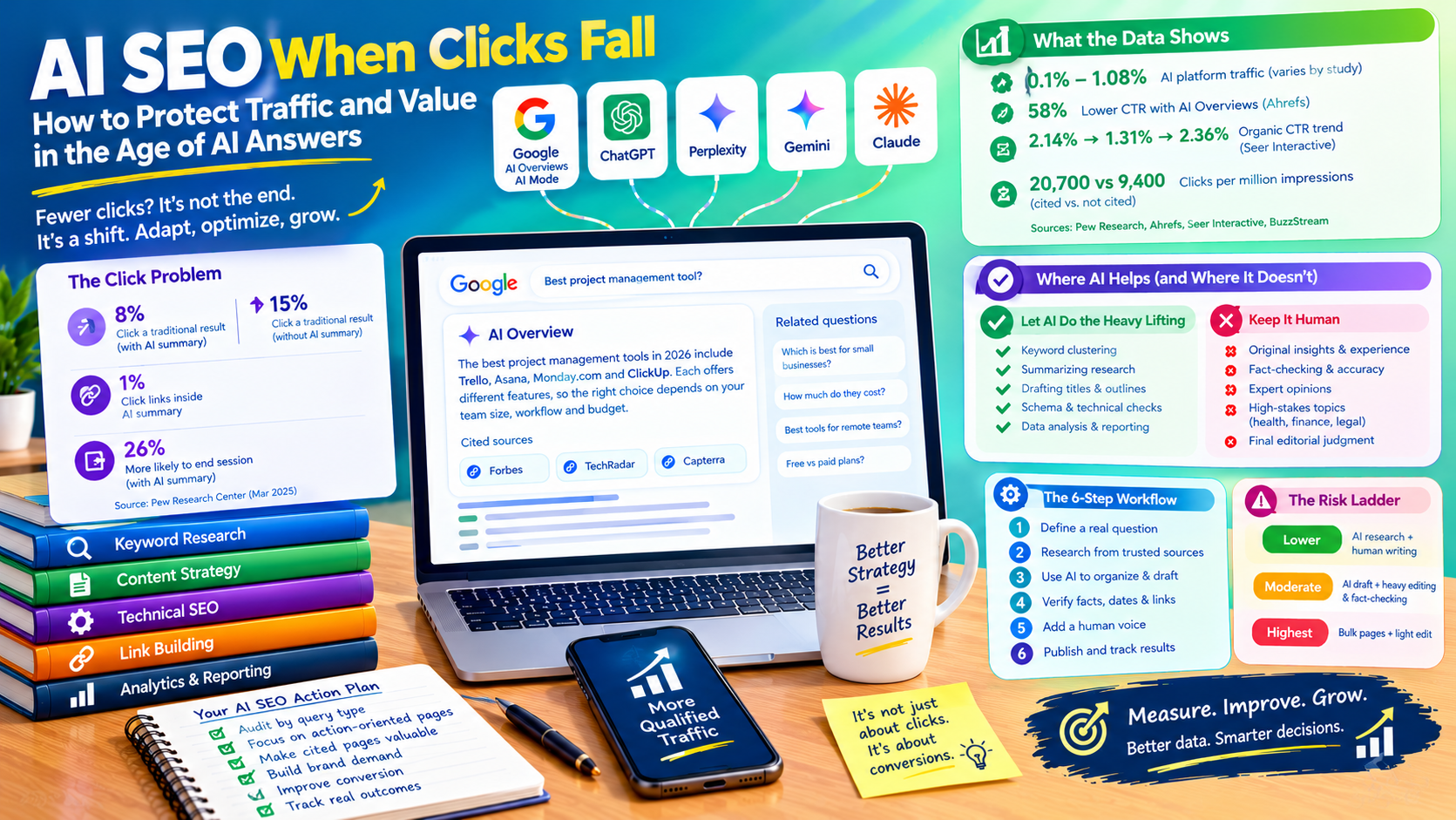
If your organic traffic has softened while your rankings have not, AI answers are a likely suspect. When a search page answers the question itself, fewer people need to visit a website. That does not make AI SEO pointless. It changes what you should aim for, which queries deserve investment and how you judge success. Here is what the research shows and how Sarkar SEO suggests responding.
What the Click Data Actually Shows
The most cited behavioral evidence comes from Pew Research Center. It tracked the browsing of about 900 US adults in March 2025, covering roughly 69,000 Google searches. About 18% of those searches produced an AI summary. On pages with one, users clicked a traditional result in 8% of visits, versus 15% when no summary appeared. Clicks on links inside the summary were rare, around 1%, and users were more likely to end their session afterward (26% versus 16%). See the Pew Research findings.
Keyword-level studies point the same way, with different numbers. As summarized in a 2026 comparison of research, Ahrefs found that position-one click-through rate was about 58% lower when an AI Overview appeared, with smaller drops lower on the page. I did not review Ahrefs’ original report, so treat that figure as reported rather than verified.
The Rebound Nobody Expected
The more interesting finding is that the damage may not be one-directional. According to the same roundup, Seer Interactive analyzed 53 brands and 5.47 million queries from January 2025 to February 2026. On queries with an AI Overview, organic CTR fell from 2.14% in September 2025 to 1.31% in December, then recovered to 2.36% by February 2026. It remained below the 3.82% baseline for queries without an Overview.
Seer also compared outcomes by citation. Per million impressions, a brand cited in the Overview earned roughly 20,700 clicks, compared with about 9,400 when it was not cited. Both trail the roughly 33,500 clicks seen when no Overview appeared.
Two cautions apply. The recovery spans only a few months and may not last. And these studies use different samples and methods, so their figures should not be averaged or compared directly. What they agree on is the direction: AI answers reduce clicks, and being cited softens the loss.
Not Every Query Is at Equal Risk
This section is our own reasoning, not a research finding, but it is a practical way to prioritize. Ask of each query: can a short paragraph fully satisfy the person asking?
High exposure. Definitions, simple how-tos, quick facts and basic comparisons. An AI answer can resolve these completely, so organic clicks are most vulnerable. Treat them as brand-building and citation opportunities, not traffic engines.
Medium exposure. Research-heavy questions where readers want detail, examples or evidence. The summary introduces the topic; the best sources still earn the visit.
Low exposure. Tasks that require action or trust: getting a quote, booking, buying, using a calculator, downloading a template, comparing live prices or checking a specific provider. A summary cannot complete these for the user.
Most sites over-invest in the first group because those pages were easy to rank and drove volume. The shift now favors the third.
A Practical Plan When Clicks Fall
- Audit by query type, not just by total traffic. This is where Sarkar SEO begins with any traffic-decline review. Split your pages into the three exposure groups above. A decline concentrated in definitional pages is a different problem from a decline on product pages, and it calls for a different fix.
- Shift effort toward action-oriented pages. Strengthen service pages, tools, comparisons with real data, pricing explanations and local pages. These capture visitors who have moved beyond the summary stage.
- Make cited pages worth the click. If an AI answer quotes you, give readers a reason to continue: a worked example, a downloadable checklist, original data, a calculator or a diagram the summary cannot reproduce. A citation without a compelling next step is a missed opportunity.
- Build brand demand outside search. People who search your name directly bypass the problem. Newsletters, communities, video, podcasts and partnerships create demand that no summary can intercept.
- Capture the visitors you do get. With fewer clicks, each visit matters more. Check page speed, clarity of the offer, internal pathways and calls to action. Improving conversion on existing traffic is often cheaper than winning more of it.
- Report on outcomes. Track leads, sales, sign-ups and assisted conversions alongside sessions. A smaller audience that converts well is a better business than a larger one that never acts.
What Not to Do
Do not abandon informational content entirely. It still builds the expertise, citations and brand familiarity that support everything else. Do not chase traffic with thin pages, and do not panic over a single month of data: the Seer figures moved sharply within a few months in both directions. Compare year over year, segment your pages and look for stable patterns. Sarkar SEO advises clients to set a baseline first, because without one it is impossible to tell whether AI answers, seasonality or a ranking change caused a drop. Write down your current clicks, impressions and conversions by page group before changing anything.
