



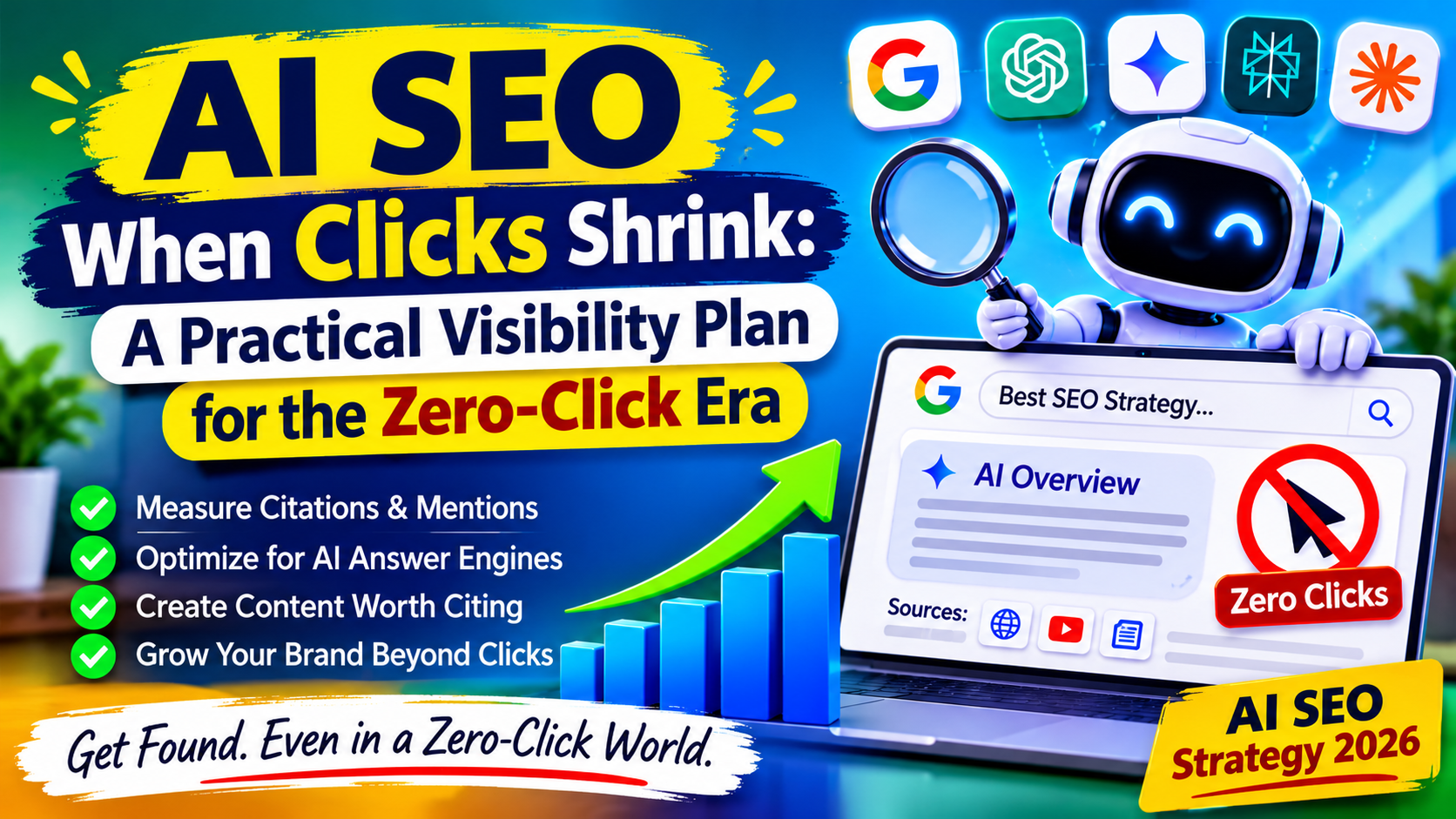
Ranking well used to mean traffic. In AI-driven search, a page can be read, summarized and recommended without anyone visiting it. That doesn’t make AI SEO pointless. It changes what you optimize for, who you let in, and how you prove it’s working.
The Click Problem, Honestly Stated
Start with the evidence, and with its limits. A Pew Research Center study tracked the browsing of 900 U.S. adults in March 2025. Users who saw an AI summary clicked a traditional result link in 8% of visits, against 15% for those who didn’t. Clicks on links inside the summary itself were just 1% of visits.
Treat that as a signal, not a verdict. The sample is small and U.S.-only, and Google told Platformer the study used a flawed methodology and an unrepresentative query set, saying it hasn’t seen significant drops in aggregate web traffic. Also, only about 18% of the searches in the study produced an AI summary at all. 512pixelspewresearch
The sensible reading is that AI answers absorb some simple, informational clicks, and the effect varies by query type. Pages that merely restate common knowledge are most exposed. This is why Sarkar SEO advises clients to audit which queries their traffic depends on before changing anything else.
Redefine What Winning Looks Like
If a share of discovery now happens inside answers, a traffic-only scorecard understates your reach. Add these measures:
- Citation and mention share: across a fixed list of 25 to 50 buyer questions, how often is your brand named?
- Branded search growth: people who see you in an answer often search your name later.
- Assisted conversions: check whether leads who first came via branded or direct visits earlier met you elsewhere.
- Click quality: fewer visits can still mean better visits. Compare conversion rates, not just sessions.
Log prompts and results monthly in a simple sheet. AI answers vary from run to run, so judge trends, never a single screenshot.
Decide Who Gets In: A Crawler Policy
This is where most sites make avoidable mistakes. AI-related bots do three different jobs: collecting training data, building search indexes for AI answers, and fetching pages on demand for a user. Blocking one doesn’t block the others.
Provider documentation, as summarized by several technical guides, shows the pattern clearly:
- Blocking GPTBot stops AI training, while blocking OAI-SearchBot removes you from ChatGPT Search. A blanket block on one leaves the other untouched.
- Google-Extended isn’t a separate crawler. It’s a control token for whether content can train Gemini and related APIs, and it doesn’t affect Google Search or AI Overviews.
- For limiting what Google shows in its AI features, Google points to nosnippet, data-nosnippet, max-snippet or noindex.
- Don’t block Googlebot to “keep Google’s AI out.” Doing so can remove you from Google Search entirely, AI Overviews included.
A common policy is to allow search-focused and user-triggered bots while opting out of training. Whether that suits you is a business decision. A publisher selling licensed content may choose differently from a service company that wants maximum exposure. Because these guides summarize provider documentation that changes often, confirm each bot’s current rules at the source before editing your robots.txt, and remember robots.txt is a policy signal, not access control.
Also test for accidental blocks. A firewall, CDN rule or bot-protection setting can turn away AI crawlers even when robots.txt allows them, and pages that depend on JavaScript to show their text may appear nearly empty to some fetchers.
Build Pages Worth the Click
If an assistant can answer the surface question, your page must offer something the summary can’t hold. Think in terms of the next step the reader wants:
- Tools and calculators that give a personalized result
- Templates, checklists and downloads people use after reading
- Comparison tables with your own testing criteria, not recycled specs
- Worked examples with real numbers, screenshots or process notes
- Local or regional specifics, such as pricing norms, regulations and language differences, which matter for a worldwide audience
Write the summary-friendly answer in the first lines, then make the rest of the page worth scrolling. The short answer earns the citation; the depth earns the visit.
Your Brand Lives Beyond Your Website
AI answers draw on more than company sites. In the Pew data, Wikipedia, Reddit and YouTube together accounted for 15% of the sources in AI summaries, and government sources about 6%. That reflects Google’s summaries in one U.S. sample, but the lesson travels: assistants lean on encyclopedic, community and video sources. yahoo
So extend your presence deliberately and honestly:
- Publish video explainers that answer your core questions, with accurate titles and descriptions.
- Take part in community discussions where your expertise is relevant, disclosing who you are.
- Keep business listings, author profiles and company descriptions consistent everywhere.
- Earn references through original research and useful commentary, never purchased mentions.
A 30-Day Starting Plan
Week 1: Pull your top 50 landing pages and tag each as “answerable in a sentence” or “needs depth.” Check robots.txt, firewall rules and rendering for AI-bot access.
Week 2: Choose your crawler policy and document it. Rewrite the five most exposed pages to add proprietary examples, data or tools.
Week 3: Create or update one video and one community-ready resource tied to your highest-value topic.
Week 4: Set up your prompt log, record baseline mentions, and add branded search and assisted conversions to your reporting.
Is organic traffic dead? No. Google still drives far more visits than AI assistants. Ahrefs’ Q1 2026 benchmark reported Google sending about 190 times more traffic than ChatGPT, though the gap may narrow.
Should I block AI crawlers? Only deliberately. Blocking search bots removes you from answers; blocking training bots does not.
Will fewer clicks hurt leads? It can for generic content. Pages built around tools, proof and decisions tend to hold up better, though results depend on your market.
