



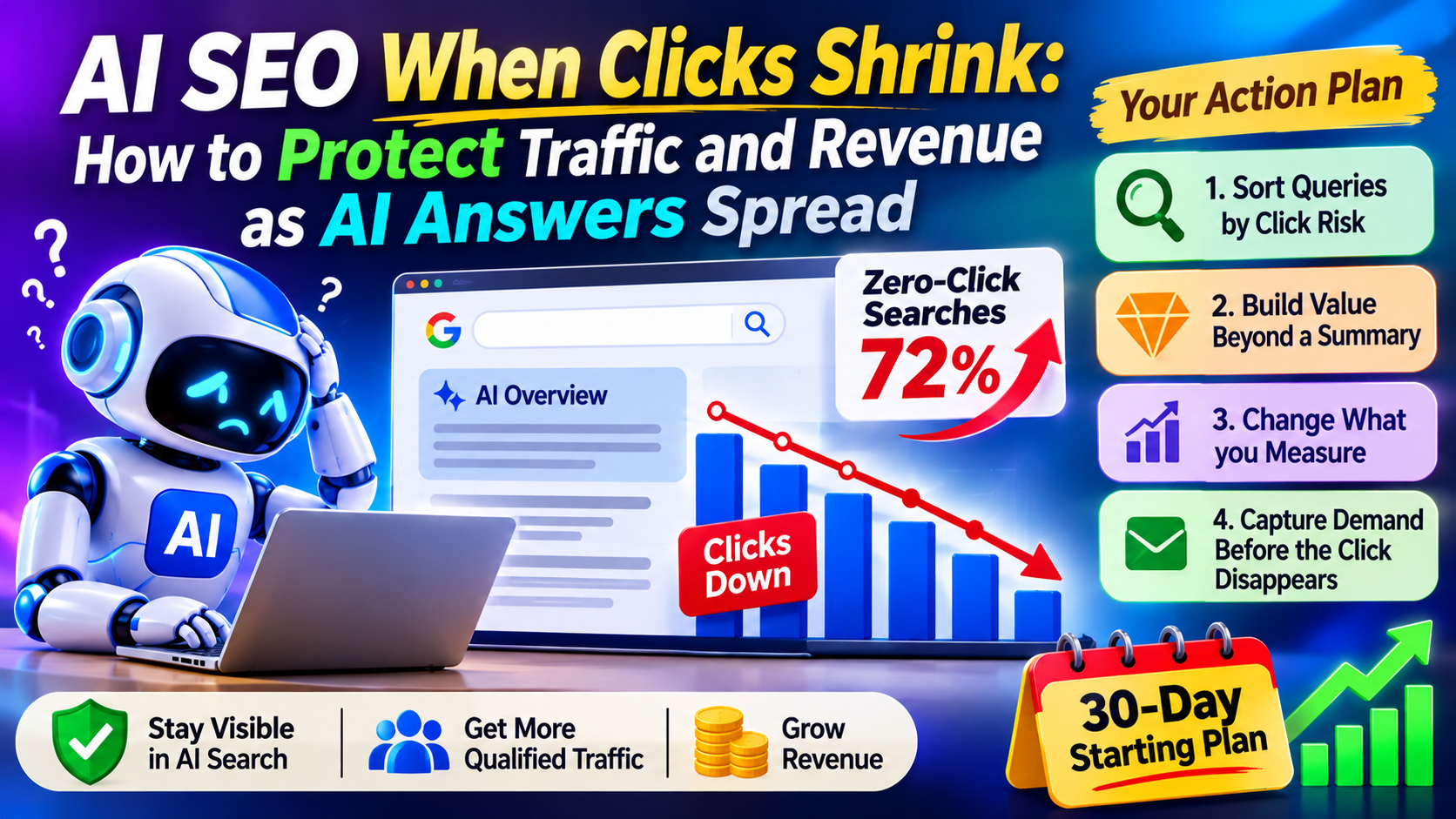
Many marketers watch impressions rise while clicks fall. Search results now answer questions before anyone visits a website, which changes what a good AI SEO strategy has to do. Ranking is no longer enough. Pages also have to earn a visit that a summary can’t replace. This guide explains what the evidence shows and gives you a plan to adapt.
What the Evidence Says
The strongest study so far is a randomized field experiment by Agarwal and Sen. It assigned 1,065 U.S. participants to groups that saw Google normally, had AI Overviews hidden, or were redirected to AI Mode. AI Overviews appeared on 42% of queries, and removing them raised outbound clicks from 0.38 to 0.61 per search. The same source reports that zero-click searches rose from 54% to 72% when AI Overviews were shown. Satisfaction barely changed, which suggests the summaries replaced clicks without clearly improving the experience. SEJ Live: Boost Your Local Business Visibility Across AI Search +2
Treat the numbers with care. The paper is a draft on SSRN and has not been peer-reviewed. Its sample reflects active desktop Chrome users rather than all Google users. Different write-ups also report slightly different figures, with some citing 39.8% instead of 38%, so read it as “roughly 40%,” not a precise constant.
Other data points the same way. Pew Research found users click on results 8% of the time when an AI Overview appears, compared with 15% without one. Together, these findings suggest that old click-through assumptions overstate what a ranking is worth today.
Step 1: Sort Your Queries by Click Risk
Not every keyword is equally exposed. The experiment found that the effect was strongest when AI Overviews appeared at the top of the page, which occurred 85% of the time. Beyond that, the following grouping is my own reasoning, not a published finding. It is a hypothesis to test against your own data.
- Answer-seekers want a definition, a fact or a quick explanation. A short summary can satisfy them, so these queries are the most exposed.
- Evaluators compare options or look for “best” lists. They often need detail, pricing or trust signals, so some still click.
- Doers want to calculate, download, book or buy. An AI answer can’t complete these tasks for them.
- Brand searchers already know your name and are the least affected.
Export your top 100 queries from Search Console and label each one. You’ll quickly see how much of your traffic sits in the exposed group.
Step 2: Build Value That a Summary Can’t Hold
Ask one question of every important page: could three sentences replace this page? If yes, the page is vulnerable. The fix is to put value behind the click:
- Interactive tools: calculators, checkers, estimators and templates people use rather than read.
- Original data: a survey, benchmark or analysis of your own that no one else can summarize without citing you.
- Live or changing information: pricing tables, availability, and comparisons you update on a schedule.
- Decision support: real examples, trade-offs and mistakes to avoid, which a short summary tends to flatten.
- Downloadable assets: checklists, worksheets and sample documents.
This does not mean hiding answers. Give a clear, direct answer, because that is how you get cited, then offer something deeper for readers who want to act.
Step 3: Change What You Measure
If you judge success by sessions alone, you will conclude everything is failing. Add measures that reflect where visibility now happens:
- Impressions and click-through rate by query group, using the Step 1 labels.
- Citation presence: a fixed list of 20 to 30 buyer questions, checked monthly in the AI tools your audience uses. Record whether you’re cited, mentioned or absent.
- Branded search volume, which shows whether visibility is building recall.
- Conversion rate per organic session. Fewer visits are tolerable if each visit is more qualified.
- Assisted conversions, since people may see your brand in an answer and return later through a different route.
Citation matters commercially too. One analysis reported that brands cited inside an AI Overview earned 35% more organic clicks than non-cited competitors on the same page. That figure comes from a secondary summary of Seer Interactive’s work, so use it as directional evidence and verify it before quoting it to clients.
Step 4: Capture Demand Before the Click Disappears
When a visit is no longer guaranteed, your site needs a second way to keep the relationship. Offer an email list, a free resource or a community that readers choose to join. Keep your brand name, service descriptions and key facts consistent across your site and the third-party pages that mention you, so answer systems have clear, matching information to draw on. Sarkar SEO treats this consistency as part of AI SEO, not a separate branding exercise.
A 30-Day Starting Plan
- Week 1: Export Search Console data and label your top 100 queries by type.
- Week 2: Find your five most exposed pages using the three-sentence test, and decide what tool, data or asset each one needs.
- Week 3: Build or upgrade two of them. Add a clear call to action that fits the reader’s next step.
- Week 4: Set up your monthly citation check and a dashboard that tracks branded search and conversions beside traffic.
Then repeat, using what each cycle teaches you.
What Not to Do
Don’t respond by publishing more thin pages. More low-value content doesn’t recover clicks, and it creates its own risks. Don’t assume your old traffic forecasts still hold, either. Revise them downward for exposed queries and be honest with stakeholders about why.
