



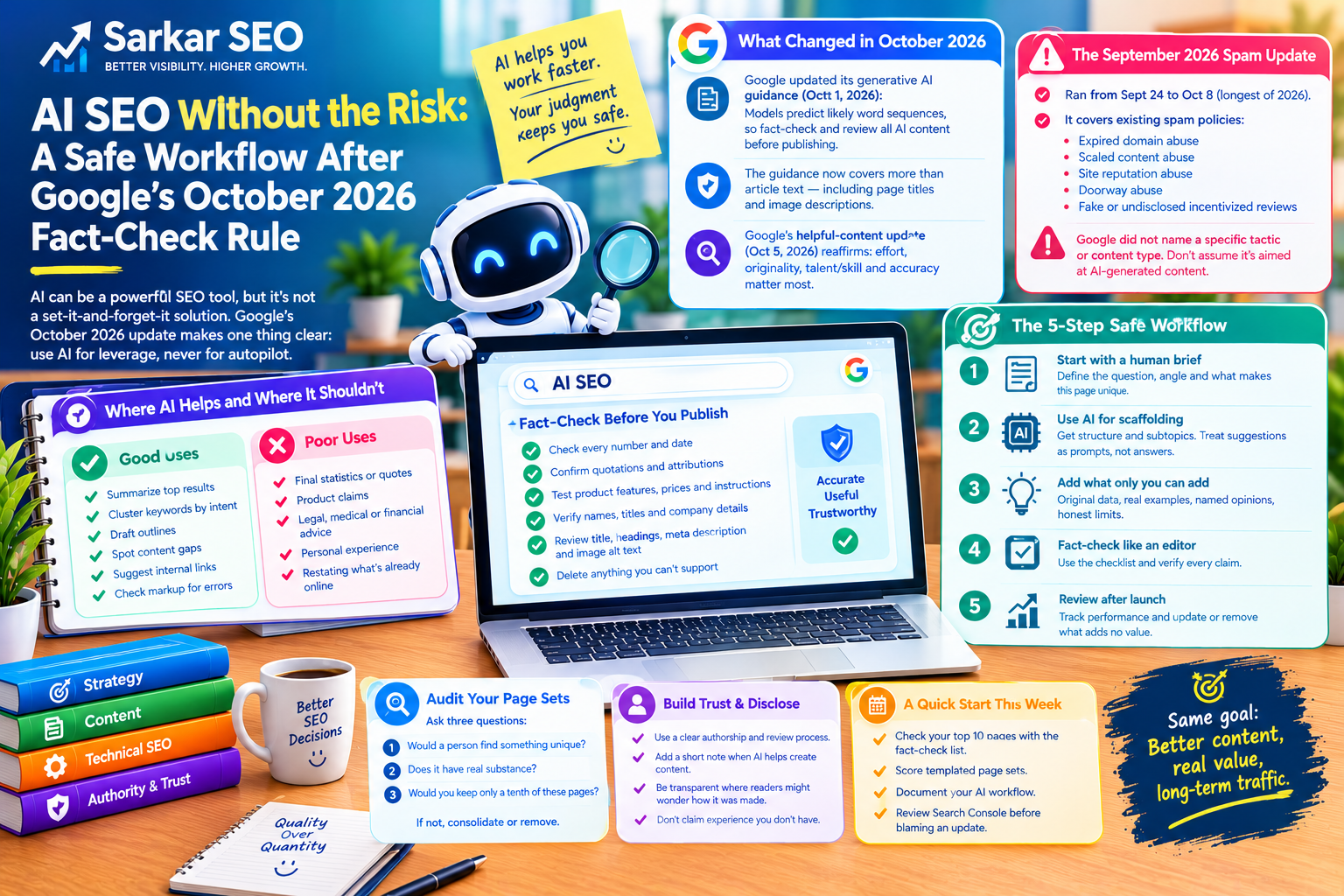
AI can now draft, cluster, summarize and audit faster than any SEO team could a few years ago. That speed is also the danger. October brought two developments that every team using AI SEO should read together: a longer-than-usual spam update and a short but pointed change to Google’s guidance. Sarkar SEO reads them as one message: use AI for leverage, never for autopilot.
What changed this autumn
On October 1, 2026, Google rewrote the accuracy section of its generative AI content guidance, explaining that models predict likely word sequences instead of retrieving facts, so outputs may contain inaccuracies. It states that it is critical to manually fact-check and review all AI-generated content before publishing. The coverage notes the expectation extends beyond article text to page titles and image descriptions.
What did not change matters equally. Google still says generative AI can be useful for researching a topic and adding structure to original content, and it still warns that producing many pages without adding value may breach its scaled content abuse policy.
Days later, Google’s helpful-content guidance (last updated October 5, 2026) described how main content is assessed: effort, originality, talent or skill, and accuracy, with generating large amounts of text through generative AI without manual oversight given as an example of little to no effort. itechguidesitechguides
The spam update: read it carefully
The September 2026 spam update ran from September 24 to October 8, Google’s longest spam update of the year so far. It was the fourth of 2026, after March, June and August.
Be careful with the headlines. Google did not name a specific tactic or content type, so it should not be read as an update aimed at AI-generated content. What it enforces is a set of policies already in place, including expired domain abuse, scaled content abuse, site reputation abuse, doorway abuse and fake or undisclosed incentivized reviews.
There is also an attribution problem. With four spam updates in seven months, it is getting harder to tell which update caused which ranking change. If your traffic moved, diagnose before you blame AI.
The principle that has not moved
Google’s long-standing line is that it aims to reward high-quality content however it is produced, and that using AI gives content no special gains. Scaled content abuse is defined by purpose: generating large numbers of pages chiefly to manipulate rankings rather than help the people who land on them. The method is irrelevant, so AI is a production tool, not a violation.
Where AI helps and where it should not decide
Good uses. Summarizing what top results cover, clustering keywords by intent, drafting outlines, spotting gaps between your pages and a topic, suggesting internal links, drafting alternative titles, and checking markup for errors.
Poor uses. Final statistics, quotations, product claims, legal, medical or financial advice, anything described as personal experience, and any page whose main value would be restating what is already online.
The dividing line is simple. AI can organize and accelerate. It cannot supply what you actually know.
A five-step workflow that fits the new guidance
- Start with a human brief. Write the reader’s question, the angle and the one thing this page will say that others do not. A page without that sentence is not ready for a draft.
- Use AI for scaffolding. Let it propose structure and surface subtopics. Treat every suggestion as a prompt for your own judgment.
- Add what only you can add. Original data, screenshots, real processes, named opinions, honest limits. This step carries the “effort and originality” Google describes, and it cannot be automated.
- Fact-check like an editor. Use this list before anything goes live:
- Trace every number and date to a source you opened yourself.
- Confirm that every quotation exists and is attributed correctly.
- Test every product feature, price and instruction.
- Check names, titles and company details.
- Read the page title, headings, meta description and image alt text, since Google’s wording covers these too.
- Delete any sentence you cannot support.
- Review after launch. Revisit pages after a few weeks. Look at how they perform in search and whether readers engage. Update or remove pages that add nothing.
Audit your page sets
The riskiest area is rarely a single article. It is a group of pages produced from a template: city pages, comparison pages, glossary entries, “best X for Y” variants. Coverage of recent updates points to thin programmatic pages, mass affiliate lists, expired domain abuse, doorway pages and content farms as the spammy uses of AI, although this is one commentator’s reading, not Google’s statement. mean
Run each set through three questions:
- Would a person who lands here find something they could not get from the next result?
- Does each page have its own substance, or just a swapped keyword?
- If we published only a tenth of these, would the set be stronger?
If the answers are no, no, yes, consolidate or remove. Fewer, deeper pages are safer and usually perform better.
Disclosure and trust
Google’s earlier guidance suggests disclosure is useful when readers would reasonably wonder how content was created. That is a judgment call. A short note on authorship and review, with a named person responsible for accuracy, serves readers and shows accountability. Do not claim experience nobody had.
A realistic way to start this week
- Pick your ten most important pages and run the fact-check list above.
- List every templated page set and score it with the three questions.
- Document your AI workflow in one page so every writer follows the same steps.
- Check Search Console before blaming a single update, and compare dates against all four spam updates.
Sarkar SEO’s view is that the teams best placed for the next update are not those who avoid AI. They are the ones who can show, page by page, who checked it and what it adds.
