



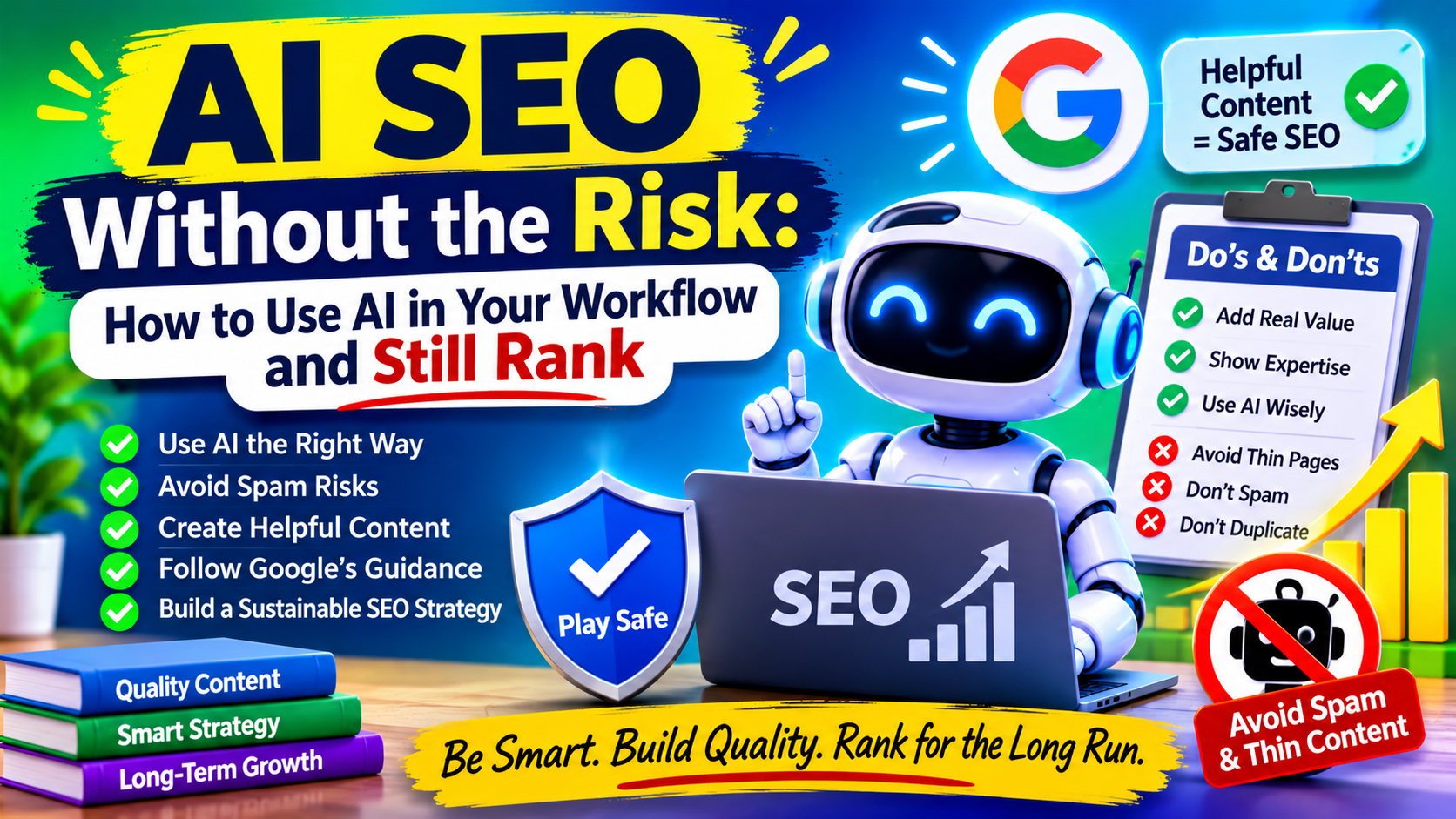
Most conversations about AI SEO focus on how to appear inside AI answers. A quieter question matters just as much for your traffic: how do you use AI to do SEO work without damaging the site you are trying to grow?
Publishing has never been faster or cheaper, and that is the trap. Teams that treat AI as a printing press tend to end up with a pile of thin pages. Teams that treat it as a research assistant tend to end up with better work in less time. This guide shows where that line sits and how to stay on the right side of it.
Google’s Position: Tool Is Fine, Intent Is Not
Google has not banned AI-written content. Its stated position is that AI content is acceptable when it is helpful, original and made primarily for people rather than search engines. The rule that actually bites is about purpose and scale. Google’s spam policy defines scaled content abuse as producing many pages primarily to manipulate rankings rather than help users. hashmetavappingo
The policy is deliberately blind to the production method. It applies whether the content comes from automation, humans, or a mix of both. A farm of underpaid writers producing near-identical pages breaks the rule just as an unedited AI batch does.
This is not a historical footnote. The September 2026 spam update began on September 24 and lists scaled content abuse among the policies in scope. If you publish at volume, this is a live risk rather than a theoretical one.
The New Trap: Building a Page for Every Question
Here is a risk that is specific to the AI search era. Answer engines break big questions into many smaller ones, and some marketers conclude that they should publish a separate page for every variation.
Google addressed this in its May 2026 guide. According to one analysis of that guide, building pages for every fan-out query variation primarily to manipulate rankings or AI answers violates the scaled content abuse policy. I read this through a secondary source, so confirm the exact wording on Google’s own page. The principle is easy to apply, though: one page should serve one real need, and a variation deserves its own page only if a real person would want it standing alone.
Where AI Genuinely Helps
Used well, AI saves hours without touching quality. Google’s newer guidance says AI can help with research and structuring content, with the warning that generating many pages without added value may violate the policy. In practice, these jobs are safe and productive:
- Clustering keywords into topics and spotting overlap, so you do not publish two pages that compete for the same query.
- Summarising your own data, such as support tickets, sales call notes and survey answers, to find the questions customers actually ask.
- Auditing existing content for outdated claims, missing sections and thin pages.
- Drafting meta descriptions and alt text that a human then edits.
- Translating content that a native speaker reviews.
- Preparing technical work, such as redirect maps, schema drafts and log-file summaries, that someone competent checks before it goes live.
Notice what is missing from that list: unattended publishing. Every task has a person accountable at the end.
Where AI Quietly Hurts
The danger zone is content that adds nothing the web does not already have. One practitioner breakdown rates AI summaries of public search results as medium risk because they add little beyond what exists, and hundreds of AI pages for keyword variants as high risk. The ratings are that author’s opinion, not Google’s, but they match the logic of the policy. inblog
Quality raters add another signal. Per one summary of the September 2025 rater guidelines, AI-generated pages showing little effort, originality or added value can receive the lowest quality rating. Raters do not directly set rankings, but their guidelines show what Google wants its systems to recognise.
The deeper problem is sameness. If ten competitors ask the same tool the same question, they publish the same article. Readers sense it, and so do search systems.
A Review Test Before Anything Goes Live
Google’s helpful content guidance suggests judging content by Who, How and Why. The framework is useful for AI-assisted work because it separates the tool from editorial responsibility. Turn it into a pre-publish checklist:
- Who is accountable for this page, and would a reader know?
- How was it made, and did someone with real knowledge verify the facts?
- Why does it exist: to help a visitor, or to catch a keyword?
- What is new here? Name one thing a reader cannot get from the first page of results, such as a real example, a measured result, an expert quote or a clear opinion.
- Would I publish this if search engines did not exist?
If a page fails question four or five, do not publish it. Improve it or cut it.
Build a Process, Not a Pile
A sustainable AI-assisted workflow has a few moving parts:
Start with a human brief. Define the reader, the decision they face and the evidence you will include before any tool is opened.
Feed AI your own material. Interviews, internal data and project notes make a draft distinctive. Generic prompts make generic drafts.
Edit hard. Remove padding, check every number against a source you can name, and rewrite sentences that sound like they could appear on any website.
Publish in measured waves. One analysis suggests that independent review and planned growth in waves are practical safeguards for large content programmes. Watch indexing and performance on the first batch before releasing the next.
Maintain what you publish. Refresh pages when facts change. A page that was correct last year can be a liability now.
What About Disclosure?
Google does not require a blanket “written by AI” label. Guidance summaries suggest disclosure where readers would reasonably expect it. A named author and a clear explanation of how a page was produced build more trust than silence, particularly on health, finance and legal topics, where accuracy matters most.
The Practical Takeaway
Treat AI as a fast, sometimes careless junior researcher. It can gather, sort and draft quickly, but it cannot take responsibility for being right. You can.
At Sarkar SEO, the approach we favour is simple: use AI to remove repetitive effort, then spend the saved time on what machines cannot supply, which is experience, judgement and original evidence. That mix tends to hold up when policies tighten, because it never depended on loopholes.
If you are scaling content and want a candid review of what is safe to keep, what to merge and what to remove, Sarkar SEO can audit your pages and build a workflow your team can run without fear of the next spam update.
