



Almost every SEO team now uses AI somewhere, from clustering keywords to drafting briefs. The harder question is where to use it. Done well, AI SEO shortens research and frees experts for work only they can do. Done carelessly, it produces hundreds of near-identical pages that search engines are built to discount. This guide separates the two.
What Google Actually Allows
Google does not ban AI-generated content. Its guidance says generative AI can be useful for researching a topic and adding structure to original content. The same guidance warns that using AI to generate many pages without adding value for users may violate its spam policy on scaled content abuse.
Google introduced that policy in March 2024, and it applies whether pages come from machines, humans or both. In January 2025 Google expanded its quality rater guidelines from 170 to 181 pages, with a dedicated section on scaled content abuse. Search Engine Journal has also reported Google’s advice to fact-check AI content before publishing.
The pattern is consistent. Google judges the value and intent of a page, not the tool behind it.
A Three-Lane Framework for AI Tasks
Here is a simple way to decide what to hand to AI. It is a working framework, not an official standard.
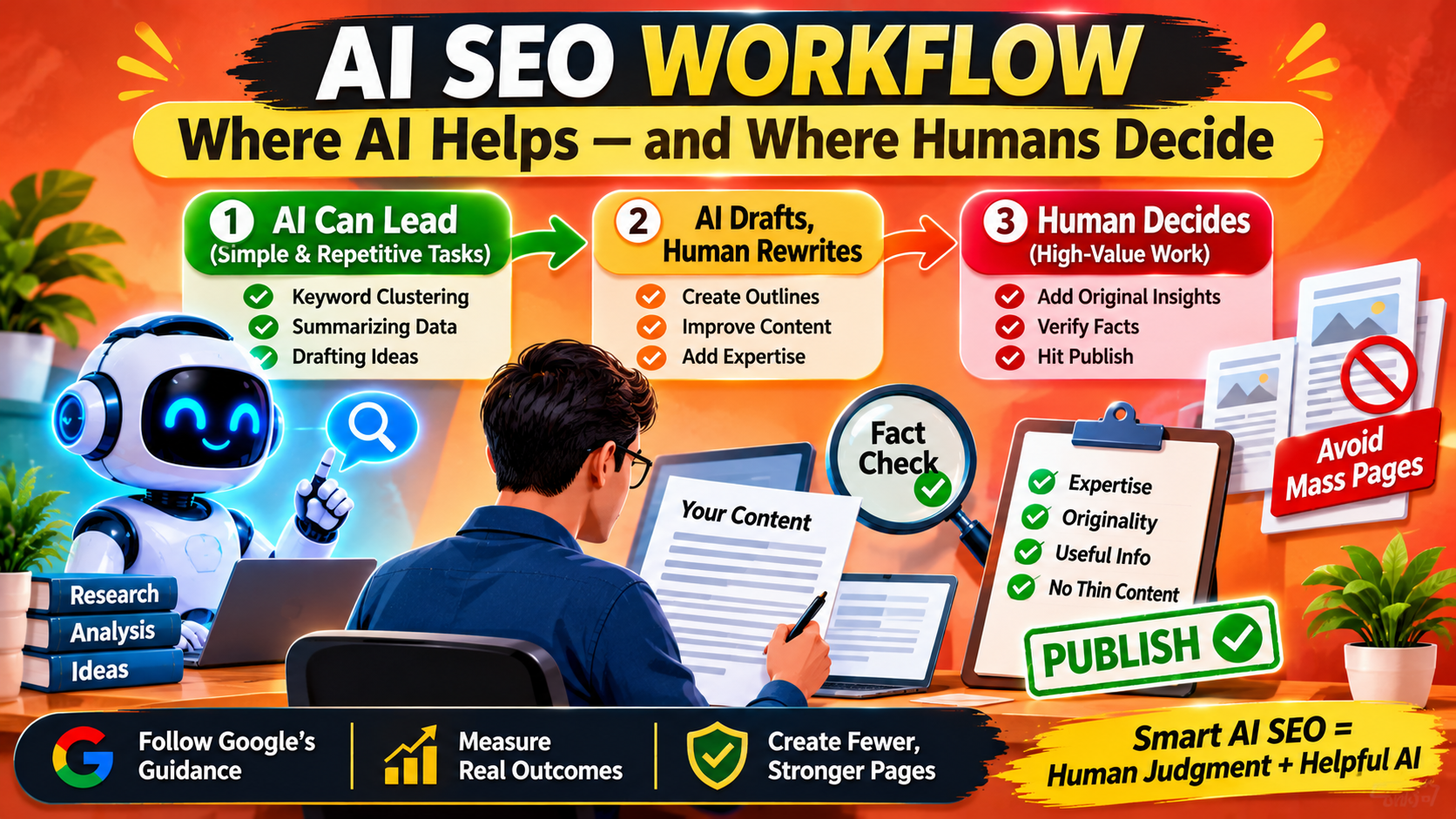
Green lane: AI leads, a human spot-checks. These are pattern-heavy tasks with low risk:
- Grouping large keyword lists
- Summarizing crawl or log exports
- Drafting title and meta description variants
- Mapping old URLs to new ones during a migration
- Turning call recordings into transcripts
Amber lane: AI drafts, a human rewrites. These tasks need judgment, but a draft saves time:
- Content briefs and outlines
- Competitor page summaries
- Internal link suggestions
- First-pass answers to common questions
Red lane: a human decides. These tasks carry accountability:
- Positioning and opinions
- Original data, examples and screenshots
- Claims about health, money or legal matters
- Final fact-checking
- The decision to publish
The rule of thumb is that the more a task depends on experience or accountability, the further it should sit from automation. Sarkar SEO encourages teams to write this map down so nobody has to guess which lane a task belongs in.
A Practical Workflow, Step by Step
- Start from real questions. Pull them from Search Console queries, support tickets and sales conversations. AI can sort and label them, but it cannot invent what your customers truly ask.
- Group by intent, not volume. Let AI cluster the queries, then read the actual search results for each cluster. Models often misjudge intent when a results page mixes guides, products and videos. If the results are all product pages, a blog post will struggle however well it is written.
- Decide what the page adds. Before drafting, name one thing the page will contain that competitors lack. It could be a worked calculation, a documented process, a decision table or a real constraint your audience faces. Without this, the page is a rewrite of the existing results.
- Feed the model your material. An expert’s notes, data and examples produce a far better draft than a request for generic knowledge. A model working from your source material is also less likely to wander into invention.
- Edit hard. Cut generic openers and filler. Verify every number against a source you have opened yourself. Add a named author who can stand behind the page.
- Publish fewer, refresh more. Updating a page that already earns impressions often does more than adding another thin article. Volume is not the goal.
The Pre-Publish Checklist
Run every AI-assisted page through these checks:
- Each statistic traces to a source someone has actually read.
- No quotes, case studies, tools or experiences are invented. Language models can produce confident citations that do not exist.
- The question is answered in the first few lines.
- A subject expert would be comfortable signing it.
- The page differs meaningfully from its sibling pages. If twenty pages share one template with only the city or product swapped, you are close to the pattern the spam policy describes.
Sarkar SEO treats this last check as the clearest warning sign in programmatic projects. Templates are fine when each page carries unique, useful data, and risky when only the keyword changes.
Judge Outcomes, Not Output
Many teams measure AI success by articles published per week. That rewards the wrong behavior. Better signals include qualified organic visits, leads, branded search growth and whether your pages are cited when people ask AI assistants about your topic. A smaller library that people trust beats a large one nobody reads.
Also keep a changelog of what AI touched. If rankings drop, you can trace which workflow changes preceded the drop instead of guessing.
