



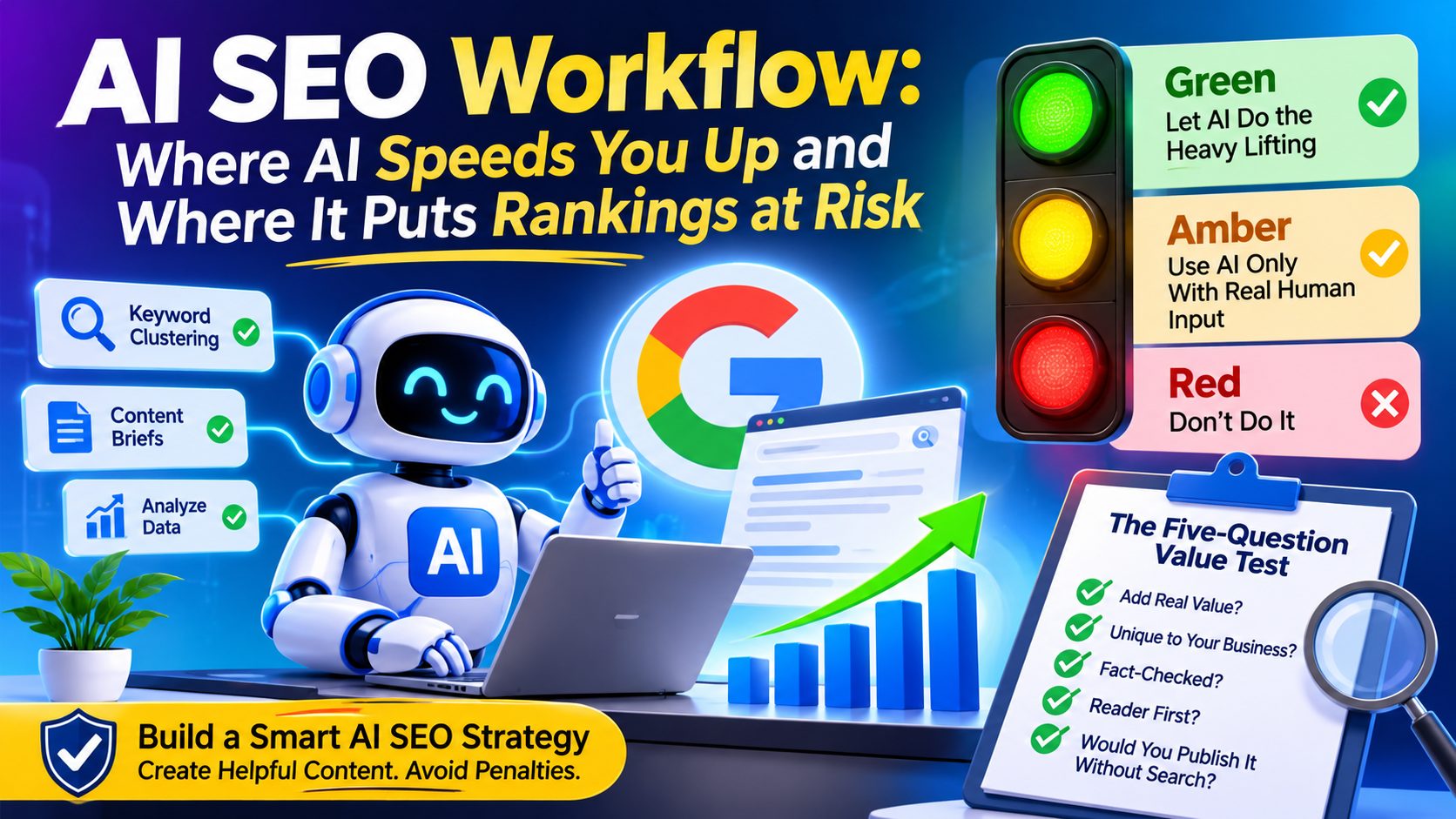
Most AI SEO teams now use AI somewhere in their process. The useful question is where it belongs. Used well, it removes hours of repetitive work. Used carelessly, it produces the content Google’s spam systems are built to catch. This guide gives you a practical way to decide, task by task. Sarkar SEO recommends this approach to teams that want the speed of AI without the penalty risk.
What Google Actually Targets
Google does not ban AI-assisted content. Its spam policy defines scaled content abuse by intent and outcome rather than production method: generating many pages primarily to manipulate rankings, with little or no value for users. The policy covers content created by humans, generative AI, or other automated means. So a poor page written by a person is still a problem, and a helpful page drafted with AI help is not automatically one.
The pressure is rising, though. Google confirmed on May 15, 2026 that its spam policies apply across all of Google Search, including AI Overviews and AI Mode. Coverage of its August 2026 spam update says scaled content abuse can include using generative AI to create large numbers of pages that add little value. Reports also describe a newer detection system, SAFE, expressly designed to identify AI-generated content. Treat details of how it works as unconfirmed, because Google rarely explains its systems fully. The direction is clear enough to plan around. birdeye.com +2
The Traffic-Light Model
Instead of arguing about whether AI is “allowed,” sort every SEO task by how much risk it carries. Here is a simple three-tier model.
Green: Let AI Do the Heavy Lifting
These tasks support your thinking and never publish anything on their own:
- Clustering keywords by intent from a raw export.
- Summarizing the top-ranking pages for a query so you can see what they share and what they skip.
- Drafting content briefs that a strategist then edits.
- Generating title and meta description variations for you to choose from.
- Suggesting internal link opportunities from your existing page list.
- Writing schema markup that you validate before release.
- Spotting patterns in Search Console exports, such as queries with high impressions and weak click-through.
The test for green tasks is that a human reviews the output before it touches the site.
Amber: Use AI Only With Real Human Input
Drafting and rewriting sit here. AI can produce a decent structure, but it cannot supply what makes a page worth reading: your experience, your data and your judgment. Before publishing an amber draft, add at least one thing the model could not have known:
- A real process, with steps you actually follow.
- A number from your own business or a source you checked.
- A specific example, screenshot or comparison.
- An opinion with reasoning behind it.
Then have a subject expert fact-check every claim. AI tools can state invented statistics with complete confidence, and publishing one damages trust quickly.
Red: Don’t Do It
- Publishing unedited AI drafts in bulk, especially across hundreds of pages.
- Templated city or service pages that swap one place name into identical text. Birdeye’s analysis flags auto-generated pages for each city or branch using near-duplicate content as a textbook scaled content abuse case. birdeye
- Mass “AI-friendly” Q&A pages written only to be quoted by answer engines.
- Invented author names, credentials or reviews.
- Rewriting competitors’ pages with a paraphrasing tool and calling it new.
If a task makes pages faster than anyone can read them, it belongs in this tier.
The Five-Question Value Test
Run every page through these questions before it goes live. If you answer “no” to two or more, hold it back.
- Would someone searching this query learn something here they couldn’t get from the top three results?
- Does the page contain at least one element unique to your business or research?
- Has a qualified person read it and checked every fact?
- Is it written for a reader first, with the keyword placed naturally?
- Would you still publish it if search engines didn’t exist?
The last question sounds philosophical, but it is a good proxy for the “primary purpose” language in Google’s policy.
Audit the AI Content You Already Have
Many sites published AI-assisted pages in 2023 to 2025 and never revisited them. A quick audit helps:
- Export every URL with its clicks and impressions for the past 12 months.
- Flag pages with near-zero engagement, thin text or heavy repetition across a template.
- For each flagged page, choose one action: improve it with original material, merge it into a stronger page, or remove it with a proper redirect or removal.
- Re-check the group after a few months and compare it with pages you left alone.
Cutting weak pages is not a loss. It concentrates your site’s strength on pages that deserve it.
Measure by Page Group, Not by Hope
Tag AI-assisted pages as their own group in your analytics so you can compare them with fully human-written ones. Track organic clicks, engagement and conversions for each group over at least a quarter. If the AI-assisted group consistently underperforms, your review process is too thin, not necessarily your tools. Also keep a changelog of when you published or updated each page. When a spam update or core update lands, that record makes diagnosis far easier.
A Realistic Way Forward
AI should shorten your production time and raise the quality of your decisions, not replace the part of SEO that earns trust. Keep the green tasks fast, keep amber tasks human-led, and stay away from the red ones. This approach protects you if Google’s detection gets stricter, and it makes better content in any case.
If you’d like help setting this up, Sarkar SEO can review your current AI-assisted content, sort it into these tiers and build a workflow your team can follow. A clear process now costs far less than recovering from a traffic drop later.
