



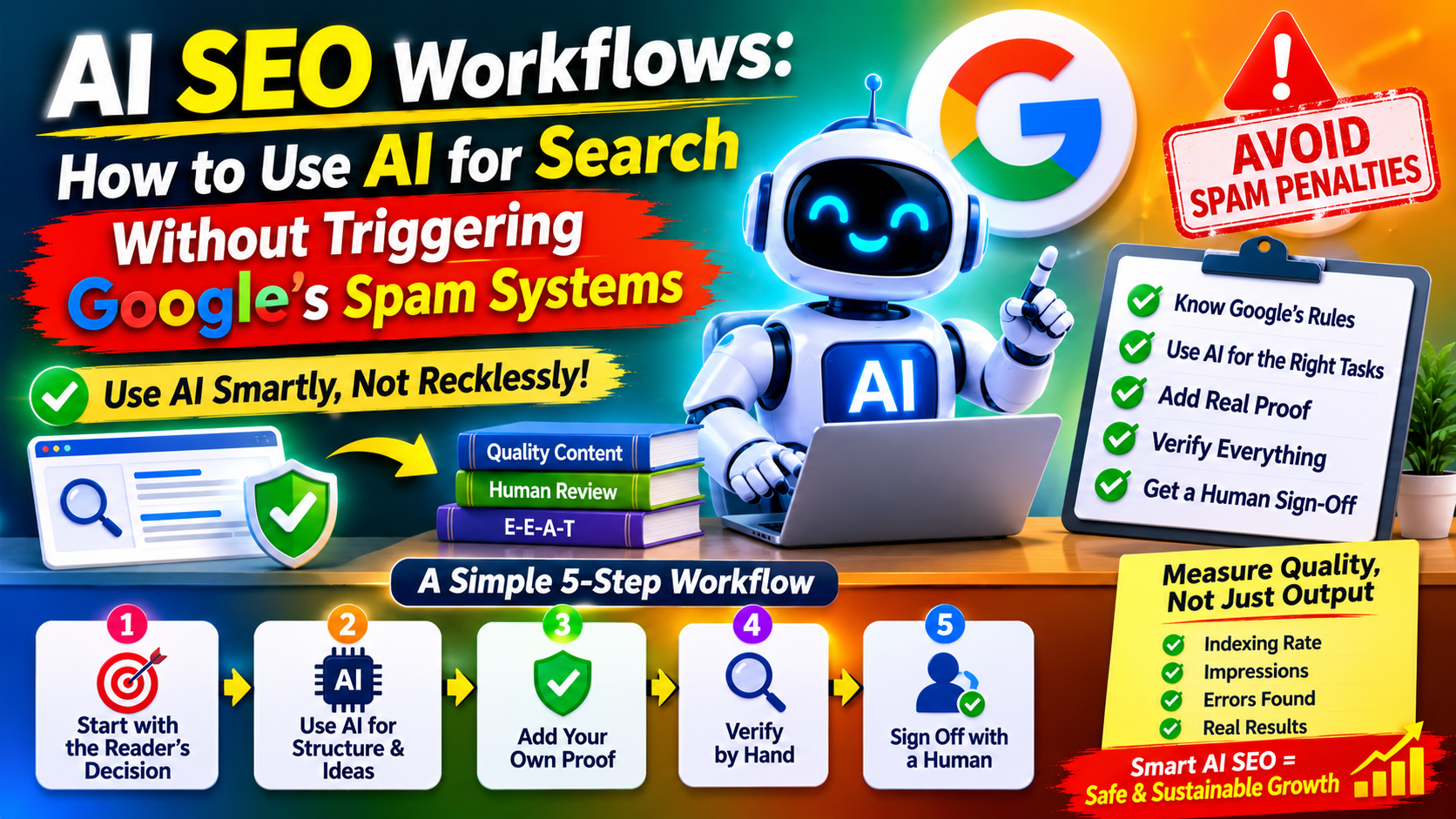
Ask ten marketers what “AI SEO” means and you’ll hear two answers. Some mean optimizing to appear in AI-generated answers. Others mean using AI inside the SEO process itself: research, outlining, drafting, analysis. This article covers the second meaning, where the main risk isn’t invisibility but penalties. AI can make good SEO faster. It can also help you publish two hundred weak pages before anyone notices.
Where Google draws the line
Google doesn’t ban AI. Its guidance says generative AI can be particularly useful when researching a topic and adding structure to original content. The word “original” matters. AI supports the work; it doesn’t replace the thinking. google
The real violation is scaled content abuse, defined as producing many pages primarily to manipulate rankings rather than to help people, no matter how they are created. The written policy dates from March 2024. One compliance guide notes that it applies equally to AI-generated, human-written, scraped, translated, and hybrid content. A human-run content farm is just as exposed.
Enforcement is current. Glenn Gabe’s case studies on Google’s August 2026 spam update cover scaled content abuse, AI-generated content, programmatic content, and thin affiliates. Birdeye’s summary adds that Google’s spam policies now explicitly apply to AI Overviews and AI Mode, so thin content can cost you in both places.
The newest signal arrived on 1 October 2026. Google updated its AI content guidance to say that human fact-checking and review of AI output before publication is critical. Search Engine Journal reports that the review now extends to metadata, so AI-written titles and alt text are covered too. relevantaudiencesearchenginejournal
Where AI helps, and where it hurts
AI is a good fit for work that organizes information:
- Clustering keyword lists by intent
- Summarizing what top results cover, so you can spot gaps
- Drafting outlines and lists of reader questions
- Producing title and meta description variants for a human to choose from
- Surfacing internal-link opportunities
- Finding patterns in Search Console exports
It is a poor fit for work that depends on truth or experience: statistics, quotations, product claims, medical, legal, or financial statements, first-hand accounts, and opinions. The reason is mechanical. As summarized from Google’s added wording, generative models predict a likely sequence of words from training data rather than retrieving facts. A fluent paragraph can still be wrong. Also, never invent author names or headshots. A fabricated expert is deception, and readers eventually find out.
A five-step workflow
- Start with the reader’s decision, not the keyword. Write one sentence describing what the reader should be able to do after reading. AI doesn’t know your customers.
- Use AI for structure and leads. Ask for outlines, counterarguments, and missing questions. Treat every fact it returns as a lead to check, never as a source.
- Add proof only you hold. Sarkar SEO suggests a simple three-proof test. This is a working heuristic, not a Google rule. Each page needs one piece of first-hand evidence, one claim traced to a primary source, and one decision aid, such as a checklist or comparison, that helps the reader choose. A page with none of the three isn’t ready.
- Verify by hand. Open every source you cite. Check numbers, dates, names, and links. Review the title, meta description, alt text, and structured data too.
- Sign off with a named human. Someone accountable should approve each page, with a real author profile behind it.
Then run a deletion test. Remove every sentence a model produced. If what remains still justifies the page’s existence, publish. If not, the page is filler.
Programmatic and location pages
Templates are where AI SEO goes wrong fastest. Birdeye describes city or branch pages generated from templated, near-duplicate copy as a textbook case of scaled content abuse. Before generating a batch, ask whether each page has unique inputs, such as local data, real staff, photos, pricing, or customer reviews. If the only difference between pages is the place name, publish fewer pages. Pilot ten, watch indexing and engagement, then expand only if they hold up.
Measure the quality gate, not just the output
Output volume is a vanity metric in an AI workflow. Track these instead:
- The share of new pages that get indexed
- Impressions per page after 60 to 90 days
- Edits required per draft
- Factual errors caught in review
A rising error count means your prompts or source material need work, not that review is wasting time. At Sarkar SEO, we’d treat the correction log as a core quality indicator, because it shows where AI is quietly costing you accuracy.
