



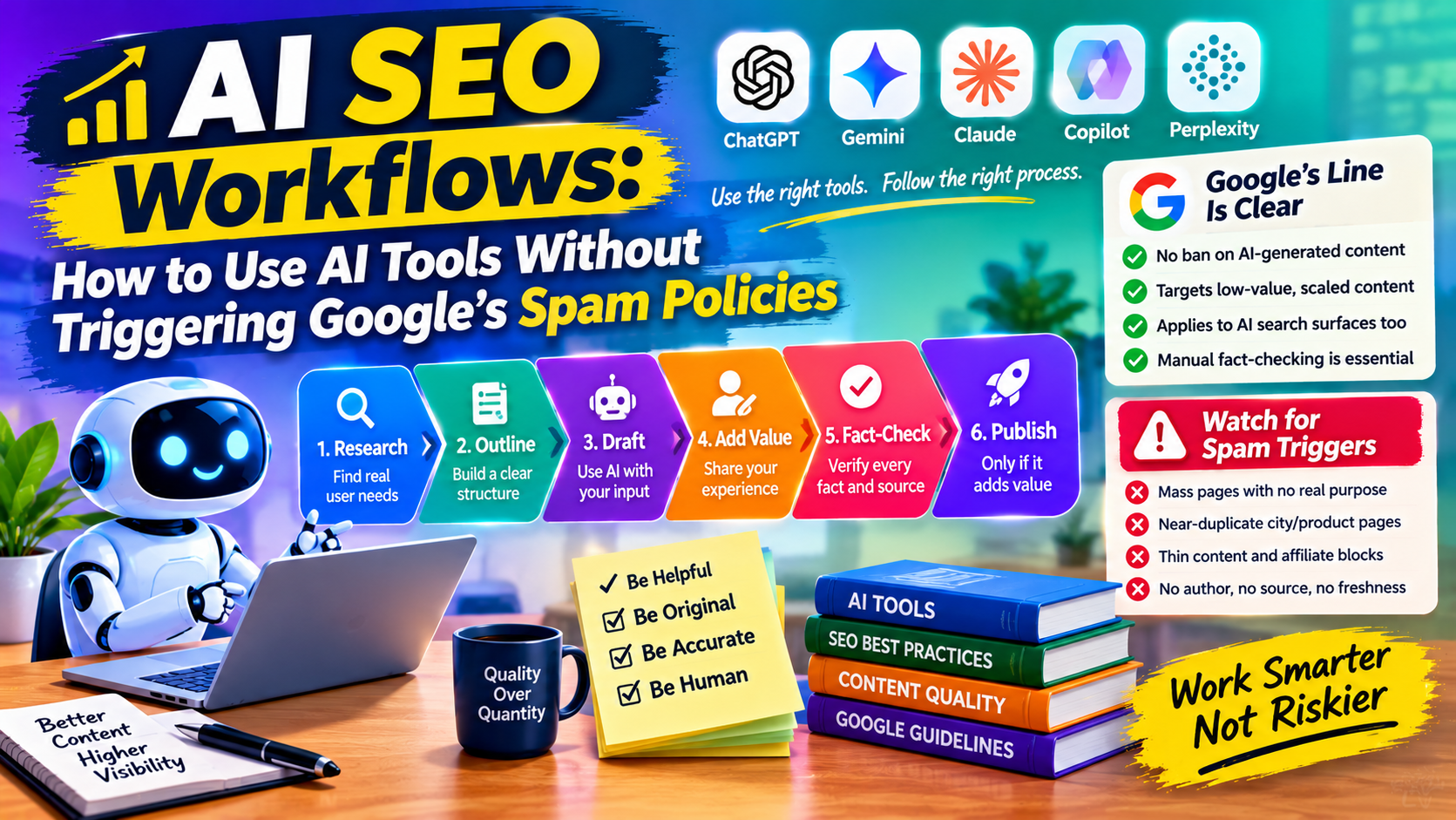
AI tools can research, outline, draft and optimize faster than any human team. Used well, that is a real advantage for AI SEO. Used carelessly, it is the quickest route to a traffic collapse. The difference isn’t the tool. It’s the workflow around it.
This guide explains where Google’s line sits, which tasks suit automation, and a review process that keeps quality high as you scale.
Where Google’s Line Actually Is
A common fear is that Google penalizes AI-written content. The policy says otherwise. The scaled content abuse policy, written in 2024, explicitly names generative AI as one way of producing scaled content, but the policy is method-agnostic. It does not prohibit AI-generated content. It targets content that gives users no real value, however it was produced. witscodedigitalapplied
The definition itself is short. Scaled content abuse means creating many pages primarily to influence rankings rather than to help people. And the rule applies to people too: the same standard can apply to content written by humans, generated by software or produced by a mix of both.
So the question to ask is not “Did a machine write this?” It is “Would this page exist if search engines didn’t?”
Enforcement Has Widened to AI Surfaces
The stakes rose as AI features grew. One summary notes that recent guidance doesn’t introduce new rules. It applies existing ones, including cloaking, scaled content abuse, link spam, site reputation abuse, doorway pages and thin affiliation, to AI search surfaces. Another source reports that a 2026 spam policy update wrote “attempting to manipulate an AI response in Google Search” into the rules for the first time.
A caution on sources: articles about 2026 spam and core updates disagree on dates and sequence, and most are commentary rather than Google documents. Treat any timeline as provisional and check Google’s own update dashboard before citing a specific rollout.
What Failure Looks Like
An analyst who reviewed sites hit by a 2026 spam update described patterns worth recognizing. They included a site combining programmatic and AI-generated content in a highly sensitive niche, a thin affiliate site with large blocks of AI-written text at the bottom of its pages, and a site with over 1.5 million indexed URLs. These are one reviewer’s judgments, not Google statements, but the traits are consistent: volume without purpose, templated pages and no human point of view.
Local and multi-location pages are a frequent trap. Pages auto-generated for each city or branch with near-duplicate templated copy are described as a textbook scaled content abuse case.
A Six-Step Workflow That Scales Safely
At Sarkar SEO, we use a gate-based approach rather than a volume target. A page only moves forward if it passes each gate.
- Start from a real reason. Define the reader, the question and what this page adds that existing results don’t. If you can’t answer that, don’t publish.
- Use AI for research and structure. Let it gather angles, cluster questions and propose an outline. Then change the outline to reflect your actual position.
- Draft with constraints. Give the tool your facts, examples and voice. Don’t ask it to invent expertise. A draft based on your own material is very different from one based on nothing.
- Add what a model can’t. Insert real experience: a result you measured, a mistake you made, a customer question you answered, a screenshot of your process. This is the content that is hard to copy, and it’s what both readers and ranking systems reward.
- Fact-check manually. One source reports that since 1 October, Google’s guidance also asks for a manual fact-check of every AI draft. Whatever the exact wording, the practice is sound. Verify every statistic, date, name and quotation against its original source. omnius
- Edit, then decide whether to publish. Cut filler. Remove repeated points. If the page still doesn’t add anything new, merge it into a stronger page or drop it.
Warning Signs in Your Own Pipeline
Check your workflow against these signals:
- Dozens of pages published per week with no named author or editor
- Pages that differ only by a swapped city, product or keyword
- Articles that restate the first three search results
- Claims with no source and no first-hand evidence
- No refresh plan for pages that go out of date
Any two of these together should prompt an audit.
Fewer, Better Pages
A recurring recommendation from analysts is to focus on fewer, higher-quality pages, because scale without substance no longer works. That also supports AI visibility. Generative answers lean on pages with clear, specific and trustworthy content, and thin pages rarely qualify.
Quality here is practical, not abstract. A strong page has a named author, a clear purpose, a current date, cited sources and at least one element that exists nowhere else.
Using AI to Improve Existing Content
Some of the safest wins aren’t new pages at all. Use AI to:
- Find outdated statistics and suggest where to refresh them
- Spot sections that duplicate each other across your site
- Draft FAQ candidates from real customer questions
- Check internal links and orphaned pages
These tasks improve content you’ve already invested in, with low risk of publishing something thin.
