



Ask five marketers what “AI SEO” means and you’ll get at least two answers. Some mean optimizing for AI-powered search results. Others mean using AI tools to do SEO work faster. This article covers the second meaning: how to build AI into your SEO process without damaging the quality, trust or rankings you’re working to earn.
The tools are powerful. The risk is that speed makes it easy to publish things you’d never have approved by hand.
Where Google Draws the Line
Google doesn’t ban AI-assisted content. Its guidance says generative AI can be particularly useful when researching a topic and adding structure to original content. The warning comes next: using generative AI to generate many pages without adding value for users may violate the spam policy on scaled content abuse.
The method isn’t the problem. Analysis of the policy notes it applies no matter how content was made, so human-written spam and AI-generated spam face identical consequences. Google Search Liaison Danny Sullivan has said that, to Google, AI-generated content is no different from the scaled content tactics of the past. He also noted that some in the SEO community misread Google’s policy as meaning AI content is fine as long as it’s good quality. rankaisearchenginejournal
So the question isn’t “Was AI involved?” It’s “Did a person with real knowledge make this page genuinely useful?”
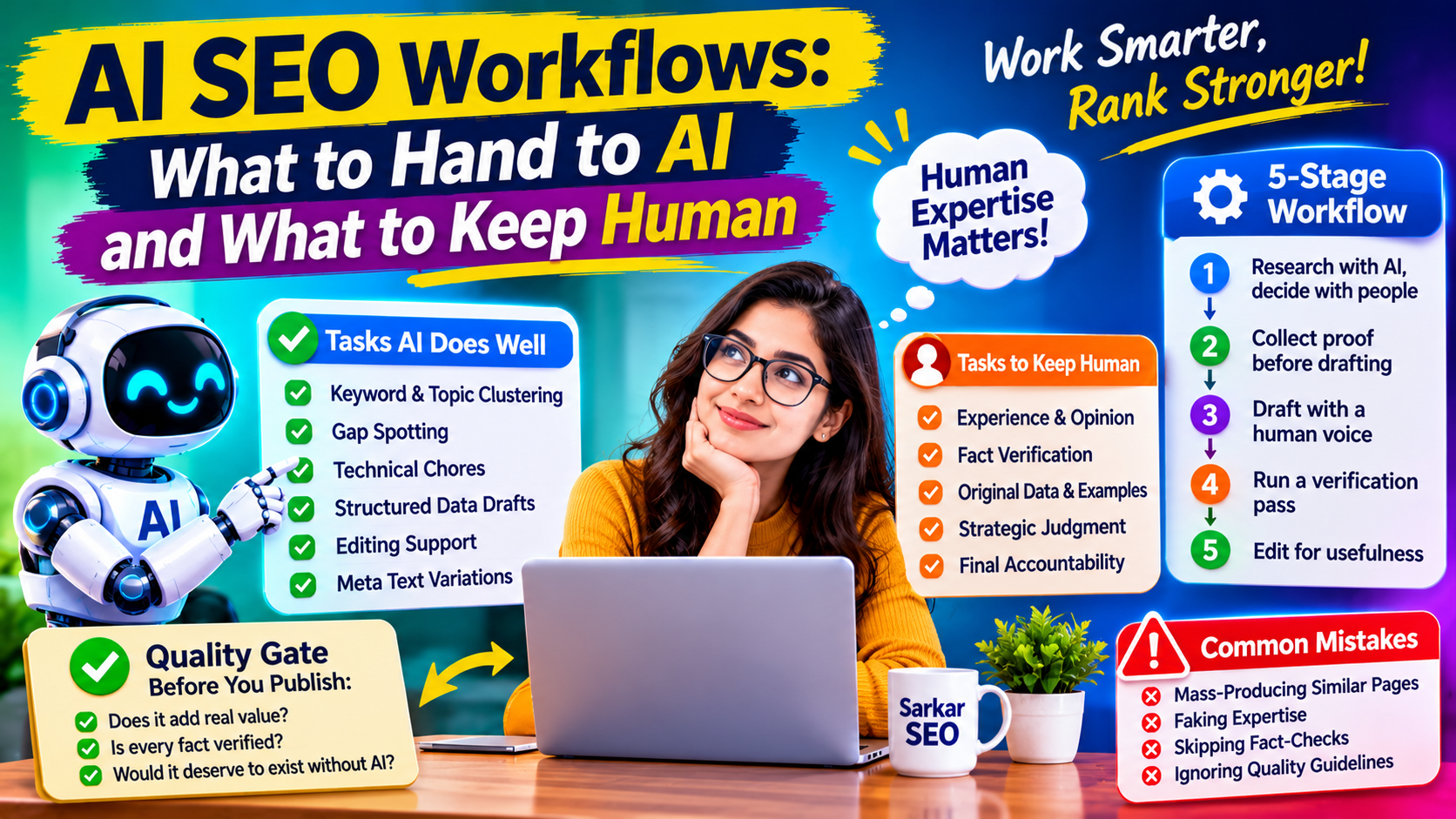
Tasks AI Does Well
Use AI where the work is mechanical, analytical or exploratory. In those areas it saves hours and the stakes of a small error are low.
- Keyword and topic clustering. Feed in a few thousand queries and ask for groupings by intent. You still decide which clusters deserve a page.
- Gap spotting. Compare your page against top results and list subtopics you’ve missed. Treat the output as a prompt for thinking, not a to-do list.
- Technical chores. Drafting redirect maps, summarizing crawl exports, spotting patterns in log files, and writing regex for bulk fixes.
- Structured data drafts. AI can produce JSON-LD quickly. Validate it, and make sure it matches what’s visible on the page.
- Editing support. Tightening sentences, flagging repetition, and checking tone consistency.
- Meta text variations. Generate options, then pick and refine the best.
Tasks to Keep Human
The work that makes content worth citing can’t be outsourced to a model that has never run your business.
- Experience and opinion. A model can’t tell a reader what it learned from a failed migration. Only someone who lived it can.
- Fact verification. Google specifically calls for reviewing AI-generated content for accuracy and trustworthiness, and that includes metadata and structured data, so checking the body copy alone is insufficient.
- Original data and examples. Screenshots, test results, client-safe case notes and interview quotes are the raw material AI can’t invent honestly.
- Strategic judgment. Deciding what not to publish matters as much as what you do.
- Final accountability. A named person should be able to defend every claim on the page.
A Five-Stage Workflow That Holds Up
- Research with AI, decide with people. Use AI to widen your view of the topic, then have an editor choose the angle and the questions the piece must answer.
- Collect proof before drafting. Gather the data, examples and expert input first. If you can’t find anything original to add, that’s a signal to rethink the topic.
- Draft with a human voice in charge. AI can create a rough structure or first pass, but the expert rewrites it using real experience.
- Run a verification pass. Check every statistic, date, name and technical claim against a primary source. Remove anything you can’t confirm.
- Edit for usefulness. Cut generic intros, repeated explanations and filler. Ask what a reader gets here that they couldn’t get elsewhere.
Sarkar SEO treats stage two as the real gatekeeper. When the evidence is thin, the piece usually shouldn’t be written yet, no matter how fast a draft could be produced.
A Simple Quality Gate Before Publishing
Before a page goes live, answer these honestly:
- Would this page deserve to exist if search engines didn’t?
- Does it contain at least one thing the top competing pages lack, such as data, a worked example or a clear point of view?
- Can a named author stand behind every claim?
- Is each fact traceable to a source you actually opened?
- Does the page serve a distinct need, or is it a near-duplicate of another page on your site?
Two or more “no” answers means the page needs work, not a publish button.
Mistakes That Create Real Risk
Mass-producing near-identical pages. Swapping a city name or product term into the same template is the pattern spam systems were built to find. Google also treats doorway abuse as its own problem: pages built to rank for narrow queries and funnel visitors elsewhere. ppc
Faking expertise. Invented author bios, made-up testimonials and “in my experience” lines written by a model about experiences no one had are both unethical and fragile. They collapse the first time a reader checks.
Skipping fact-checks because the text sounds confident. Language models produce fluent errors. Dates, statistics and product details are the usual casualties.
Optimizing only for volume. Publishing weekly sounds productive, but ten strong pages that earn links and citations beat a hundred forgettable ones.
Ignoring the rater guidelines. Google’s quality rater guidelines grew to 181 pages in January 2025, with the low-quality sections aligned to spam policies and a dedicated section on scaled abuse. Raters don’t set rankings directly, but the document shows what Google considers low value.
Building a Policy for Your Team
Write down your rules so quality doesn’t depend on who is editing that day. A good policy covers which tasks AI may handle, which require human authorship, how sources must be recorded, and who gives final approval. Add a line on disclosure: if AI helped meaningfully and readers would care, say so plainly.
Review the policy every quarter. Tools, platform rules and spam enforcement change often, so check Google’s current documentation rather than relying on last year’s summary.
