



Most AI SEO talk is about how to get cited by AI. A quieter question matters just as much: how safely can you use AI to do your SEO work? Draft a hundred pages with a prompt and you may save a month. You may also lose your rankings. Here is where the line sits, based on Google’s own documentation.
What Google Actually Allows
Google has not banned AI-assisted content. Its guidance says generative AI can be especially useful for researching a topic and adding structure to original content. Using AI tools to generate many pages without adding value for users, however, may violate Google’s spam policy on scaled content abuse.
The wording matters. The policy concerns value and intent, not the tool. One summary of the policy notes it applies whether content comes from AI, human writers, scraping, stitching content from other sources, or any other method. A team of people churning out thin pages is just as exposed as a script doing it.
The Scaled Content Line
Scaled content abuse became a named spam category on March 5, 2024. Its core test is whether many pages are generated for the primary purpose of manipulating search rankings rather than helping users. Quality raters get similar instructions: their guidelines describe it as creating large amounts of content with little effort or originality, and no editing or manual curation. Google says rater scores don’t directly influence ranking, but they show what its systems are meant to reward.
Two recent developments raise the stakes:
- AI answers are now in scope. One analysis reports that since May 15, 2026, Google’s spam policies state they also apply to generative AI responses in Search. The same analysis says that building pages for every query variation primarily to manipulate rankings or AI answers can violate the policy.
- Enforcement is active. A September 2026 spam update began on September 24, and scaled content abuse is among the policies in scope. ppc
This is the trap behind the popular advice to publish one page for every question an AI system might ask. Size alone doesn’t trigger the policy, since a large guide isn’t a violation by itself. Pages that exist only to catch variations do.
The Fact-Checking Rule Is Now Explicit
On October 1, 2026, Google updated its generative AI guidance. It now explains that generative models predict likely sequences of words instead of retrieving facts, so outputs may contain inaccuracies, and it is critical to manually fact-check all AI-generated content before publishing. searchenginejournal
The review reaches beyond body text. Google’s page applies it to metadata too, including title elements, meta descriptions, structured data and image alt text. Many teams only proofread articles while an AI tool quietly writes hundreds of titles and alt tags unchecked. That gap is now covered by Google’s own wording.
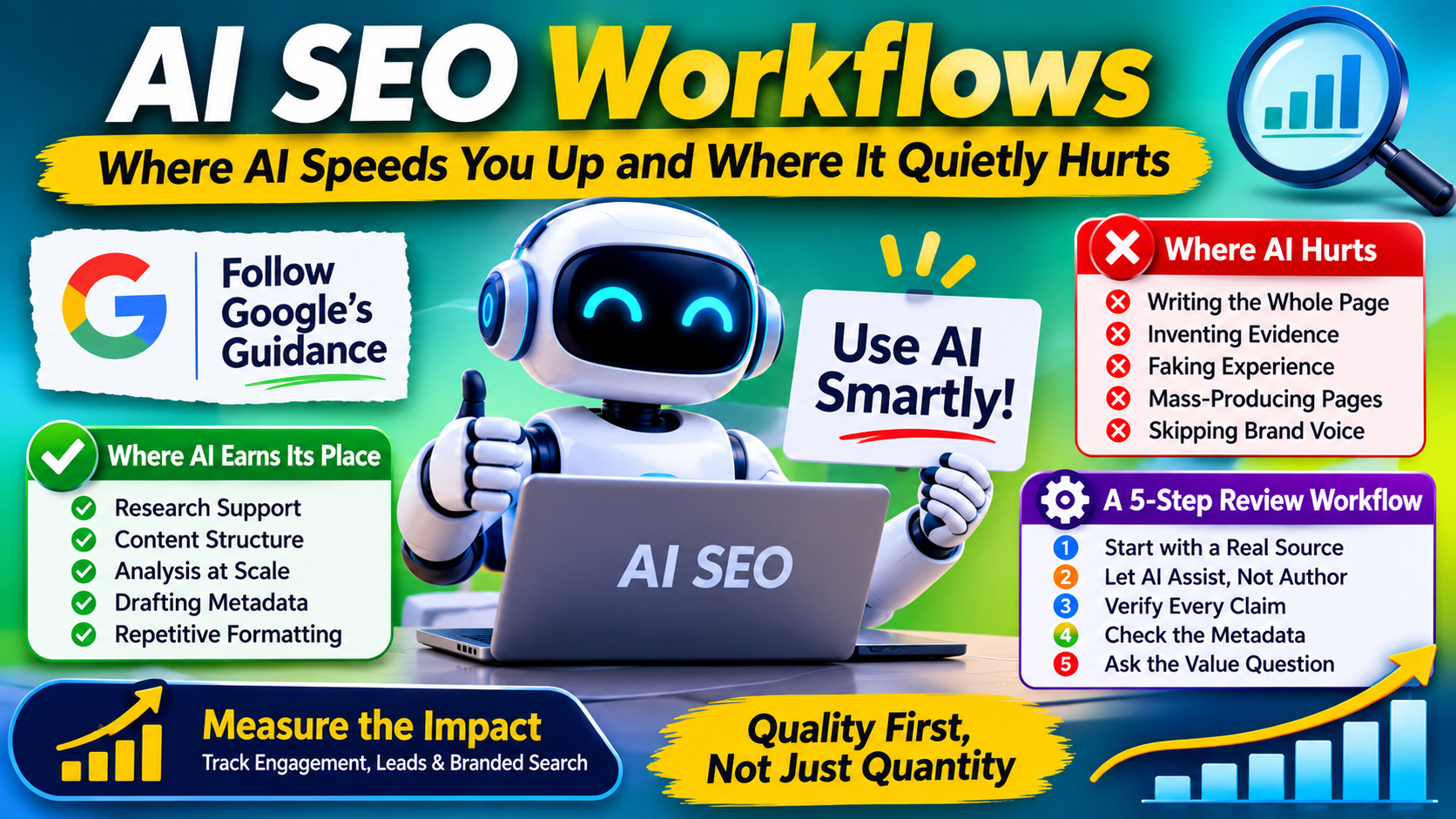
Where AI Earns Its Place
These uses fit comfortably within Google’s guidance, because a person still supplies the judgment and the original substance:
- Research support. Summarizing documents, surfacing questions people ask, and mapping subtopics you might have missed.
- Structure. Proposing outlines, heading hierarchies and ways to reorganize a rambling draft.
- Analysis at scale. Clustering keywords, spotting duplicate or cannibalizing pages, and sorting audit data.
- Drafting metadata. Producing title and description options that an editor then checks against the actual page.
- Repetitive formatting. Reformatting tables, transcripts and schema markup that a person validates.
Where AI Hurts
- Writing the whole page from nothing. Output built from other people’s pages tends to be generic. That works against the unique, non-commodity quality Google asks for in its AI search guidance.
- Inventing evidence. Models can produce plausible statistics, quotes and sources that don’t exist. Never publish a number you haven’t traced to its origin.
- Faking experience. If nobody on your team has done the thing, don’t write as though they have.
- Mass-producing near-duplicates. City-by-city or keyword-by-keyword pages with the same text and swapped nouns are the classic pattern.
- Skipping the brand voice. Readers notice sameness, and sameness gives no one a reason to cite you.
A Five-Step Review Workflow
Use this before any AI-assisted page goes live.
- Start with a real source of substance. Interviews, internal data, screenshots, product knowledge or documented results. If the page contains nothing a competitor couldn’t also prompt for, stop.
- Let AI assist, not author. Use it for research and structure, then write the argument yourself.
- Verify every claim. Trace each figure, date and quote to a source you opened. Delete anything you can’t confirm.
- Check the metadata. Review titles, descriptions, alt text and structured data as carefully as the article.
- Ask the value question. Would this page deserve to exist if search engines didn’t? If the honest answer is no, don’t publish it.
For larger programs, grow in planned waves rather than launching hundreds of pages at once. Have someone outside the writing process review samples, and monitor performance before expanding.
A Note on Measurement
Even with a clean process, judge results by outcomes. Compare engagement, qualified leads and branded search before and after AI enters your workflow. Sarkar SEO’s view is that speed is only a gain if quality holds, so track both together. If publishing volume rises while conversions fall, the workflow is costing you more than it saves.
What This Means for Your Strategy
The sensible reading of Google’s guidance is simple. AI is a power tool, and it magnifies whatever process you already have. A strong editorial process becomes faster. A weak one becomes spam at scale.
Sarkar SEO recommends treating AI as a junior research assistant: useful, fast and in need of supervision. Keep a named human accountable for every published page, and keep a record of the sources behind each claim.
Search keeps changing, and Google logs significant documentation changes on its updates page, so review your AI content policy a few times a year. If you want a second opinion on yours, Sarkar SEO can audit your workflow and flag where AI is helping and where it is putting rankings at risk.
