



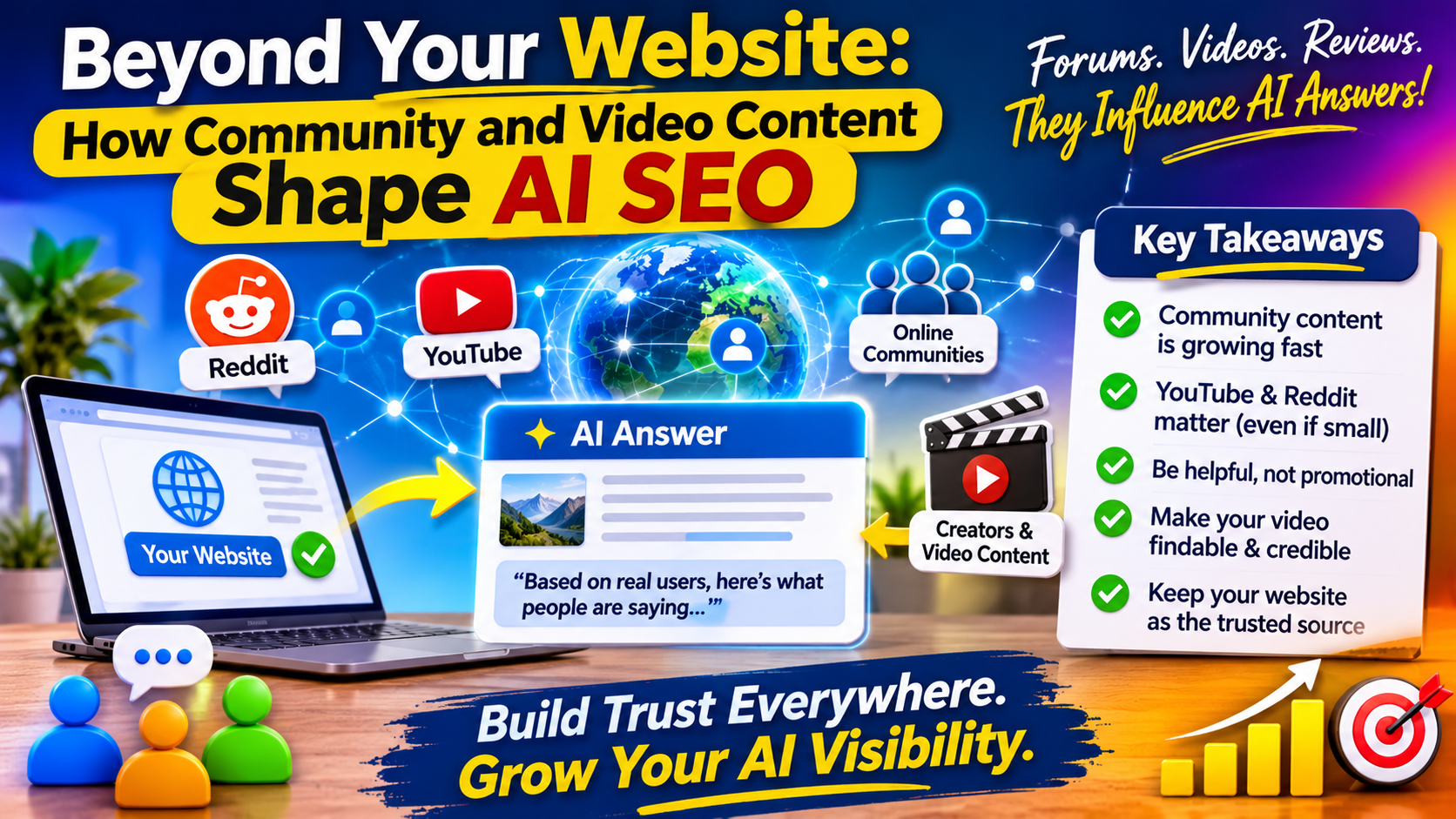
There’s an uncomfortable idea in AI SEO: the page that influences an AI answer about your business may not be on your website. It might be a forum thread, a YouTube video, or a creator’s review.
This article looks at what the research says about community and creator content, why the numbers keep contradicting each other, and how to take part without damaging trust.
The shift: more creators, fewer brand pages
AirOps, a content platform, published a large citation study covering about 3.5 billion AI citations. Its headline figures: creator and social citation share grew 140% between August 2025 and June 2026, while owned brand and product page citation share fell 10%.
The same dataset gives a more modest picture of individual platforms. YouTube held 4.6% of all AI citations by June 2026, and Reddit’s share peaked near 5.3% around the holidays before settling at 3.3%. So community content is growing quickly, but from a modest base. These are not majority numbers.
This is a vendor’s own study, so read it as one view. Still, the direction fits what practitioners report: assistants want evidence from real users, not only from sellers.
Why the statistics clash
If you search for “Reddit AI citations,” you’ll find claims that range from tiny to enormous. Here’s a sample, all from the sources I found:
- One synthesis says Reddit holds 46.7% of top-source share in Perplexity, 21.0% in Google AI Overviews and 11.3% in ChatGPT. mean
- Another puts Reddit at roughly 1 in 5 Perplexity citations.
- Another says Reddit was 6.6% of Perplexity’s total citations.
- Tinuiti reports that Reddit’s share of Perplexity citations fell from 25% in February to 7% in April.
Those can’t all describe the same thing. They differ in time period, sample, how “top source share” is defined, and which prompts were tested. That’s the real lesson: citation patterns move quickly, and no single figure is safe to build a strategy on.
The direction is also not one-way. Tinuiti also found that Reddit’s share in Google AI Overviews grew from 5% in February to 7% in April, with YouTube rising sharply in AI Mode. Different platforms, different trends, same period.
What this means in practice
Three conclusions hold up across the sources.
Platforms differ. One synthesis summarizes it neatly: Perplexity leans heavily on Reddit, ChatGPT leans on Wikipedia, Claude leans on legacy journalism, Gemini mirrors Google’s first page, and AI Overviews tracks top organic results. That is a generalization from one article, and I’d test it against your own category before leaning on it. But it explains why a strategy that works on one assistant may do nothing on another.
Video matters for Google. The same AirOps data says Google’s AI Overviews draw about one in every 9.5 citations from creator surfaces and one in 12 from YouTube alone. If your topic suits video, such as how-to tasks, product demonstrations or explanations, a well-made video may reach people your articles don’t. airops
Reputation is partly outside your control. You can’t own a thread about your product. But you can influence whether what’s said is accurate.
How to take part honestly
At Sarkar SEO, we’d frame community work as reputation and usefulness, not as a citation hack. A few practices keep that honest.
Be useful before anything else. Answer real questions in the communities relevant to your field. Share specifics, such as costs, timelines and trade-offs, not slogans. A good answer helps the asker whether or not an AI ever quotes it.
Disclose who you are. If you’re a founder or employee, say so. Hidden affiliations destroy trust, and communities such as Reddit have their own rules about self-promotion that you must read before posting.
Don’t fake it. Fake accounts, scripted praise and paid “organic” comments are unethical. They also tend to be noticed, and a failed attempt can hurt your name more than silence would.
Give people something worth discussing. Original data, honest comparisons and clear explanations get shared. A short survey of your own customers or a transparent price breakdown can spark real conversation.
Make your video findable. If you publish on YouTube, write clear titles and descriptions, add accurate chapters, and make sure captions are correct. One source notes that YouTube’s rich metadata, auto-generated captions and chapter markers help it earn citations. That’s a claim from a vendor blog, but accurate metadata costs nothing and helps viewers regardless.
Support your reviewers. Make it easy for happy customers to leave honest reviews on platforms relevant to your sector. Never pay for positive ones.
Keep your own site as the anchor
None of this replaces your website. AirOps’s data shows owned pages are still cited, just less. Treat your site as the source of record: accurate, detailed, and easy to quote. Community content then points back to something solid.
It also protects you against volatility. If a platform’s behavior changes, as the shifting figures above suggest it can, a business with a strong site, steady reviews and a modest community presence is exposed to less risk than one that bet everything on a single channel.
A simple monthly routine
- Pick five questions customers ask about your category.
- Run each in two or three assistants and note which sources appear.
- Look for community threads or videos that appear repeatedly.
- Read them. Are they accurate? Do they mention you? Do they miss something you could usefully clarify?
- If a thread has an error, reply politely with facts and your affiliation. Don’t argue, and don’t spam.
- Record what you find, and compare month to month.
This takes an hour or two and tends to reveal where your audience actually learns about you.
