



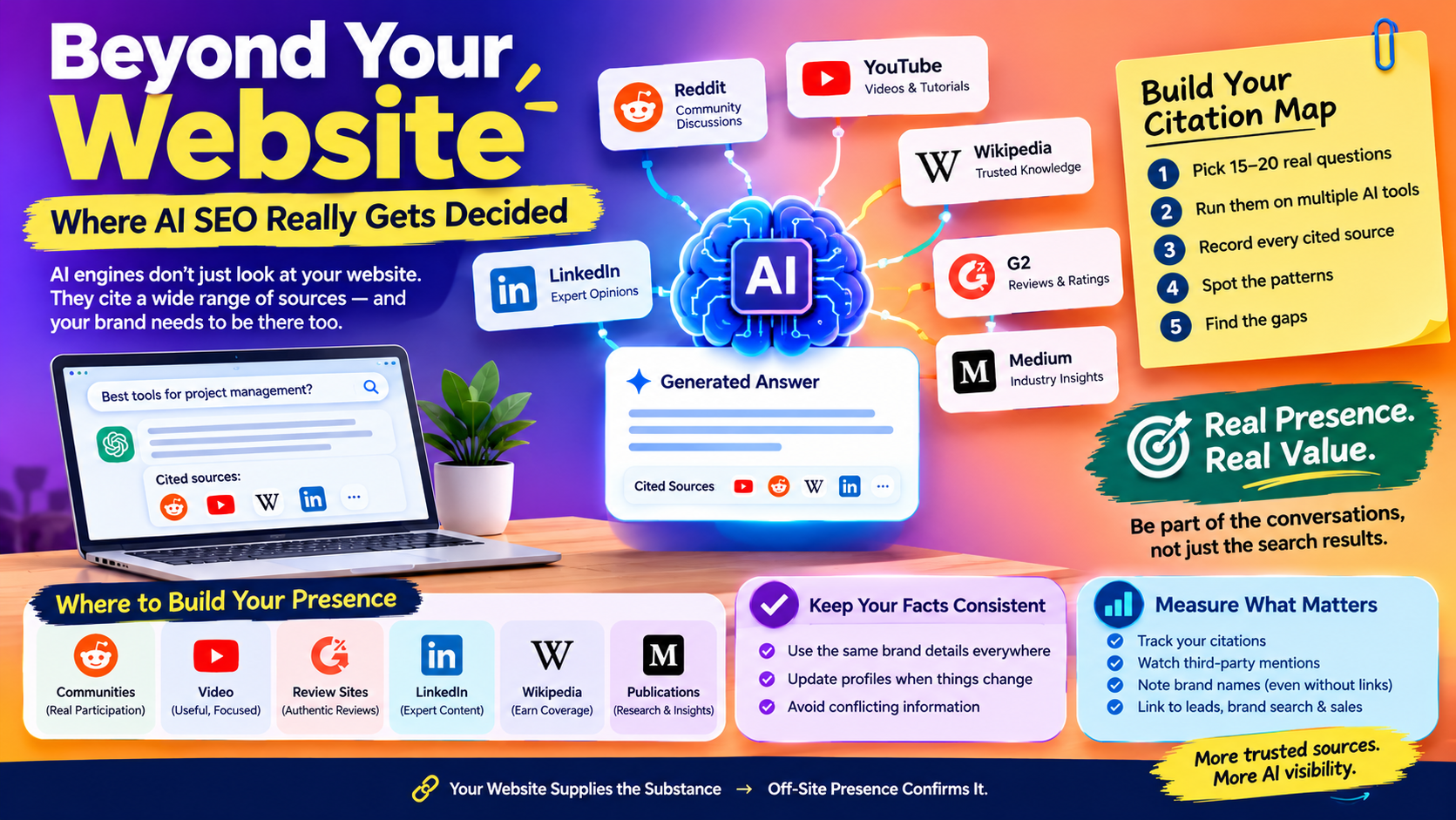
Most AI SEO advice treats your website as the whole game. But when ChatGPT, Perplexity or Google’s AI features assemble an answer, they often lean on pages you don’t own: discussion threads, videos, review profiles and encyclopedia entries. If your brand is absent from those places, a perfect website may not be enough. Here is what the research says about where AI engines look, and how to build a presence there honestly.
Which Sources AI Engines Actually Cite
Citation studies disagree on exact numbers, but the pattern is consistent. Peec’s March 2026 analysis of 30 million cited sources across five platforms found that Reddit and YouTube appear in the top five for all five platforms, the only universal signals. Beyond those two, each engine has its own taste:
- ChatGPT leans editorial. Its top five are Wikipedia, Reddit, Forbes, Techradar and LinkedIn.
- Perplexity favors community and review content: Reddit, YouTube, LinkedIn, Wikipedia and G2.
- Google’s AI Overviews lean toward YouTube, Reddit, Facebook, LinkedIn and Medium.
Meltwater’s April 2026 analysis of about 5.35 million citations across eight models points the same way, finding that YouTube is the number one source for Perplexity, Gemini, Google AI Overviews and Google AI Mode. meltwater
Read the Numbers With Caution
Treat any single percentage with suspicion. One aggregated index claims Reddit captures roughly 40% of all AI citations. AirOps, tracking citations monthly, reports a much smaller figure, saying Reddit’s share of all AI citations settled at 3.3% by June 2026, while YouTube held 4.6%. The gap comes from different engines, query sets, dates and counting methods.
The sensible takeaway is not a ranking but a principle: AI answers draw from a wide mix of sources. One analysis notes that outside Wikipedia and Reddit, no domain exceeds 3% of ChatGPT citations. The field is long-tail, so there is no single platform to win.
A Different Starting Point: The Citation Source Map
Rather than copying a generic list, build your own map for your category. This is a simple exercise you can run in an afternoon:
- Pick 15 to 20 questions your buyers genuinely ask, from early research to final comparison.
- Run them through several assistants, including ChatGPT, Perplexity, Gemini and Google’s AI features.
- Record every cited source, not just whether you appear. Note the domain and type: forum, video, review site, publication, directory.
- Tally the patterns. You’ll quickly see which three or four source types dominate your niche.
- Mark the gaps. Where do competitors appear that you don’t?
Sarkar SEO encourages treating this map as the real brief for off-site work, because a SaaS tool, a local clinic and a manufacturer will each find completely different sources shaping their answers.
Building Presence Without Faking It
One caution first. Google’s AI search guidance says that seeking inauthentic mentions is less helpful than it might seem, since quality systems and spam defenses are designed to catch it. Every tactic below assumes real participation.
Communities. If Reddit or a niche forum appears in your map, answer real questions with real expertise. Disclose your affiliation, avoid link-dropping, and expect slow results. A helpful, specific answer can be cited long after it’s posted.
Video. YouTube’s role is notable partly because of how it’s cited. AirOps found that about 99% of YouTube citations point to one specific video. That suggests value in focused videos that answer one question well, rather than broad channel branding. Give each video a clear title, an accurate description and a transcript or captions. airops
Review platforms. If your category relies on them, a complete, current profile and a steady flow of genuine customer reviews matter. Perplexity’s top five including G2 shows that review sites can be a direct path into answers for software buyers. Never buy or incentivize fake reviews.
LinkedIn. It appears in the top five for ChatGPT, Perplexity and Google’s AI Overviews in the Peec data. Publish substantive posts from named experts, and keep your company page factual and complete.
Wikipedia. It is a major source for ChatGPT, but it only covers subjects with independent, reliable coverage, and editing your own company page raises conflict-of-interest problems. Earn the coverage first, through press, research and recognition, then let others document it.
Publications. Because ChatGPT leans editorial, original research, expert commentary and contributed pieces in credible industry outlets can carry weight. Quality and relevance beat volume.
Keep Your Facts Consistent
Across all these places, the same basics should match: company name, description, services, locations, leadership and contact details. Inconsistency gives an AI system conflicting evidence about who you are. Sarkar SEO suggests keeping one short, approved brand description and reusing it everywhere, then updating it in every profile whenever something changes.
Measure What Matters
Repeat your Citation Source Map every quarter. Track three things: how often your own pages are cited, how often third-party pages mentioning you are cited, and how often your brand is named without a link. Pair this with leads, branded search and sales conversations, since citations are a means rather than the goal. Remember that these engines change quickly, so a source that dominates today may fade.
Where Your Website Still Fits
None of this replaces a strong site. Your own pages remain the source of truth that other platforms point back to, and Google’s AI features still draw on its core search index. Treat off-site presence as a multiplier: your site supplies the substance, and trusted third-party places confirm it.
If you’d like help building your own Citation Source Map or deciding which off-site channels deserve your time, Sarkar SEO can run the analysis and turn it into a focused, honest plan.
