



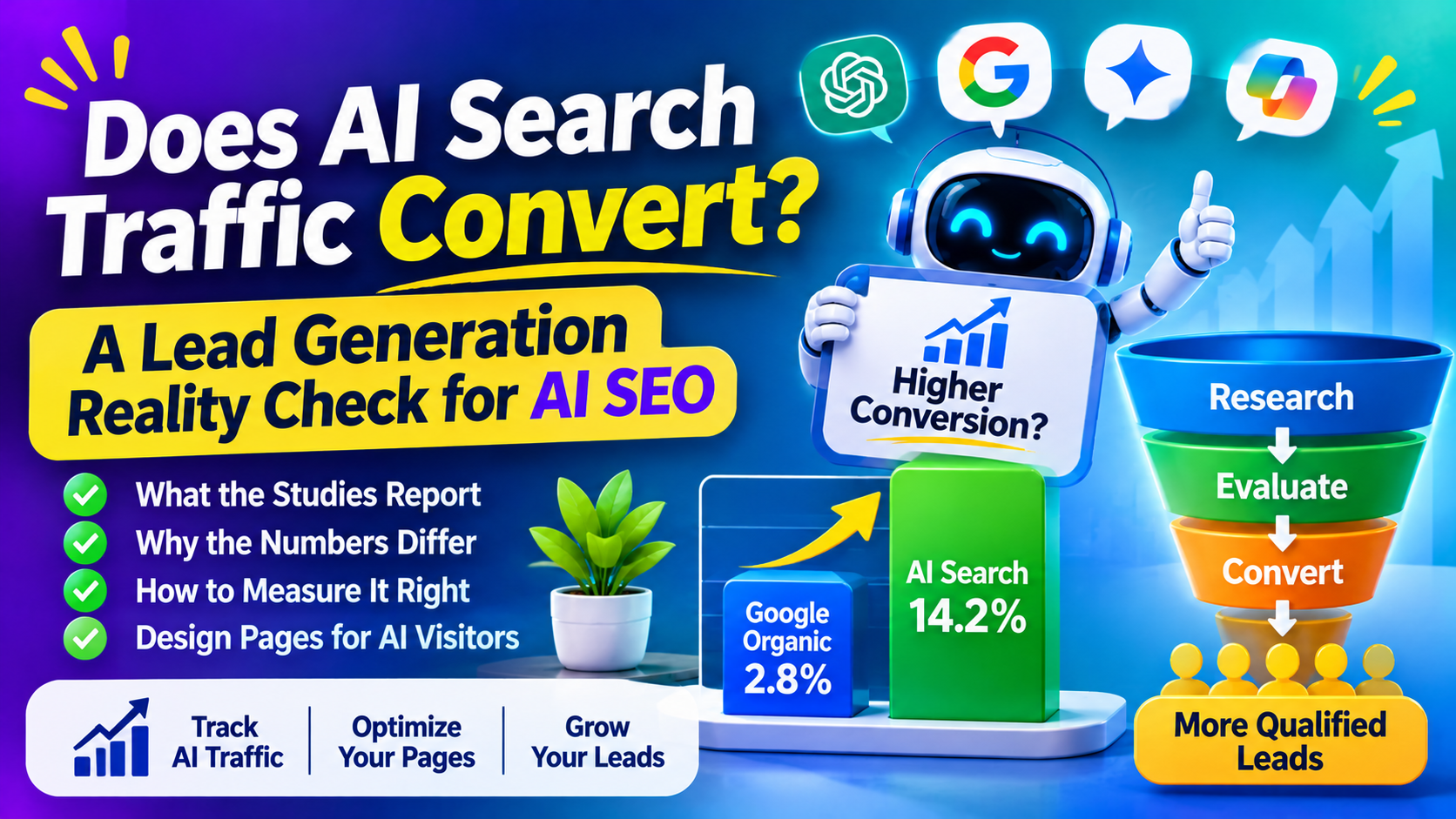
Every few weeks a new headline claims AI visitors convert five, nine or even twenty-three times better than Google visitors. If you run a lead generation business, those numbers are tempting. They are also inconsistent, often from vendors, and easy to misread. Sarkar SEO takes a more careful view: AI SEO search traffic looks valuable, but you should confirm that on your own site before reshaping a budget around someone else’s average.
What the studies report
Most of the excitement traces to a handful of datasets:
- Opollo’s benchmark of 312 B2B tech firms reported that AI-referred visitors converted at a mean of 14.2%, against 2.8% for Google organic.
- Seer Interactive’s client data showed ChatGPT referrals converting at 15.9% against 1.76% for Google organic.
- Semrush’s 2026 data puts the cross-industry advantage at 4.4 times.
- On Ahrefs’ own site, AI visitors converted at 23 times the rate of organic, with 0.5% of traffic producing 12.1% of signups, although that is single-site, self-reported data. guptadeepak
Taken together, one roundup concludes that AI search traffic converts between 1.2 and 9 times better than Google organic depending on the study, industry and definition of conversion. That spread is the real finding.
Why the numbers disagree
Three things explain the gap.
Definitions differ. One study counts a demo request, another a purchase, another a newsletter signup. A 14% rate for form fills is not comparable to a 2% rate for sales.
Industry matters. One analysis reports that B2B SaaS converts AI traffic at 2.7% against 1.4% for organic, but the pattern reverses for ecommerce, where organic reached 2.1% against 1.6% for AI.
Timing matters. Earlier research pointed the other way. A study of nearly $20 billion in ecommerce transactions found that organic search showed 13% higher conversion than ChatGPT, and ChatGPT represented only about 0.2% of total sessions. By 2026, one commentator says the early 2025 gap of roughly 50% below traditional search traffic had reversed. AI products, user habits and link placement are changing quickly, so any benchmark is a snapshot.
Volume is still small
A high conversion rate on a small base is still a small result. One analytics audit reports that B2B SaaS companies see AI referral traffic at 2% to 8% of total organic visits, and consumer ecommerce brands typically 1% to 4%. That source is a vendor, so treat the ranges as indicative. For most sites, AI search is a promising channel that supports lead generation but has not replaced organic search.
Why AI visitors might convert better
The common explanation is selection. By the time someone clicks a citation, they have already had a conversation with an assistant, compared options and narrowed the field. One AI visibility vendor puts it as AI referral visitors arriving further along in their decision process. That is a reasonable hypothesis, not a proven mechanism. It also suggests a risk: if you are not in the shortlist, you do not even get the click.
The measurement problem comes first
If you cannot see AI traffic, you cannot judge it. Two warnings stand out. One benchmark notes that ChatGPT traffic is undercounted in GA4, and that Copilot traffic splits between copilot.microsoft.com and Bing referrers. Another finds that only 14% of marketers track AI search as a separate channel. Convergence Blog August 2026 +2
A basic setup that works for most teams:
- In your analytics tool, create a custom channel group for AI referrals using the source domains of the main assistants. Check the list every quarter, because domains and tagging change.
- Segment landing pages by that group so you can see which pages receive AI visitors.
- Pass the source into your CRM so leads and revenue, not just sessions, are attributed.
- Add an optional “How did you hear about us?” field to forms. Many people who find you through an assistant arrive as direct or branded visits, and self-reported answers catch some of them.
- Ask your sales team to record when prospects mention an AI tool during calls.
Sarkar SEO suggests reviewing these numbers monthly, in one dashboard, next to organic search and paid, with the same conversion definition for all three.
Design pages for a visitor who has already done the research
An AI visitor has often read a summary of your page before arriving. Pages that restate basics lose them. Instead:
- Open with what they came to verify: fit, pricing logic, proof, process.
- Match the page to the claim the assistant likely cited, so the answer is visible within seconds.
- Offer a clear next step suited to a late-stage buyer, such as a demo, a quote, or a calculator.
- Keep a short list of “who this is for and who it is not for,” which builds trust.
- Remove friction from forms, since these visitors are already motivated.
Run your own 90-day test
Rather than rely on a study of other people’s sites, use your own data.
Days 1 to 15: Set up the channel group, CRM fields and the self-reported source question. Record a baseline.
Days 16 to 75: Improve a small set of pages that already receive AI referrals or match your priority prompts. Keep a comparison group of similar pages you do not change.
Days 76 to 90: Compare lead volume, lead quality and revenue per visit across AI, organic and paid. Judge by pipeline value, not by conversion rate alone.
A cautious reading will help here. If your AI sample is 30 visits, a 20% conversion rate is six leads, which is far too few to conclude anything.
When to invest more
AI visibility tends to justify more investment when your sales cycle is long, buyers research heavily, and your category already gets recommendations in AI answers. It is a weaker fit if your offer is a low-cost impulse purchase or if your buyers rarely use assistants. Start with measurement, then scale what your own numbers support.
