



For two years, one piece of advice has dominated AI SEO: add structured data and the machines will understand you. Agencies sold it, tools automated it, and checklists listed it first. Then someone actually tested it. This article explains what the controlled evidence shows, where schema still earns its place, and how to spend the time you’d save.
Where the Schema Advice Came From
The idea began with a correlation. Ahrefs analyzed six million URLs and found that AI-cited pages were almost three times more likely to contain JSON-LD, a common structured data format. It was easy to read that as “schema causes citations.” But well-built, authoritative sites often use schema for many reasons, so the markup may simply travel with other quality signals.
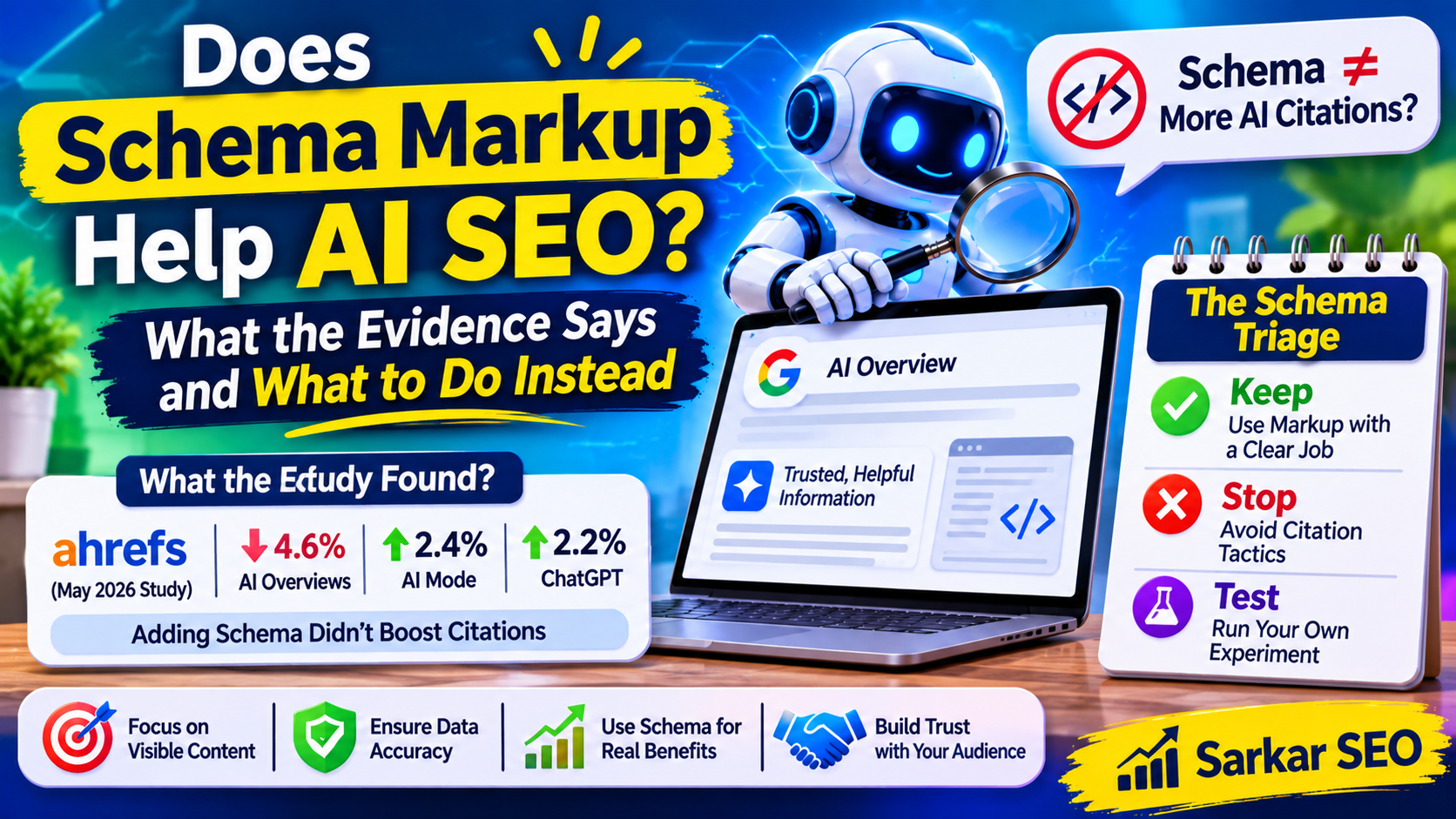
Ahrefs then tested cause and effect. According to a summary of its May 2026 study, it tracked 1,885 pages that added JSON-LD between August 2025 and March 2026 and compared them with 4,000 control pages across AI Overviews, AI Mode and ChatGPT. The changes were minus 4.6% for AI Overviews, plus 2.4% for AI Mode and plus 2.2% for ChatGPT, with the last two statistically indistinguishable from zero. In plain terms, adding schema did not make these pages more likely to be cited. techwysestrategicrevenue
What the Study Can’t Tell You
Be fair to the markup. Every page in the dataset already received 100 or more AI Overview citations before schema was added, so the study can’t say whether markup helps pages that AI tools haven’t noticed yet. Ahrefs itself acknowledged that gap. Schema additions also often happen alongside other edits, which muddies any single-factor conclusion.
A second experiment helps explain the result. Researchers at searchVIU tested ChatGPT, Claude, Perplexity, Gemini and Google AI Mode. As summarized by commentators, during live retrieval every system read visible page content and ignored JSON-LD, hidden microdata and hidden RDFa. I found this only through secondary summaries, so treat it as supporting evidence, not settled fact. It does fit the broader point that machines respond to the words on your page.
Google’s position is consistent with this. It states that structured data isn’t required for generative AI search and that no special schema.org markup needs to be added.
What Schema Is Still Good For
None of this makes structured data useless. Ahrefs’ report concluded that schema supports rich results and knowledge graphs, even though it doesn’t increase citations for pages already cited. Classic benefits still apply: eligible rich results in Google, clearer product and organization data, and cleaner connections between your site and your business profiles.
So the decision is not “schema or no schema.” It’s about purpose. Add it where it serves a defined, verifiable goal, and don’t expect it to be an AI visibility lever.
The Schema Triage
Here is a simple way to sort your markup decisions. This is a working framework based on the evidence above, not an industry standard.
Keep: Markup With a Clear Job
- Organization and website basics that identify your business consistently.
- Product, review and availability data for stores, where rich results and merchant systems use it.
- Article and author details that match what readers see on the page.
- Breadcrumbs and similar navigation markup that help search engines understand structure.
The rule for every type is that the markup must match the visible page. A mismatch is worse than none.
Stop: Markup Used as a Citation Tactic
- Marking up dozens of generic FAQs purely in the hope that AI tools quote them.
- Putting facts in JSON-LD that appear nowhere on the page.
- Paying for a “schema overhaul” as the centerpiece of an AI strategy without controlled evidence.
If a vendor claims schema drives AI citations, ask what experiment supports it. One commentator suggests requesting controlled evidence, not correlation and not case studies where six things changed at once. jamiemckaye
Test: Your Own Pages, Your Own Market
The research leaves one question open, so run a small experiment. One guide suggests picking five to ten pages that already earn some AI citations, adding JSON-LD to them, and leaving a matched group untouched as controls, then comparing after 30 days. Record the same set of prompts for both groups. It won’t be statistically rigorous, but it will tell you whether the effort deserves more budget.
Put Your Facts Where Machines Read Them
If AI tools read visible text, the practical move is to make key facts impossible to miss in plain language:
- State prices, specifications, locations, hours, eligibility and policies in the main body, not only in markup or collapsed tabs.
- Place direct answers near the top of each section, in a full sentence that makes sense on its own.
- Use clear headings that match how people phrase questions.
- Label tables and lists so each one explains what it shows.
- Make sure important content appears in the HTML a crawler receives, without requiring user clicks to reveal it.
Sarkar SEO treats this as the practical test for any page: if you removed all the markup, would a stranger still find the answer in the first screen of text?
A One-Week Review
- Export a list of the schema types your site uses and the pages they appear on.
- Check each against the visible page for accuracy, and fix mismatches.
- Remove markup you can’t justify with a specific purpose.
- For your ten most important pages, rewrite any key fact that appears only in markup so it appears in text.
- Set up the 30-day experiment on a small group of pages.
