



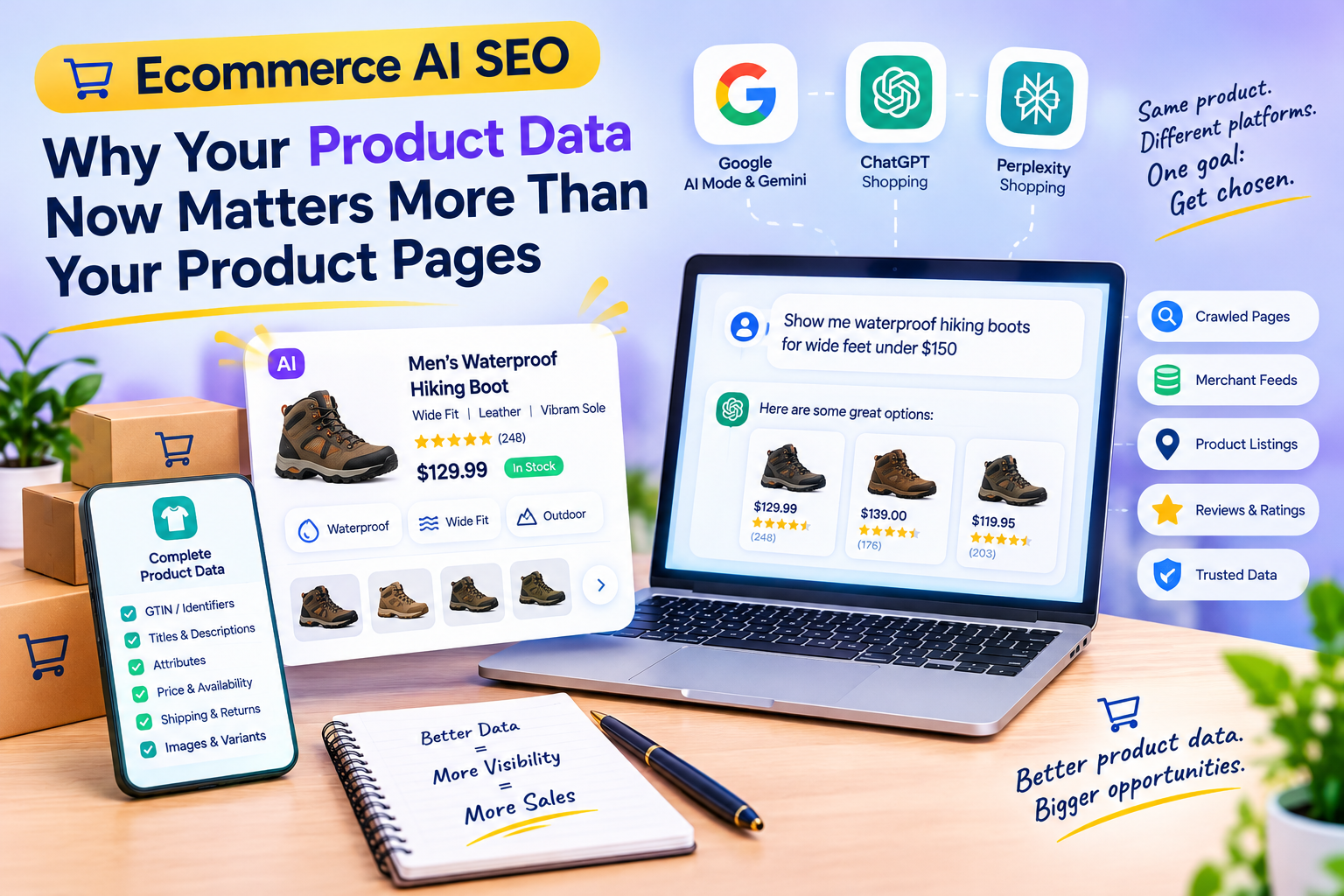
A shopper types, “waterproof hiking boots for wide feet under $150,” into an AI assistant. Within seconds they see three or four products with prices, images and ratings. Nobody browsed a category page or compared tabs. The assistant did that work, using data it could trust and parse.
For online stores, that makes AI SEO partly a data problem. The question is no longer just whether your product page reads well, but whether your product information is complete, consistent and structured enough for a machine to select it.
How AI Shopping Finds Products
The routes differ by platform, and several details are changing fast.
Google’s AI Mode and Gemini. According to Scandiweb’s guide, AI Mode shopping draws from the same sources as Google Shopping: pages Google can crawl and index, and product data in Google Merchant Center. Google reportedly says no extra requirements or special markup apply to AI Mode. Lengow adds that Merchant Center introduced “conversational attributes” for AI-driven discovery in May 2026, though I could not review Google’s own documentation to confirm the details.
ChatGPT shopping. Scandiweb describes ChatGPT’s product results as drawing on crawled pages, Shopify Catalog, direct feeds and third-party data. One vendor guide, citing Search Engine Land research from March 2026, claims that 83% of products in ChatGPT’s shopping carousels trace back to Google Shopping organic results. Treat that figure as unverified, since I found it only in a vendor’s summary.
Perplexity. Per Alhena’s comparison, it relies on its own Merchant Program and feed integrations.
The common thread is that clean product data feeds several surfaces at once. Alhena notes that Google has not confirmed Merchant Center as a direct AI Mode ranking signal, though its Shopping Graph is shared infrastructure behind many product mentions. In other words, the feed is probably important, but nobody outside Google can prove exactly how much.
Being Listed Is Not the Same as Being Chosen
Many platforms now syndicate products automatically, which tempts merchants to assume the job is done. It isn’t. A product can be present in a feed and still never appear in an answer because its data gives an assistant nothing to match against a shopper’s request.
Consider two listings for the same boot. One title says “Trail Boot 400.” The other says “Men’s Waterproof Hiking Boot, Wide Fit, Leather, Vibram Sole.” A shopper asking about wide-fit waterproof boots can only be matched with the second. Specificity is the entire game.
What to Fix in Your Product Data
At Sarkar SEO, we split ecommerce AI readiness into five checks, ordered by how often they go wrong.
- Titles that describe, not brand. Lead with what the product is, then key attributes such as material, size range, fit, color and use case. Keep brand names where they help recognition, but don’t let them replace meaning.
- Descriptions that answer buying questions. Explain who the product is for, when to use it, what it is made of and how it differs from close alternatives. Avoid recycled manufacturer text that appears on dozens of other sites.
- Complete attributes. Fill identifiers such as GTINs, plus size, color, material, age group, gender and condition. Missing fields are the most common reason products fail to match specific requests.
- Prices and availability that agree everywhere. Alhena reports that Google cross-references feed data against what’s on the product page, so an item marked in stock in the feed but sold out on the page undermines trust. That claim comes from a single vendor, but the logic is sound regardless: mismatches frustrate customers and can cause disapprovals.
- Images and variants. Provide clear main images, useful secondary angles and correctly structured variants, so one product with five colors isn’t five confusing duplicates.
Keep the Page and the Feed Aligned
Feed data gets a product selected, but the landing page closes the sale, and AI systems may read both. Make sure the product page states key specs in plain text rather than only in images, shows real customer reviews with dates, lists shipping and return terms and uses product schema markup that matches visible content. Google says no special markup is required for AI Mode, so treat schema as a consistency aid, not a trick.
Support pages matter too. Buying guides, sizing charts and comparison articles can answer the pre-purchase questions that AI tools handle, and they give your brand something to be cited for beyond a single listing.
Platform Changes Worth Checking Now
Commerce infrastructure is moving quickly, and several claims below come from single vendor sources, so verify them in the platforms themselves.
- Alhena reports that Google’s older Content API for Shopping was scheduled to shut off on August 18, 2026, and that feeds still writing through it would stop updating. If your store connected years ago, confirm you’ve moved to the Merchant API.
- The same source says ChatGPT’s Instant Checkout was discontinued in March 2026, with discovery continuing and purchases redirecting to merchant sites. Check OpenAI’s current merchant documentation.
- Scandiweb notes that Google announced an AI performance report in Merchant Center showing how brands appear on AI surfaces. Use it if it has reached your account.
Mistakes That Cost Visibility
- Treating the feed as a one-time setup. Stale prices, discontinued items and old stock levels accumulate quickly.
- Blocking the wrong crawlers. Scandiweb notes that blocking OAI-SearchBot removes pages from ChatGPT search answers, and blocking Googlebot removes you from Google’s AI features entirely.
- Copying manufacturer descriptions. Identical text gives an assistant no reason to prefer your listing.
- Ignoring reviews. Ratings and review content support product selection and trust.
- Optimizing only for one engine. Because much of the data is shared, fix the foundation once rather than building separate versions for each platform.
