



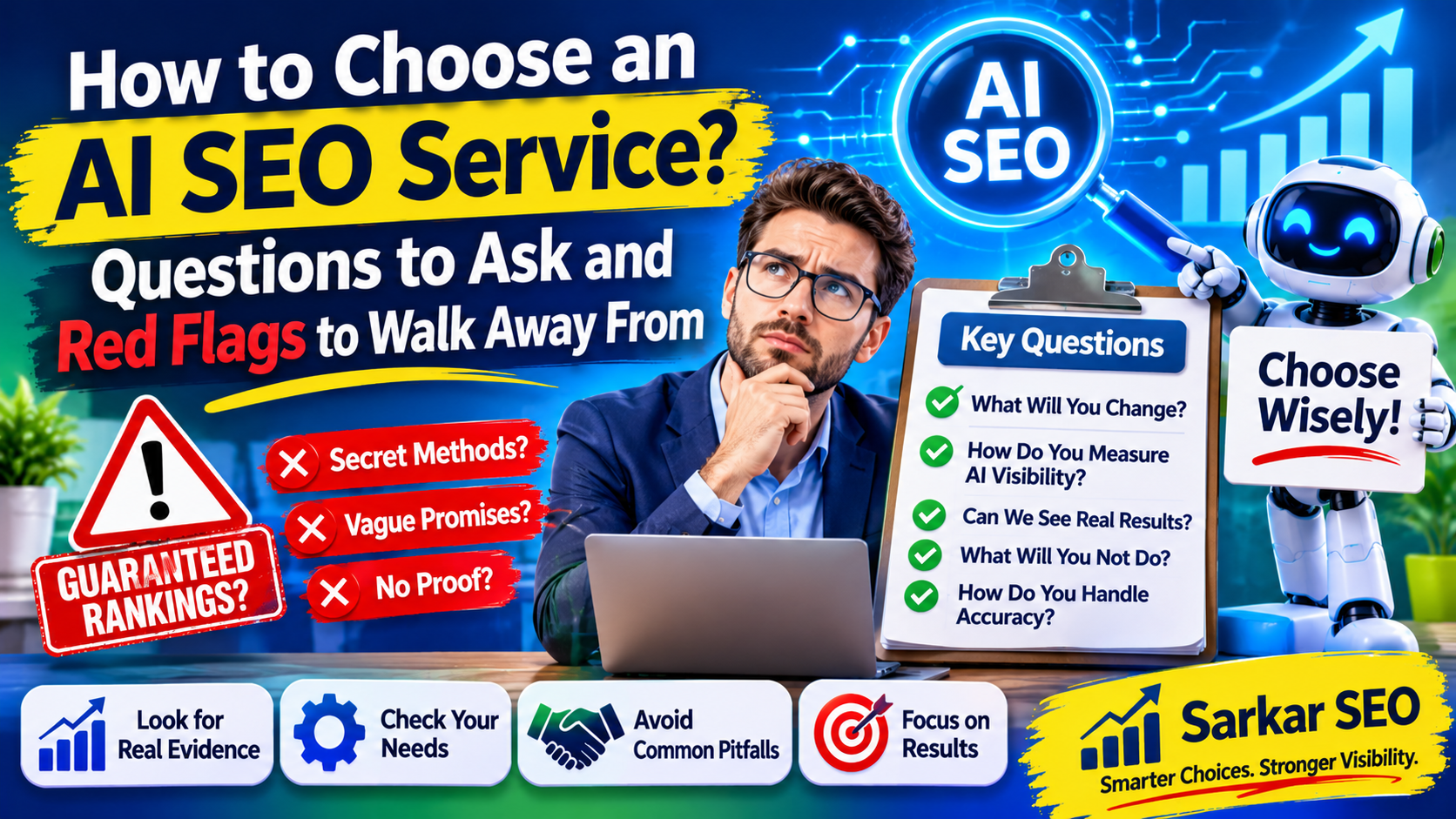
Every agency now seems to sell AI search. “Generative engine optimisation,” “answer engine optimisation” and “AI visibility” have appeared on service pages almost overnight. Some of those services are genuine. Others are old AI SEO packages with a new label. If you are about to hire, the hard part is telling them apart before you sign. This guide gives you a way to do that, and Sarkar SEO encourages you to apply every test below to us as well.
Why choosing a provider got harder
One UK agency describes the situation well: scroll through almost any agency’s services page and you’ll find AI search or generative engine optimisation near the top, often added in the last few months. New terms mean buyers cannot rely on familiar benchmarks, and no standard credential exists for this work.
There is also an official reference point. Google’s guidance for its own AI features says optimising for them is still SEO. A summary of that guide notes that Google tells owners weighing third-party AEO or GEO advice or services to review its own guidance and evaluate their recommendations against it. That is a useful starting habit: ask any provider to justify each recommendation against official documentation or to explain clearly why the advice applies to a different engine.
The proof ladder
The following is my own framework for sorting what a provider tells you into three levels of reliability. It is not an industry standard.
Rung one: claims. “We get you recommended by AI.” “Proprietary method.” “Proven results.” These are statements with no way to check them.
Rung two: activities. “We will fix crawler access, rewrite these twelve pages, add original data, and audit your listings.” Specific work can be reviewed and scheduled.
Rung three: evidence. Baseline tests, dated before-and-after results, real reports from existing clients and measured business outcomes.
A good proposal lives mainly on rungs two and three. One buyer’s guide puts it neatly: if a proposal describes outcomes without naming activities, keep asking, because deliverables can be audited and promises cannot.
The biggest red flag: guarantees
Several independent guides agree on this point. One says the biggest red flag is a guaranteed spot in ChatGPT or Google’s AI answers, because no agency controls which sources an AI engine picks. Another adds that the same prompt changes from run to run. A third explains that a credible agency talks about increasing your chances of inclusion and improving visibility signals. What to Look For in an AI Search Agency: 29 Questions to Ask Before You Sign +2
Treat guaranteed rankings, citations or mentions as a reason to end the call. That applies to any agency, including us.
Other warning signs
- Secret methods. Guides list secret or vague methods, where it is unclear what they do to get you into AI search as a warning sign. You do not need to see trade secrets, but you should understand the work.
- Rebranded reporting. One guide warns of keyword rankings, SERP features or “AI position tracking” that is actually just Google Search Console data rebranded. If reporting shows no AI-specific data, the AI element may be only a label.
- Single screenshots as proof. Answers vary over time. A single screenshot proves very little, and a good provider should be able to explain the pattern of which questions produce citations and how.
- Treating AI as a separate world. Pitches that ignore ordinary SEO foundations, such as crawlability, content quality and technical health, deserve scepticism, since those foundations still matter.
- Vague “boost your AI presence” language without named prompts, engines or deliverables.
Questions worth asking
Keep the list short and make every answer concrete.
- What will you change on our site and elsewhere, and in what order?
- How do you measure AI visibility, which engines and prompts do you track, and how often? One guide says there is no single official dashboard the way there is for traditional rankings, so methodology matters.
- What is our baseline today? A provider should test current visibility before promising improvement.
- Can we see a real, redacted report from a current client? If they cannot show one, ask why.
- What will you not do? Honest providers decline unrealistic requests, such as buying fake reviews or publishing hundreds of thin pages.
- How do you handle AI-generated content and accuracy checks? Look for human review and source verification.
- How will you connect results to leads or revenue, not only visibility?
- Who does the work, and who is our contact?
A simple test you can run yourself
One buyer’s checklist suggests opening ChatGPT or Perplexity and asking a question the agency claims expertise in. It reasons that an agency that wins AI citations for itself has demonstrated the skill it sells. It is not conclusive, since a small firm may serve clients well without ranking itself, but it is a revealing check. Also look for a clear explanation of the work in plain language. frostbitemarketing
Cost: expect variation
Published price guides exist but should be treated cautiously. One vendor guide suggests an initial audit of $5,000 to $15,000 and ongoing optimisation of at least $3,000 to $10,000 per month. That is a single source, aimed at a particular market, and prices vary widely by country, scope and business size. Do not anchor on one figure. Compare scope instead: what is delivered, how often, and how it is measured. Beware of unusually cheap offers that promise large outcomes.
Should you do it yourself?
Not every business needs an agency. Many of the most valuable steps are within reach for a capable team: fixing crawler access, updating key pages, improving reviews and listings, and testing prompts monthly. Hire help when you lack time, technical skills or the ability to measure results. Bring in specialists for audits and specific projects, then continue in-house.
Contract sense
Prefer short initial terms or a defined audit phase before a long retainer. Agree deliverables, reporting dates and how success will be judged. Make sure you own your content, analytics access and any assets created. Ask what happens if results are slow, because they often are. AI visibility can take months to change and fluctuates.
