



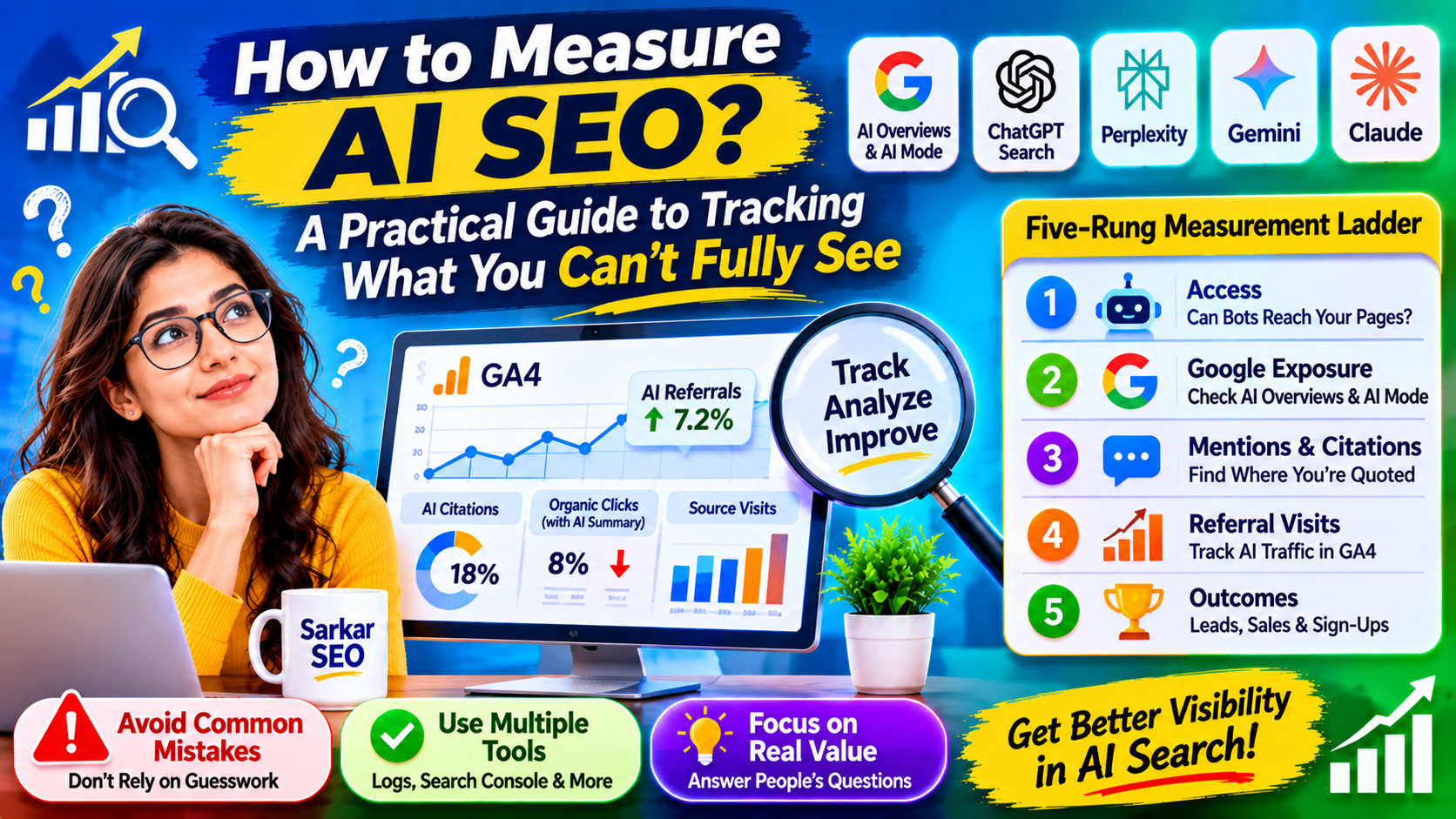
Ask ten marketers whether their AI SEO is working and you’ll get ten confident answers, and almost none of them will be backed by clean data. AI search is hard to measure. Some of it is invisible, some of it is mislabeled, and some of it is guesswork sold as a dashboard.
This guide takes a different path from the usual “how to rank” advice. It’s about knowing what happened. Sarkar SEO’s view is that an honest, partial measurement beats a confident, wrong one.
Why Your Numbers Are Probably Too Low
AI-driven visits are routinely undercounted. A guide from NoGood puts it bluntly: every AI referral number you report is lower than the real one. Four problems explain why.
Google’s AI traffic hides inside organic search. Clicks from AI Overviews and AI Mode are attributed to Organic Search in GA4 and cannot be separated natively there.
Some assistants strip the referrer. An InsideA analysis notes that ChatGPT’s desktop referrals arrive with a source, while visits from its mobile app tend to land in Direct.
GA4’s AI channel is incomplete. GA4 added a native “AI Assistant” channel in May 2026, according to several guides. But NoGood reports that Perplexity still falls into the generic Referral bucket, which is why a custom channel group is often needed.
Influence isn’t traffic. Someone may see your brand in an AI answer, then search your name later. That visit is credited to branded search or Direct, not to AI.
None of this means measurement is hopeless. It means you need several instruments, each covering a different part of the picture.
A Five-Rung Measurement Ladder
Think of AI visibility as a ladder. Each rung needs different tools, and a problem on a lower rung explains weak results above it.
Rung 1: Access. Can bots reach and read your pages? Server or CDN logs show visits from bots such as OAI-SearchBot, Claude-SearchBot, and PerplexityBot. Logs record no human sessions, and user agents can be spoofed, so treat them as evidence of access, not of audience.
Rung 2: Google exposure. In June 2026, Google introduced generative AI performance reports in Search Console. According to Target Internet, NoGood, and Anglera, they show how often your URLs appeared in AI Overviews, AI Mode, and Discover, broken out by page, country, date, and device. The limitation matters: reporting describes this as impressions only, with no clicks, queries, or API access. Older guides describe an “AI Mode” filter with click data, so check what your own property actually shows before you build reporting around it.
Rung 3: Mentions and citations elsewhere. This is where ChatGPT, Perplexity, Claude, Gemini, and Grok live. No free, official dashboard exists, so you rely on manual prompt testing or third-party tools. Be careful here, and see below.
Rung 4: Referral visits. GA4 and a custom channel group. Roughly three-quarters of AI referrals came from ChatGPT in one 2026 SE Ranking study cited by SEOquick, with Gemini and Perplexity far behind. Shares vary by study and by site, so measure your own.
Rung 5: Outcomes. Leads, sales, and sign-ups from those visits. This is the only rung that justifies the budget. Similarweb data cited by Search Engine Journal suggests ChatGPT referrals convert at around 7%, ahead of organic search, though that is an aggregate figure and your own results could differ in either direction.
Setting Up the GA4 Piece
Create a custom channel group that matches referral sources such as chatgpt.com, chat.openai.com, perplexity.ai, claude.ai, gemini.google.com, and copilot.microsoft.com. Place it above the default Referral rule so the rule takes priority. Review the list quarterly, because platforms change domains.
Then add one check that most guides skip. Open your Direct traffic and look at landing pages. A sudden rise in Direct visits to deep, specific articles, rather than your homepage, is a hint that untagged AI or app traffic is hiding there. This is a diagnostic suggestion, not a proven attribution method, so describe it that way in reports.
Be Skeptical of Prompt-Tracking Tools
Many paid tools run a fixed set of prompts and report your “AI share of voice.” They can help, but the underlying behavior is unstable. An Erlin analysis of over 15,000 AI search sessions found that only 12 to 18 percent of brands appeared consistently across queries. That is a vendor study, but it matches common experience: answers change from run to run.
Practical rules:
- Run each prompt several times and treat the result as a rate, not a yes or no.
- Use real customer questions, not just your keyword.
- Track direction over months, not daily swings.
- Ask any vendor how often they repeat prompts and which engines and countries they test.
What to Do This Week
- Build the custom GA4 channel and backfill as far as the data allows.
- Open the Search Console generative AI report and note which pages already appear.
- Pull a month of server logs and count AI bot visits by page.
- Write twenty real customer prompts and test them three times each in two or three engines.
- Save everything in one dated sheet so next month has a baseline.
