



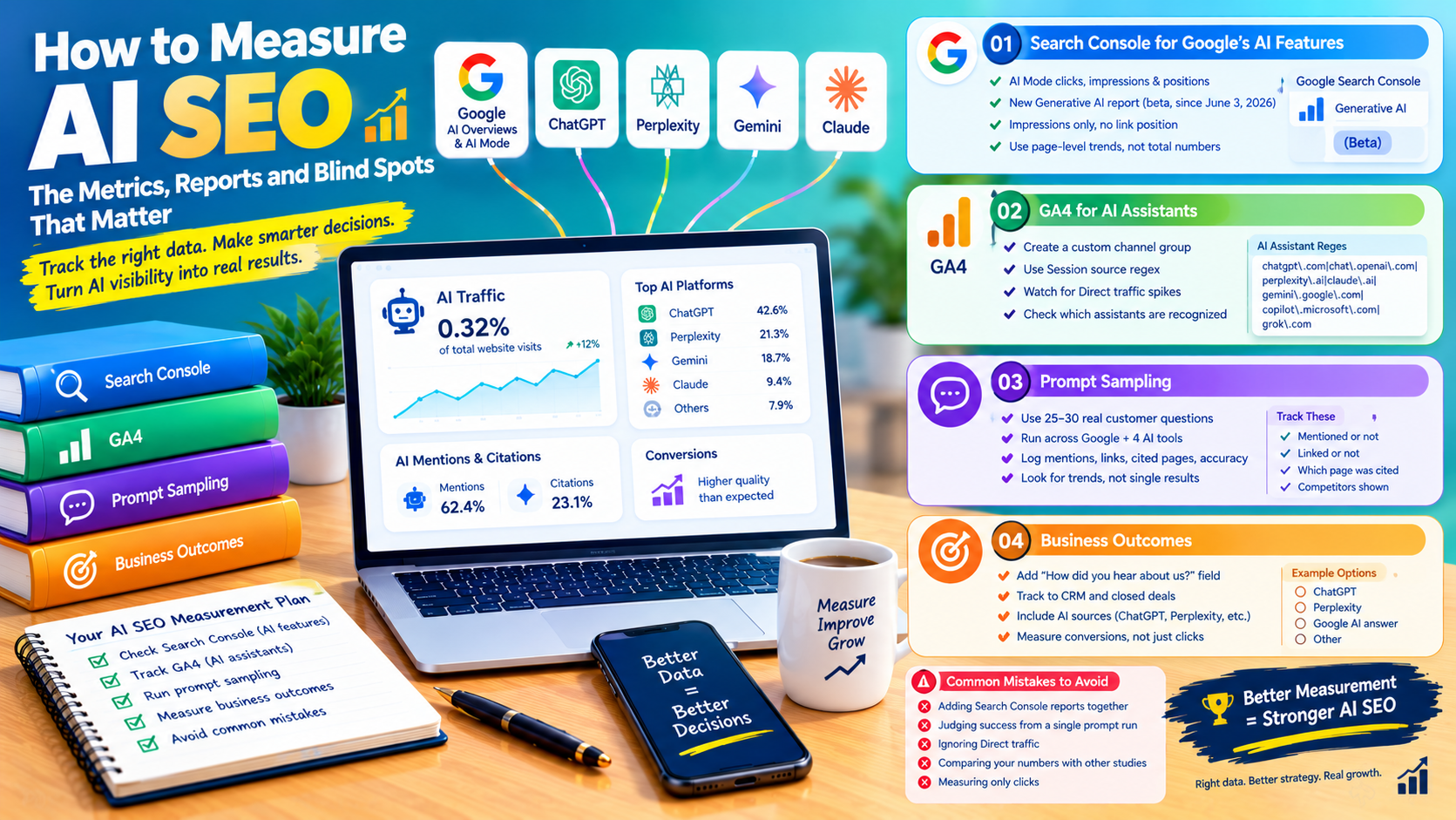
Everyone is told to invest in AI SEO, but few people are told how to tell whether it is working. Traffic from AI platforms is small, spread across several tools, and partly invisible. Without a measurement plan, you will either overspend on a hunch or write the channel off too soon.
At Sarkar SEO, we think measurement should come before optimization. Here is a practical, four-layer system you can set up this week.
Start With a Reality Check
AI referrals are real but modest. Across major studies, AI platforms account for roughly 0.1% to 1.08% of website visits, and the spread comes mostly from different sample panels. SE Ranking measured 0.32% across 101,574 sites in early 2026, and its ChatGPT referral analysis shows how quickly that share can move in a single month.
Conversion data conflicts too. One Seer Interactive case study reported ChatGPT referrals converting at 15.9% against 1.76% for Google organic, while a larger study of 973 websites found organic outperforming ChatGPT by about 13% on transactional purchases. The lesson is that nobody else’s benchmark can replace your own numbers, and traffic alone is the wrong yardstick.
Layer 1: Search Console for Google’s AI Features
Google counts AI Mode clicks, impressions and positions in the overall Performance report, as explained in Search Engine Journal’s coverage. Since June 3, 2026, a dedicated Generative AI report has also been rolling out in beta.
Know its limits before you rely on it:
- It reports impressions only, and groups AI Overviews and AI Mode together.
- It cannot show where your link sits inside an AI Overview, and Google has said it has no solution yet.
- It is a filtered view of existing Web data, so adding its totals to the standard report inflates your figures.
- According to John Mueller, an impression is recorded only when a link to your page is actually shown.
Use it for page-level trends: which pages gain AI impressions, and whether clicks on those pages move with them.
Layer 2: GA4 for AI Assistants
Google’s own AI features land in Organic Search, so GA4’s AI channel will not include them. For assistants such as ChatGPT and Perplexity, several guides report that GA4 added a native AI Assistant channel in May 2026. However, Google does not publish which assistants it recognizes, and Perplexity may be missed. Check your own property rather than assuming.
The dependable fix is a custom channel group under Admin, then Data display, then Channel groups. Add a channel called “AI assistants” with a Session source regex condition, and place it above Referral so Referral doesn’t claim the visits first:
chatgpt\.com|chat\.openai\.com|perplexity\.ai|claude\.ai|gemini\.google\.com|copilot\.microsoft\.com|grok\.com
A custom group can reclassify data GA4 already collected, but it cannot recover referrals that never carried a source. ChatGPT tags many outbound links with utm_source=chatgpt.com, which helps, but reports say logged-in and app visits can arrive without a referrer and land in Direct. Watch for unexplained rises in Direct traffic on pages you know are being cited.
Layer 3: Prompt Sampling
Analytics cannot show you the answers where you were mentioned but not clicked. For that, sample the engines yourself:
- Write 25 to 30 realistic questions across awareness, comparison and buying stages.
- Run each on Google, ChatGPT, Perplexity, Gemini and Claude on a fixed schedule, and repeat each prompt a few times, since answers vary between runs.
- Log whether you were mentioned, whether you were linked, which page was cited, whether the description was accurate, and which competitors appeared.
Read the results as sampled trends, not rankings. One run proves little, but six months of consistent logs show direction.
Layer 4: Business Outcomes
Visibility only matters if it produces leads or sales. Add a “How did you hear about us?” field to your forms with options such as ChatGPT, Perplexity and Google AI answer. Pass the traffic source into your CRM so it survives through to closed deals. Many buyers research in an AI tool, then return later by typing your name, and a self-reported field catches what analytics misses.
Mistakes to Avoid
- Adding Search Console reports together. The generative AI view is a subset, not an extra.
- Judging success from a single prompt run. Averages beat anecdotes.
- Ignoring Direct traffic. Some AI visits hide there.
- Comparing your numbers with other studies. Panels differ, so benchmark against your own history.
- Measuring only clicks. Mentions and assisted conversions count as well.
