



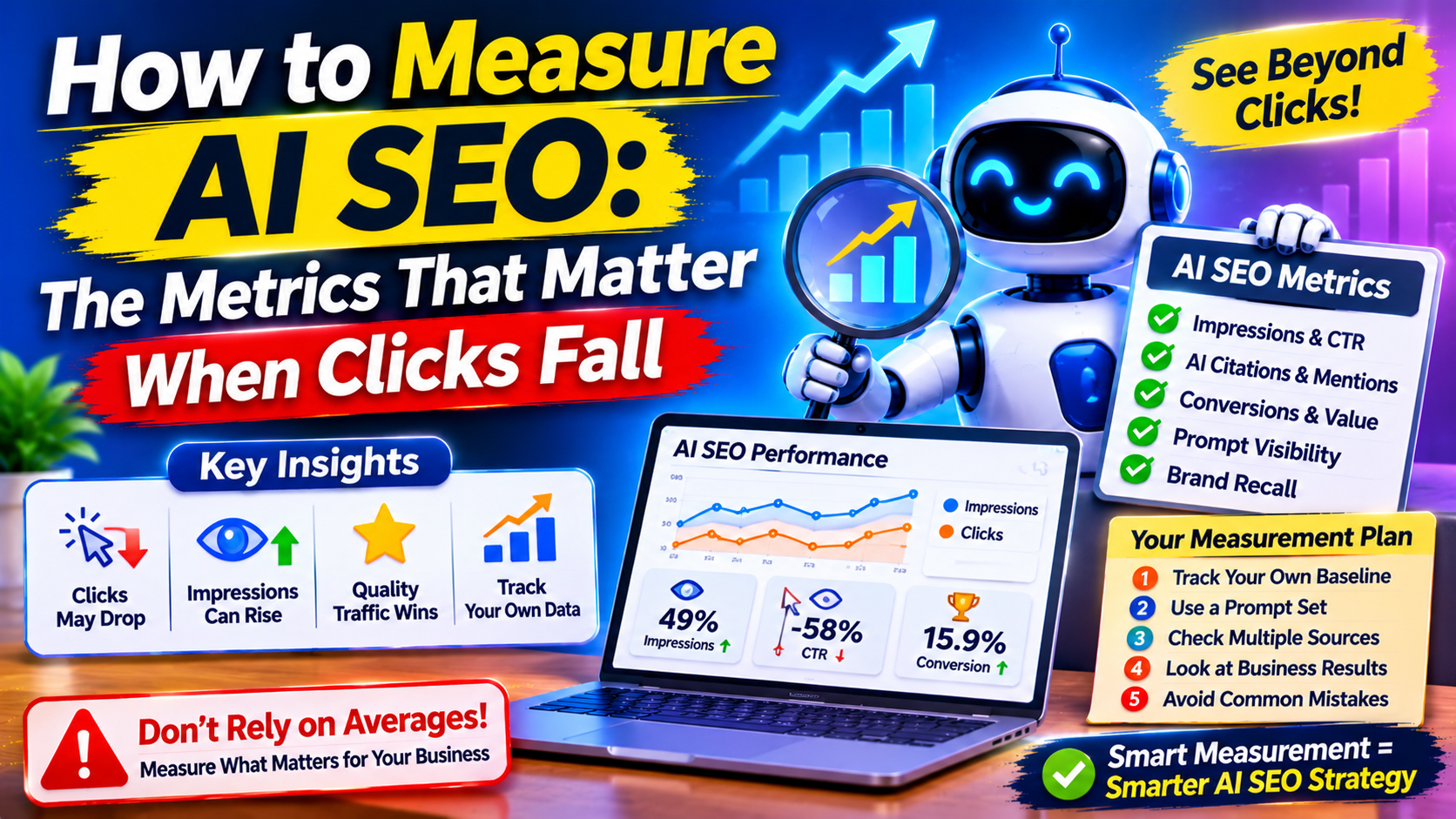
AI SEO is hard to manage if you can’t measure it. Rankings and clicks still matter, but they no longer tell the whole story: AI SEO answers can mention your brand, shape a buyer’s shortlist, and send no visit at all. This guide gives you a measurement framework built on what the data shows, where it conflicts, and what to track instead of guessing.
Why Old Dashboards Mislead
Start with the pressure on clicks. An Ahrefs analysis of 300,000 keywords found a 58% lower click-through rate for top-ranking pages when an AI Overview appeared. Pew Research found traditional results alongside an AI Overview earned an 8% click rate, against 15% without one.
Treat each figure as an estimate, not a law. An earlier Ahrefs calculation put the position-one reduction at roughly 34.5%. Methods, dates, and query sets differ, and the effect keeps moving. Seer Interactive reported that clicks on AI Overview links recovered from 1.3% in December 2025 to 2.4% in February 2026. And while Google says its AI features send valuable traffic, it hasn’t provided data to verify that, and third-party analyses show lower click-through rates when AI Overviews appear. Data & Studies +2
The practical takeaway: don’t import industry averages into your reporting. Measure your own site against your own baseline.
The Visibility Gap Inside Your Analytics
Three blind spots explain why reports look confusing.
Impressions rise while clicks fall. BrightEdge reported impressions growing 49% even as click-through rates dropped. If you only watch clicks, you’ll miss that people are seeing you.
AI Overview traffic hides in plain sight. It appears as a google.com referral in analytics, so you need Search Console analysis to isolate it. That claim comes from a single report, so verify it against your own data.
Assistant traffic is small but real. BrightEdge put AI search at under 1% of total referral traffic as of August 2025. Google Analytics reportedly added an AI Assistant default channel, which should make this traffic easier to separate.
Building a Prompt Set
This layer is the newest and the easiest to do badly. Pick 20 to 30 questions your customers genuinely ask, covering problems, comparisons, and “best for” queries. Run them on the major assistants on a fixed schedule and record four things: whether you’re mentioned, whether you’re linked, how you’re described, and who else appears.
Two cautions come from how these systems work. Answers vary between runs, so one screenshot proves nothing; repeat each prompt several times and report percentages. And keep the prompt list stable, or your trend line becomes meaningless.
What the Traffic Is Worth
Volume is small, so quality is the argument. Seer Interactive reported ChatGPT referrals converting at 15.9% against 1.76% for Google organic, and Semrush found assistant visitors converting at 4.4 times the organic rate. These are vendor studies drawn from specific samples, so test the claim on your own conversions before building a budget around it.
The same caution applies to platform share. One report puts ChatGPT at 55% to 60% of chatbot referrals. Another puts it near 87.4%. The gap is a reminder that panels and definitions differ. Your analytics beat any benchmark. upgrowthmarketixdigital
Also watch where clicks are least likely. Semrush and Seer reported that about 93% of AI Mode sessions end without an external click. For queries that an answer fully resolves, influence and brand recall are the realistic goals, not visits.
Common Measurement Mistakes
- Declaring victory from one screenshot. Sample repeatedly.
- Chasing share of voice without checking accuracy. Being mentioned with the wrong pricing or outdated services can hurt more than silence.
- Comparing against other companies’ benchmarks instead of your own history.
- Ignoring assisted conversions. A buyer may see you in an AI answer, then search your name later. That visit looks like branded or direct traffic.
- Treating studies as permanent. Click patterns changed within months in the data above.
Which metric matters most?
None alone. If forced to pick one, choose business outcomes by channel, with prompt visibility as the leading indicator.
How often should I check AI visibility?
Monthly is enough for most sites. Weekly checks mostly track noise.
Do I need paid tools?
Not at the start. A spreadsheet, Search Console, and your analytics cover layers one, two, four, and five. Add tools only if manual prompt testing becomes too slow.
